The final whistle has been blown. The trophy has been handed over. Spain are the winners of the 2026 FIFA World Cup after beating Argentina in the final and coming out on top over 47 other footballing nations.
The six-week tournament in the USA, Canada and Mexico was the first where AI was used in a big way to tell the stories behind the games and the players - and not everyone may have realised it. BBC Bitesize Other Side of the Story went into extra time with three examples to see why they were created - and how trustworthy they were.
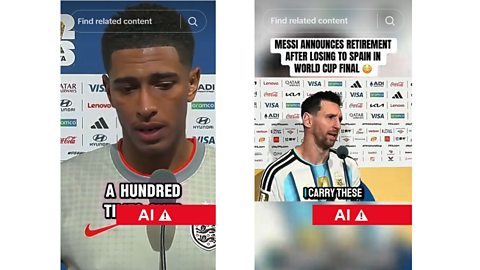
Were these post-match interviews featuring Bellingham and Messi genuine?
Harry Kane may have launched a thousand memes with his exhausted chat after England beat Mexico in their Round of 16 tie, but other post-match interviews at the World Cup were a bit trickier to spot.
One AI video appeared after the final where Argentina’s Lionel Messi, seen by many people as one of the greatest players of all time, is seen announcing his retirement to reporters. Although official social posts before the game suggested the match may have been Messi’s final one in an Argentina shirt, he is still contracted to play club football with the US team Inter Miami until 2028. There has been no official confirmation of his retirement.
England’s Jude Bellingham has also had the AI interview treatment. When Argentina knocked England out of the competition at the semi-final stage, Bellingham was seen slapping substitute Valentin Barco on the head. There has been no statement from Bellingham about the incident but several AI-generated interviews posted by different users show him supposedly talking at length about it. Some are deliberately humorous while others could be mistaken for genuine. If you are suspicious that a video or image is AI-generated, there are signs you can look out for. Remember also to be careful before sharing any posts like these as you could be spreading misinformation.
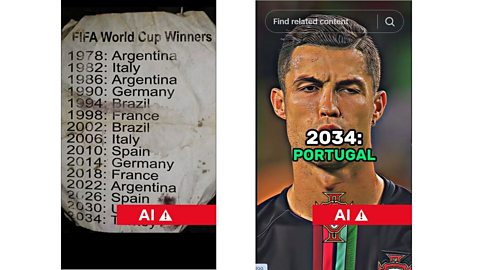
Can people accurately predict future World Cup winners?
Ahead of the tournament, several social posts predicted the winners of the 2026 World Cup. That’s not unusual, it’s something many people do, from BBC Sport experts to friends chatting at the start of the group stage.
That didn’t stop some people thinking a lot further ahead than this year. There were AI posts predicting the winners of next three or four men’s tournaments, going as far into the future as 2046. One poster suggested the USA, who went out in the Round of 16 this time around, would win the next World Cup, with Turkey victorious in 2034 when Saudi Arabia hosts.
One prediction that went viral was not related to AI, but appeared on X. Someone claiming to be a time traveller posted in 2021 that the 2026 final would be between Spain and Argentina and that the Spanish team would lose 3-2. Fast-forward five years and some people were so impressed the poster had predicted the finalists five years beforehand that they were convinced this would be the genuine result.
Posts like these can be fun, as they are a bit of speculation that football fans enjoy talking about. The only issue can be if people gamble large amounts of money based on them. Enjoy them - but don’t take them too seriously.
Why were there AI images of Lamine Yamal bathing Lionel Messi?
When you’re seen as one of the greatest football players in history, it shouldn’t be a surprise that you pop up in more than one World Cup meme.
In the run-up to the final, an AI image of Spain’s Lamine Yamal looking after Lionel Messi while he’s in a baby bath went viral. It may look a bit odd, but there is a story behind it.
In 2007, by a complete coincidence, a 20-year-old Messi was part of a charity photo shoot while he was playing for Barcelona where he met a five-month-old Yamal.
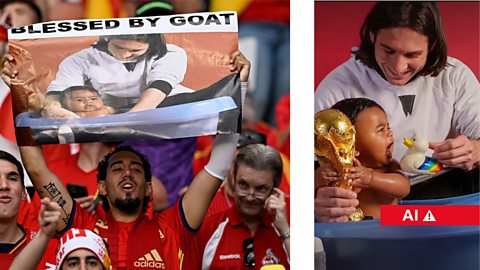
Yamal’s mother, Sheila, was also at the shoot where photographer Joan Monfort snapped the two of them giving the future Spanish star a bath, as well as Messi looking after Yamal on his own. One of the pictures was first shared by Yamal’s dad two years ago when Spain won the Euro 2024 final with the caption, “The beginning of two legends”.
Joan Monfort confirmed the photo shoot really did happen in a report published by FIFA ahead of the final. With the two players facing each other on the pitch, AI memes started appearing with the roles reversed, and a now 19-year-old Yamal looking after Messi instead.
The photo has proved such a talking point that it was even waved by one Spanish fan during the final. We know that the story behind this photo is genuine as the explanation came from different trusted and primary sources. The photographer herself confirmed the picture was taken in 2007 and her words were published by FIFA, the official body which organises the World Cup.
When you’re thinking critically and fact-checking information, these are multiple, trustworthy sources which help to prove it’s not fake news - and that you don’t have to lie to tell a story that intrigues the world.
This article was published in July 2026

Not sure if the news you’re seeing on social media is true or false? Can you always tell if the things you see online are real or fake? Learn how to get the other side of the story with our quizzes, videos and explainers.
Four things football commentators can teach us about checking facts
Guy Mowbray on the preparation that goes into describing the action
Taylor & Travis - how AI images fill the gap when there’s no news
It was the wedding of the year - and it generated a LOT of fake photos