What are the key learning points?
Each A pure substance which is made from only one type of atom. Elements are listed on the periodic table. An element cannot be broken down into anything simpler by chemical means. is represented by a chemical symbol. These symbols can be joined together with numbers to make chemical formulae.
Chemical formulae can be worked out using a ‘swap and drop’ method.
Chemical equations show how The chemical present at the start of a reaction. Reactants appear on the left of a chemical equation, before the arrow →. interact to make products in a chemical reaction.
All chemical symbol equations must be balanced.
There are two other types of chemical equation: A chemical equation that shows how positively charged ions join with negatively charged ions to make a compound. and An equation, involving ions and electrons, that describes the process happening at an electrode. (Higher tier only).
What are symbols and formulae?
Chemical symbols
Each element in the periodic table is represented by its own chemical symbol.
A chemical symbol has one or two letters, and it must always start with a capital letter.
Any second letter must always be lower case.
For example, Mg is the correct symbol for magnesium, but mg, mG and MG are wrong.
Take care to write chemical symbols correctly.
Diatomic elements
The formulae for most elements is just their symbol.
The exceptions are some non-metal elements known as diatomic elements .
They contain two atoms of the same element A covalent bond is formed by a shared pair of electrons. together.
| Diatomic element | Molecular formula |
|---|---|
| hydrogen | H2 |
| nitrogen | N2 |
| oxygen | O2 |
| fluorine | F2 |
| chlorine | Cl2 |
| bromine | Br2 |
| iodine | I2 |
Key facts
The same chemical symbols are used all over the world, no matter which language is spoken, which makes them very useful.
You will need to memorise the seven diatomic elements.
A mnemonic that can help is “Now I Only Have Bright and Clever Friends”.
How to interpret formulae
A formula gives information about the type and the number of each The smallest particle of an element. We often think of atoms as tiny spheres, but in fact they are made from smaller particles called protons, neutrons and electrons. present in a A substance formed when two or more elements are chemically combined..
The formula for sodium sulfate is Na2SO4. It tells you that sodium sulfate contains:
two sodium atoms,
one sulfur atom and
four oxygen atoms.
The subscript numbers refer to the element before them.
Key fact
If there is just one atom in the formula a ‘1’ is not written.
Question
How many calcium, carbon and oxygen atoms are there in calcium carbonate, CaCO3?
Answer
- 1 calcium atom
- 1 carbon atom
- 3 oxygen atoms
What happens when a formula includes brackets?
Sometimes a formula includes brackets.
The atoms inside the brackets are multiplied by the number outside the brackets.
Aluminium sulfate’s formula is Al2(SO4)3.
It contains:
- 2 atoms of aluminium
- 3 atoms of sulfur
- 12 atoms of oxygen
Question
How many calcium, nitrogen and oxygen atoms are there in calcium nitrate, Ca(NO3)2?
Answer
1 calcium atom
2 nitrogen atoms
6 oxygen atoms
What are compounds?
A compound is two or more elements that are chemically combined.
The table below shows some common compounds.
| Compound | Formula | Elements present |
|---|---|---|
| Water | H2O | Hydrogen, oxygen |
| Carbon monoxide | CO | Carbon, oxygen |
| Carbon dioxide | CO2 | Carbon, oxygen |
| Sulfur dioxide | SO2 | Sulfur, oxygen |
| Sulfur trioxide | SO3 | Sulfur, oxygen |
| Nitrogen monoxide | NO | Nitrogen, oxygen |
| Nitrogen dioxide | NO2 | Nitrogen, oxygen |
| Ammonia | NH3 | Nitrogen, hydrogen |
| Hydrochloric acid | HCl | Hydrogen, chlorine |
| Nitric acid | HNO3 | Hydrogen, nitrogen, oxygen |
| Sulfuric acid | H2SO4 | Hydrogen, sulfur, oxygen |
How to work out the formula of an ionic compound
Ionic compounds contain positive and negative Electrically charged particle, formed when an atom gains or loses electrons..
The number of positive charges must equal the number of negative charges, so that the compound has no overall charge.
When the number of charges on the positive ion is the same as the negative ion, they cancel each other out.
When the number of charges is different, a ‘swap and drop’ method can help.
- Write down the symbol and charge of each ion in the compound.
- Ignore the sign and if the number of the charges are the same, then write the formula in a 1:1 ratio.
- If the number of the charges is different, swap the charges by crossing sides, drop the signs and write the formula.
- Watch out for A charged particle containing more than one element. – you’ll need to use brackets if there is more than one of them.
Here are some worked examples of the ‘swap and drop’ method.
What are equations?
In a chemical reaction, the substances that react together are called reactants and the substances that are made are called products.
Word equations
All reactions can be represented in word equations, which must contain an arrow (→)
The chemical present at the start of a reaction. Reactants appear on the left of a chemical equation, before the arrow →. → A chemical which is made in a chemical reaction. Products are written on the right of a chemical equation, after the arrow (→).
For example, when heated, green copper(II) carbonate decomposes into black copper(II) oxide and colourless carbon dioxide gas.
copper(II) carbonate → copper(II) oxide + carbon dioxide
Key fact
Chemical equations contain an arrow and not an equals sign.
The arrow means 'reacts to make'.
Question
Nitrogen and hydrogen react together to form ammonia. What is the word equation for the reaction?
Answer
nitrogen + hydrogen → ammonia
What are balanced symbol equations? (Higher tier only)
No atoms are created or destroyed in a chemical reaction – they are just rearranged.
Balanced symbol equations show the original arrangements and the new ones.
What are the key rules about balancing symbol equations?
| Step | Result |
|---|---|
| Check to see if there is an equal number of atoms of each element on both sides. There is not. | N2 + H2 → NH3 |
| There are two nitrogen atoms on the left but only one on the right, so put a big 2 on the left of the NH3. | N2 + H2 → 2NH3 |
| Check again. There are two hydrogen atoms on the left but (2 × 3) = 6 on the right, so put a big 3 in front of the H2. | N2 + 3H2 → 2NH3 |
| Check again to see if there are equal numbers of each element on both sides. There is. | (Two nitrogen atoms and six hydrogen atoms) |
What is the 'bubble method' when balancing equations?
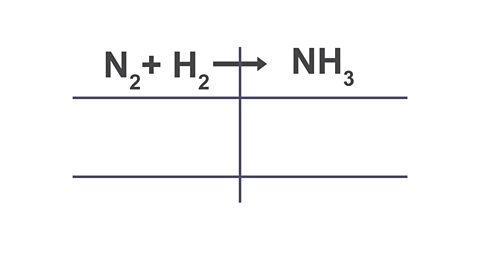
Image caption, 1. Write out the equation that needs to be balanced and draw a table through the equation.
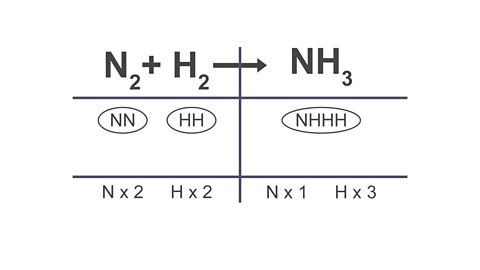
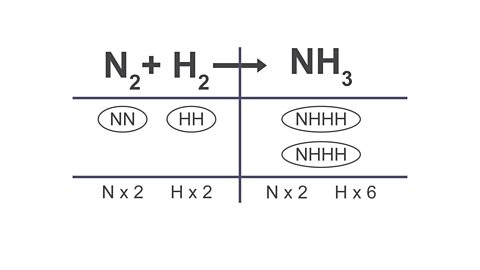
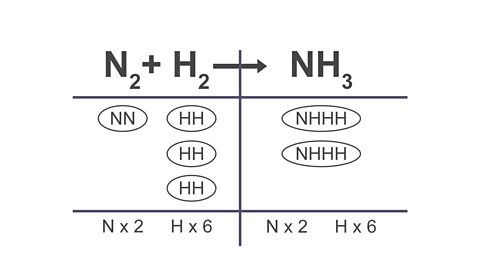
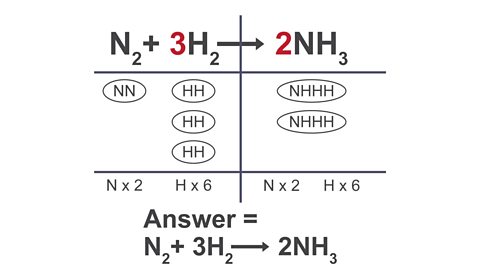
1 of 5
Key fact
A balancing number multiplies all the atoms in the formula next to it.
Never change the formula of a compound to make the equation balance.
Question
Balance the following equation:
Al + O2 → Al2O3
Answer
4Al + 3O2 → 2Al2O3
What are state symbols? (Higher tier only)
Chemical equations use state symbols:
| State symbol | Meaning |
|---|---|
| (s) | solid |
| (l) | liquid |
| (g) | gas |
| (aq) | aqueous solution (dissolved in water) |
Question
An iron nail is placed in a solution of blue copper(II) sulfate.
Over time, a brown solid appears and the solution becomes colourless.
This is because copper and a solution of iron(II) sulfate forms.
Add state symbols to the balanced chemical equation for the reaction of iron with copper(II) sulfate.
Fe + CuSO4 → FeSO4 + Cu
Answer
Fe(s) + CuSO4(aq) → FeSO4(aq)+ Cu(s)
What are half equations? (Higher tier only)
Half equations are most often used in Splitting up a liquid or dissolved compound into its elements using electricity. .
They involve either atoms and molecule gaining or losing electrons to become ions, or ions gaining or losing electrons to become atoms and molecules.
Either way, the process for writing the equation is the same.
- Write down the The chemical present at the start of a reaction. Reactants appear on the left of a chemical equation, before the arrow →. and the A chemical which is made in a chemical reaction. Products are written on the right of a chemical equation, after the arrow (→). .
- Balance the atoms.
- Write the total charge underneath each species in the equation.
- Balance the charge by adding electrons.
For example, you may be asked to write the half equation for the conversion of oxide ions into an oxygen molecule.
| Step | Action | Half equation |
|---|---|---|
| 1. | Write down the reactant and the product. | O2- → O2 |
| 2. | Balance the atoms. | 2O2- → O2 |
| 3. | Write the total charge underneath each species in the equation. | \(\frac{{20}^{2-}}{(-4)}→\frac{{0}_2}{(0)}\) |
| 4. | Balance the charge by adding electrons. | 2O2- → O2 + 4e- |