What are the key learning points about the Solar System?
The structure of the Solar System.
The order of the planets.
What gravity is and how it shapes our Solar System.
What a Body that orbits a planet. For example, the Moon is a natural satellite of the Earth but communication satellites are artificial satellites of the Earth. is.
Uses for artificial satellites.
What is the structure of the Solar System?
The Earth is our planet.
It is one of eight planets that move around the Sun, each in an oval shaped,An orbit that is the shape of an ellipse. An ellipse is similar to a slightly stretched circle..
Our Moon orbits the Earth.
All of the other planets except Mercury and Venus have at least one moon.
A ball of icy rock that follows an elliptical orbit around the Sun. and A rock in space. Asteroids orbit the Sun but some may cross the Earth's orbit, producing a small risk of collision. also orbit the Sun.
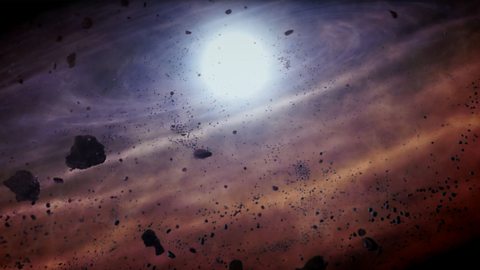
Together the Sun, the eight planets, the moons, asteroids and comets make up our Solar System.
Key point
The main features of our Solar System are:
the Sun
the eight planets
moons
asteroids
comets
What is the Sun's role in our Solar System?
The Sun is a star.
The Sun is the largest object in the Solar System and was the first to form.
The huge gravitational pull of the Sun keeps many other objects - planets, dwarf planets, asteroids and comets - in orbit around it.
The Sun alone contains 99.8% of the total mass in the Solar System.
Planets
The Earth is one of eight planets in the Solar System.
The planets orbit the Sun at different distances.
The following sentence may help with remembering the order of the names of the planets from the Sun outwards:
My Very Easy Method Just Speeds Up Naming
- Mercury
- Venus
- Earth
- Mars
- Jupiter
- Saturn
- Uranus
- Neptune
The different planets have different properties and conditions.
In general, as the distance from the Sun increases:
The temperature decreases, for example, Mercury is 430 °C whereas Neptune is -200 °C.
The time taken to orbit the Sun increases, for example, Mercury orbits once every 88 Earth days, but Neptune orbits once every 165 Earth years.
What are the different planet groups?
Astronomers have divided the planets into two groups of four:
The four inner planets (Mercury, Venus, Earth and Mars), which:
- are small, rocky, dense planets;
- are close to the Sun, and so are warmer than the outer planets;
- have craters, mountains, volcanoes, valleys.
The four outer planets (Jupiter, Saturn, Uranus and Neptune), which:
- are large balls of gas - you couldn't stand on the surface of the planet because it's not solid;
- have a small, solid core;
- are much further from the Sun, and so are cooler than the outer planets;
- are much bigger than the rocky planets;
- are called gas giants.
When the Solar System formed, rocks (and other dense, heavy materials in the dust cloud such as iron and uranium) tended to gather closer to the Sun, and these materials combined together to form the inner planets.
Lighter gaseous substances gathered together further away from the Sun and formed the outer gas giants.
What other objects make up the Solar System?
Moon
A body orbiting a planet is called a satellite.
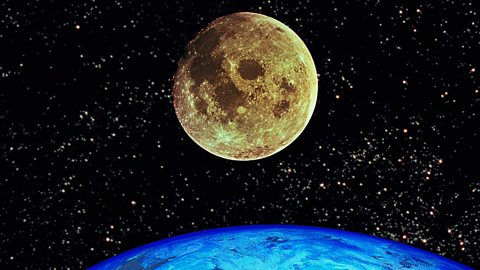
The Moon is the only natural satellite that orbits planet Earth.
Many planets have moons, and some planets have many moons.
- as of March 2025 - Saturn has 274 confirmed moons, over 100 of these were discovered in 2025.
Dwarf planets
Pluto is a A planetoid that is too small to be considered to be a planet, eg Pluto..
As the name suggests, a dwarf planet is smaller than a planet.
Its force of gravity is not strong enough to pull in all the many other objects in its orbit around the Sun.
Pluto is not very big.
It is only half as wide as the USA and is smaller than our moon.
The Solar System contains hundreds of dwarf planets, including Ceres, which can be found in the asteroid belt.
Asteroids
Asteroids are made of metals and rocky material.
There are many asteroids in our Solar System which orbit the Sun in oval or egg-shaped elliptical orbits which can take millions of years to complete.
There are large numbers of asteroids orbiting the Sun in the asteroid belt between Mars and Jupiter.
Comets
The Solar System also contains objects called comets.
Comets are similar to asteroids, but are made of ice, dust and rocky material.
As a comet approaches the Sun, it begins to vaporise, which means that it turns into a gas.
It then produces a distinctive tail, which lets us see it in the night sky.
The main difference between asteroids and comets is what they are made of.
Asteroids are made up of metals and rocky material.
Comets are made up of ice, dust and rocky material.
Both asteroids and comets were formed early in the history of the Solar System about 4.5 billion years ago.
Both asteroids and comets orbit the Sun.
One way of remembering that a comet is made of ice is to highlight the letter c in both words.
Summary
The Sun, the eight planets, the moons, asteroids and comets make up our Solar System.
The order of the eight planets from the sun outwards is: Mercury, Venus, Earth, Mars, Jupiter, Saturn, Uranus and Neptune.
My Very Easy Method Just Speeds Up Naming.
The four inner planets are small, solid, rocky, dense planets, close to the Sun.
The four outer planets are large balls of gas with a small, solid core, much further from the Sun.
Asteroids are made up of metals and rocky material.
Comets are made up of ice, dust and rocky material.
What causes asteroids to strike Earth?
The orbits of some asteroids cross the orbit of the Earth.
Small lumps of rock enter the atmosphere of the Earth and burn up.
They form a shooting star and don’t reach the surface of the Earth.
However, at various times during the history of the Earth, asteroids have been large enough to hit the Earth.
When this happened, a tremendous amount of energy was released, throwing up billions of tonnes of dust.
This huge dust cloud blocked heat and light from the Sun, making the Earth very cold.
About 66 million years ago, a giant asteroid travelling about 15 miles per second hit the coast of what is now Mexico.
The impact caused wildfires, tsunamis and put so much sulphur into the atmosphere that it blocked the Sun.
This caused the Earth to cool rapidly bringing about the extinction of the dinosaurs.
Scientists investigating the crater left by the asteroid strike found no sulphur remained at its core.
This supports the idea that when the asteroid hit, sulphur from the crater was released into the atmosphere.
There are other craters on the surface of the Earth which are a direct result of asteroid hits millions or billions of years ago.
On Friday, April 13, 2029, the asteroid 99942 Apophis will pass just 19,000 miles above the Earth.
The lump of rock is about 350 m wide.
It will miss the Earth, but it is the closest known approach to Earth of any large asteroid this decade.
What are artificial satellites and orbital motion?
Gravity is the force needed to maintain the orbit of planets, asteroids and comets around a star and moons and artificial satellites around a planet.
The Moon is a natural satellite.
An artificial satellite is a man-made body placed in orbit round the Earth or another planet in order to collect information about it or for communication purposes.
The International Space Station is an example of an artificial satellite.
Key Point
Artificial satellites can be used for:
Communications – satellite television and phone calls.
Earth observation - including weather forecasting, tracking storms and pollution, spying and satellite photography.
Navigation - including the Global Positioning System (GPS) on mobile phones and in cars.
Astronomy – looking into outer space from our Solar System.
Examples of artificial satellites orbits include:
- Polar orbits
- Geostationary orbits
Polar orbits take the satellites over the Earth’s poles.
The satellites travel very close to the Earth - as low as 200 km above sea level, so they must travel at very high speeds - nearly 8000 m/s.
Polar orbits are often used for earth-mapping, as well as for some weather satellites.
Geostationary satellites take 24 hours to orbit the Earth, so the satellite appears to remain in the same part of the sky when viewed from the ground.
They orbit above the equator.
These orbits are much higher than polar orbits (typically 36,000 km) so the satellites travel more slowly (around 3 km/s).
Geostationary orbits are used for communication and broadcast satellites.
What is gravity?
Gravity is a force of attraction that exists between all objects that have The amount of matter an object contains. Mass is measured in kilograms (kg) or grams (g)..
Gravity provides the force needed for:
- planets, asteroids and comets to orbit the Sun;
- moons to orbit planets;
- artificial satellites to orbit planets;
- a dropped mobile phone to fall to the ground.
We are pulled down towards the ground because of gravity.
The gravitational force pulls in the direction towards the centre of any object.
So, we are pulled towards the centre of the Earth.
As an astronaut travels upwards from Earth into space, the force of gravity due to the Earth decreases, because the distance between the Earth and the astronaut increases.
This is why an astronaut is weightless in space.
What is the difference between mass and weight?
People often confuse mass and weight.
But in physics they are very different quantities.
What is mass?
The mass of an object is the amount of matter or ‘stuff’ it contains.
The more matter an object contains, the greater its mass.
An elephant contains more matter than a mouse, so it has a greater mass.
Mass is measured in kilograms, kg.
A 100 kg object has a greater mass than a 5 kg object.
An object's mass stays the same wherever it is.
So, a 5 kg mass on Earth has a 5 kg mass on the Moon because the amount of matter stays the same.
What is weight?
Weight is the force of gravity acting on an object.
Weight is a force and so it is measured in newtons, N.
The force of gravity is not the same everywhere and so the weight of an object can change from one place to another.
For instance, on earth, the downward force of gravity on, or weight of, a 1 kg mass is 10 N.
The Moon has a smaller mass than the Earth and the pull of gravity on the Moon is only \(\frac{1}{6}\) of that on the Earth.
In other words, a 1kg mass will always have a mass of 1kg but has a weight on the Moon of 1.6 N.
Key points
- The mass of an object is the amount of matter it contains.
- Mass is measured in kg.
- Mass is the same everywhere in the Universe.
- Weight is the force of gravity acting on an object.
- Weight is a force and measured in N.
- The force of gravity is not the same everywhere in the universe and so the weight of an object is not the same everywhere.
How to calculate weight
On the surface of the Earth a 1 kg mass has a weight of 10N.
We say that the strength of gravity is 10 N/kg or on Earth, gravity = 10 N/kg.
Weight is calculated using the equation:
Weight = mass x gravity
W = mg
W = weight in N
m = mass in kg
g = gravity in N/kg
On the surface of the Earth g = 10 N/kg
| W = mg | W = m x g |
| m = \(\frac{W}{g}\) | m = W ÷ g |
| m = \(\frac{W}{m}\) | g = W ÷ m |
Example
Find the weight of a person on Earth if they have a mass of 65 kg (g = 10 N/kg)
Answer
W = mg
m = 65 kg
g = 10 N/kg
W = 65 x 10
W = 650 N
The weight of the person is 650 N.
Question
What is the weight of a 45 kg girl on:
- The Earth, where g = 10 N/kg?
- The Moon, where g = 1.6 N/kg?
Answer
- The Earth
W = mg
m = 45 kg
g = 10 N/kg
W = 45 x 10
W = 450 N
The weight of the girl on the Earth is 450 N.
- The Moon
W = mg
m = 45 kg
g = 1.6 N/kg
W = 45 x 1.6
W = 72 N
The weight of the girl on the Moon is 72 N.
The mass of the girl is the same on the Earth and the Moon because the amount of matter in the girl is the same in both places.
However, the weight of the girl on the Earth is much greater than the weight of the girl on the Moon because the Earth’s pull of gravity is much greater than the Moon’s.
Question
- What is the mass of a person who weighs 120 N on the Moon (g = 1.6 N/kg)?
- What would the mass and weight of the same person be back on Earth where g = 10 N/kg?
Answer
- The Moon
m = \(\frac{W}{g}\)
W = 120 N
g = 1.6 N/kg
m = 120 ÷ 1.6
m = 75 kg
The mass of the person on the Moon is 75 kg.
- The Earth
The mass of the person back on the Earth will also be 75 kg as mass does not change from place to place.
W = mg
m = 75 kg
g = 10 N/kg
W = 75 x 10
W = 750 N
The weight of the person on the Earth is 750 N.
Summary
| Mass | Weight |
|---|---|
| Measured in kilogrammes kg | Measured in newtons N |
| A measure of the amount of matter | The force of gravity acting on the object |
| Never changes | Varies from place to place |
How does weight vary from planet to planet in our Solar System?
The force of gravity on 1 kg on the surface of different planets varies as shown below.
| Planet | Gravity on the surface, g in N/kg |
|---|---|
| Mercury | 3.8 |
| Venus | 9.1 |
| Earth | 10 |
| Mars | 3.8 |
| Jupiter | 23.4 |
| Saturn | 9.3 |
| Uranus | 9.2 |
| Neptune | 11.2 |
Use a set of bathroom scales to measure your mass in kg.
Then use the table above and the equation:
Weight = mass x gravity to investigate how your mass and weight would vary from planet to planet.
Here is a typical set of results for a student whose mass measured 64 kg.
| Planet | Gravity on the surface, g in N/kg | Mass of student on the surface of each planet in kg | Weight of student on the surface of each planet in N |
|---|---|---|---|
| Mercury | 3.8 | 64 | 243 |
| Venus | 9.1 | 64 | 582 |
| Earth | 10 | 64 | 640 |
| Mars | 3.8 | 64 | 243 |
| Jupiter | 23.4 | 64 | 1498 |
| Saturn | 9.3 | 64 | 595 |
| Uranus | 9.2 | 64 | 589 |
| Neptune | 11.2 | 64 | 717 |
How much do you know about the Solar System?
More on Earth in space
Find out more by working through a topic
- count2 of 2