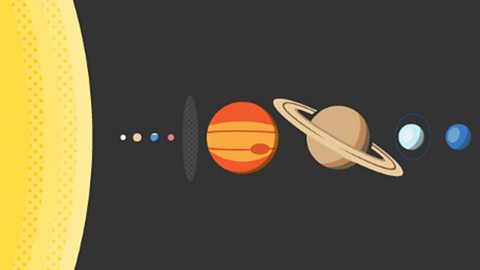
What are the key learning points about stars?
How stars form.
The structure of galaxies.
Measuring huge distances in space.
The Big Bang and "steady state" models of the Universe
How was the Sun formed?
Our Sun was formed around 4.6 billion years ago from a giant cloud called a stellar A cloud of gas and dust in outer space. If massive enough, these can collapse under gravity to form a protostar., mainly made up of hydrogen gas and dust.
The nebula collapsed under its own gravity and, as it did, temperature and pressure increased.
It became denser as gravity pulled the particles of the cloud closer together and rotated more rapidly, spiralling inwards.
The hot core in the centre is called a The early stage in the formation of a star, before nuclear fusion occurs..
The collapsing and joining together of gas and dust under gravity is called accretion.
Eventually gravity compressed the hydrogen so much that the temperature reached about 15 million °C.
At this temperature and pressure The joining together of two smaller atomic nuclei to produce a larger nucleus. Radiation is released when this happens. Nuclear fusion happens in stars like our sun, and in hydrogen bombs. began and our Sun was born.
Nuclear fusion is the energy source of our Sun and all the stars.
As a result, heat and light energy radiate outwards, and it can be seen shining brightly in the sky.
In fusion reactions:
Hydrogen Nuclei is the plural of nucleus. The nucleus is the central part of an atom. It contains protons and neutrons, and has most of the mass of the atom. fuse together to form helium nuclei.
Energy is released and radiates outwards.
WATCH: How the Earth was formed
Brian Cox explains how the Earth was formed
What are galaxies?
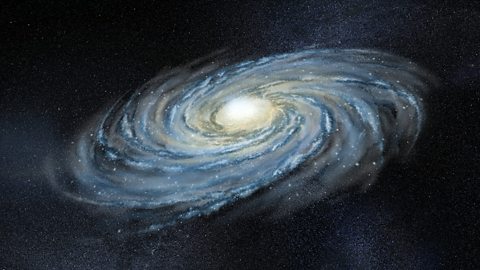
Galaxies are huge collections of stars like our Sun.
Our Sun belongs to a spiral galaxy called the Milky Way.
Astronomers estimate that the Milky Way is a collection of about 100 thousand million stars.
That’s 100,000,000,000 stars.
Our Solar System lies in one of the Milky Way’s spiral arms, nearly two thirds of the way from the centre.
Part of the Milky Way is visible on a clear night from Earth, as a thick band of stars stretching across the sky.
What is a light year?
The distances between objects in space are huge:
The distance from one star to another in a galaxy is millions of times more than the distance between the planets in the Solar System.
The distance from one galaxy to another is millions of times more than the distance between the stars in a galaxy.
This means that the numbers used to describe distances in space become very difficult to understand and to write down.
For example, the distance between the Earth and the Sun is about 150,000,000,000 m but the distance to the next nearest star (Proxima Centauri) is 39,900,000,000,000,000 m.
To get around this problem, scientists use the light year as the unit of astronomical distance.
A light year is defined as the distance light travels in a year.
So, for example:
It takes light from our Sun about 8 minutes to reach the Earth.
Sun to Proxima Centauri distance is about 4.24 light years.
Sun to the centre of the Milky Way is about 27,000 light years.
The Milky Way is about 100,000 light years across.
Milky Way to Andromeda (the next nearest spiral galaxy) distance is about 2.5 million light years.
How far is one light year? (Higher tier only)
Remember that one light year is the distance light travels in one year.
Distance = speed x time.
Speed of light = 300,000,000 m/s.
Speed of light = 3.0 x 10⁸ m/s.
Time = 1 year.
Time = 365 x 24 x 60 x 60.
Time = 31,536,000 s.
Distance = 3.0 x108 x 31,536,000.
Distance = 9.46 x 10¹⁵ m.
1 light year = 9.46 x 10¹⁵ m.
One light year is a distance of 9.46 x 10¹⁵ m.
Summary
Distances to stars and galaxies are so enormous that they are measured in light years.
A light year is the distance light travels in one year.
A light year is a distance not a time.
One light year is a distance of 9.46 x 10¹⁵ m
Example
Alpha Centauri is 4.4 light years away from us.
How far is that in metres?
Answer
One light year = 9.46 x 10¹⁵ m.
4.4 light years = 4.4 x 9.46 x 1015.
4.4 light years = 4.2 x 10¹⁶ m.
Alpha Centauri is 4.2 x 10¹⁶ m away from us.
What is the Big Bang?
Scientists have gathered a lot of evidence and information about the Universe.
They have used their observations to develop a model called the Big Bang to help explain its formation and evolution.
The theory states that about 13.8 billion years ago all the matter in the Universe was concentrated into a single incredibly tiny point.
From this tiny point, the whole Universe expanded outwards to what exists today.
The Big Bang
The Universe is thought to have originated 13.8 billion years ago from a very small, extremely hot and dense region called a singularity. The Big Bang was a massive expansion that blew space up like a gigantic balloon.
Initially, the Universe expanded rapidly. Rapid expansion is always accompanied by cooling, so, as the Universe got bigger, it cooled down. This enabled Subatomic particle with a positive charge and a relative mass of 1. The relative charge of a proton is +1. and Uncharged subatomic particle, with a relative mass of 1. The relative charge of a neutron is 0 (neutral). to form.
Further expansion and cooling allowed protons and neutrons to combine to form Nuclei is the plural of nucleus. The nucleus is the central part of an atom. It contains protons and neutrons, and has most of the mass of the atom..
The Universe continued to expand, although now more slowly. As it cooled even more, electrons combined with neutrons and protons to form atoms of hydrogen.
The force of gravity acted on the atoms of hydrogen, pulling them together into bigger and bigger clumps.
Some 400,000 years later the first stars formed from the clumps of hydrogen and begin to light-up the Universe.
What evidence is there for the Big Bang?
Evidence for the Big Bang includes:
All other galaxies are moving away from us.
The further away a galaxy is, the faster it is moving away.
These two features are found in explosions - the fastest moving objects end up furthest away from the explosion.
Scientists have also detected cosmic microwave background radiation or Electromagnetic radiation, detected throughout the Universe that is left over from the Big Bang. CMBR has a wavelength of about 2 mm..
This is received from all parts of the Universe and is thought to be the heat left over from the original explosion.
Key points
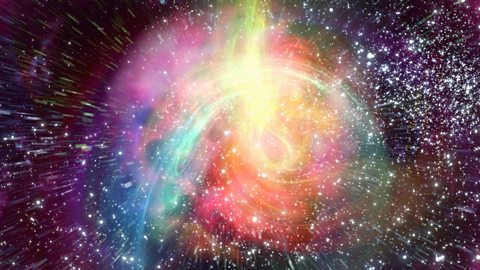
During the Big Bang, the Universe expanded and cooled.
Galaxies are moving away from each other.
The further away the galaxies are, the faster they are moving apart.
Space is expanding.
The Universe is expanding.
What is redshift?
You may have noticed that when an ambulance, fire engine or police car goes past, its siren is high-pitched as it comes towards you, and then becomes low-pitched as it goes away.
This effect, where there is a change in The number of waves produced each second. The unit of frequency is hertz (Hz). and The length of a single wave, measured from one wave peak to the next., is called the Doppler effect.
It happens with any wave source that moves towards or away from an observer.
If the object is moving towards an observer, the waves are shifted to a higher frequency, shorter wavelength.
If the object is moving away from an observer, the waves are shifted to a lower frequency, longer wavelength.
This happens with light as well as sound.
Our Sun contains helium.
We know this because there are black lines in the spectrum of the light from the Sun where helium has absorbed light.
These lines form the absorption spectrum for helium.
When we look at the spectrum of a star in another galaxy, the absorption spectrum is there, but the pattern of lines has moved, or ‘shifted’, towards the lower frequency, longer wavelength, red end of the spectrum, as you can see below:
This is called redshift.
Light from a star in a distant galaxy is shifted towards the long wavelength, red end of the spectrum.
This tells us that:
Other distant galaxies are moving away from our galaxy.
The Universe is expanding.
Astronomers have found that the further from us a star is, the more its light is redshifted.
This tells us that:
- The further away a galaxy is, the faster it is moving away
Since we cannot assume that we have a special place in the Universe, it suggests that everything is moving away from everything else as you would expect with an explosion.
WATCH: What is redshift?
Here is redshift explained in under two minutes.
First thing you need to understand is what wavelength is.
Think of how when a stone is dropped into a pond and ripples form around it.
The distance between each ripple is the wavelength which is constant in all directions.
Now think of a fire engine sitting still with its siren blaring.
The sound waves coming from the siren move the same way as the ripples.
But when it starts to move the waves in front of it bunch up together creating a shorter wavelength.
When this happens with light waves it's called blueshift.
The waves behind it should spread out, creating a longer wavelength.
When this happens with light waves it is called redshift.
This happens when an object is getting further away.
There are an infinite number of colours in the light spectrum and each colour has its own wavelength.
When we look at the light spectrum from the sun we get an absorption pattern.
This is where particular colours are missing, and we are left with black lines on the spectrum.
This happens because the light has passed through the Hydrogen and Helium in the sun's outer layers which have absorbed certain wavelengths of light.
When we look at stars from distant galaxies we get the same absorption pattern, but these black lines are moved towards the red end of the spectrum and so appear to have a longer wavelength, because they are redshifted.
This indicates that the stars in distant galaxies are getting further away, telling us the universe is expanding and giving us evidence for the Big Bang Theory.
So to recap, redshift is when the light from distant galaxies is shifted towards the longer wavelength, the red part of the spectrum.
Redshift tells us that distant galaxies are getting further and further away from us because space itself is expanding.
Summary
There is a redshift in light observed from most distant galaxies.
Redshift shows that a galaxy is moving away from us.
The further away the galaxies are, the bigger the redshift.
The further away a galaxy is, the faster it is moving away.
Redshift gives us evidence that the universe is expanding.
What is cosmic microwave background radiation (CMBR)?
Further evidence for the Big Bang comes from the discovery of cosmic microwave background radiation (CMBR).
Astronomers discovered cosmic microwave background radiation in the 1960s.
The The length of a single wave, measured from one wave peak to the next. of this radiation appears to be the same no matter where in space it comes from and corresponds to a temperature of about –270 °C.
It comes from all directions and from all parts of space.
Scientists believe that the continuous microwave background radiation is the remains of the heat energy from the Big Bang, spread thinly across the whole Universe.
The Big Bang is currently the only model that explains the existence of CMBR.
| Prediction from Big Bang theory | Evidence observed and explanation | Does evidence support the Big Bang theory? |
|---|---|---|
| Galaxies should move away from each other. | • Light from stars in other distant galaxies is redshifted. • This indicates that other galaxies are moving away from ours. | Yes |
| More distant galaxies should move away faster. | • More distant galaxies have greater redshift. • This indicates that more distant galaxies are moving away faster than nearer galaxies. | Yes |
| Heat energy left over from the Big Bang should now be thinly spread across the whole Universe. | • CMBR is everywhere at a temperature of about -270°C. • CMBR is the remains of the heat energy from the Big Bang, spread thinly across the whole Universe. | Yes |
WATCH: What is CMBR?
What is cosmic microwave background radiation?
CMBR is electromagnetic radiation that is detected from all directions in space.
It is the afterglow or leftover heat from the Big Bang.
But to understand this fully, let's bring it back a bit to 14 billion years ago.
The point from which the Big Bang started was extremely hot and dense.
After the explosion, the universe expanded and began to cool down.
As it cooled, everything the universe is made up of began to form, starting with protons and neutrons.
It further expanded and cooled allowing nuclei to form.
Then, even further expansion and cooling allowed these nuclei to capture electrons and for atoms of hydrogen to form.
The light and heat energy from the Big Bang was sent out throughout the universe, which we now call cosmic microwave background radiation or CMBR.
We could see evidence for CMBR if we were to position four people at different points on the Earth—the North Pole, the South Pole, east and west—all with microwave detectors.
Although all pointing in different directions, they will all pick up the same signal strength, proving this energy is coming from everywhere and fills the whole universe.
CMBR, along with redshift, is evidence for the Big Bang Theory.
Let's recap: cosmic microwave background radiation or CMBR is leftover radiation from the Big Bang and it is everywhere in space.
What is the "steady state" theory of the Universe?
Another theory about the Universe, called the steady state theory, says that the Universe has always existed, and that the Universe is expanding and constantly creating matter as it expands.
This idea is supported by the redshift evidence, but not by CMBR.
After the discovery of CMBR, the steady state theory lost support and is no longer considered likely.
| Evidence observed | Does evidence support the Big Bang theory? | Does evidence support the steady state theory? |
|---|---|---|
| More distant galaxies have greater redshift. | Yes | Yes |
| CMBR is everywhere at a temperature of about -270°C. | Yes | No |
Question
Many scientists believe that the Universe began in an explosion known as the Big Bang.
Describe and explain two observation that supports the Big Bang Theory.
Answer
- Redshift - When we look at the Refers to the visible spectrum, the range of the electromagnetic spectrum visible to the human eye. It can be seen when white light is split by a prism, or by raindrops to form a rainbow. of a star in another distant galaxy, the pattern of lines in the absorption spectrum has moved, or ‘shifted’, towards the lower The number of waves produced each second. The unit of frequency is hertz (Hz)., longer The length of a single wave, measured from one wave peak to the next., red end of the spectrum.
The shifting of the light to longer wavelength is an indication that the galaxy is moving away from our galaxy.
- Astronomers discovered cosmic microwave background radiation CMBR in the 1960s.
The wavelength of this radiation appears to be the same no matter where in space it comes from and corresponds to a temperature of about –270°C.
It comes from all directions and from all parts of space.
It is thought that the continuous microwave background radiation is the remains of the heat energy from the Big Bang, spread thinly across the whole Universe.
How much do you know about stars?
More on Earth in space
Find out more by working through a topic
- count1 of 2