What is energy flow?
The Sun is the source of energy for most ecosystems on the Earth.
Plants are Plant that produces its own food by photosynthesis.. They use light energy absorbed by chlorophyll to make sugars and starches through photosynthesis, which provide food for animals.
Animals, or consumers, get this energy by feeding on plants or other animals.
Herbivores (plant eating animals) are primary consumers.
Carnivores (animals who eat other animals) are secondary consumers, and those eating secondary consumers are tertiary consumers.
Food chains and food webs
The feeding sequence, showing the energy flow from producers to consumers, is called a food chain.
Each step is called a trophic level: producers are on the first trophic level 1, primary consumers are 2nd trophic level, and so on.
Specific feeding sequences (and therefore flow of energy) can be represented as a food chain.
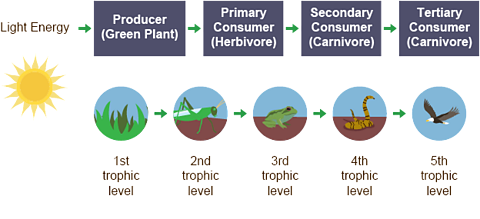
Arrows between each organism show the direction of:
- feeding (consumption)
- energy flow
- the transfer of substances such as carbon and nitrogen
Food webs show interconnecting food chains showing feeding relationships within a community.
Most organisms will have more than one food source that can be seen in a food web but not a food chain.
Energy loss
Energy is lost between each trophic level.
From the Sun to the plant (Plant that produces its own food by photosynthesis.), energy is lost when light is reflected off the leaf or passes through the leaf missing the Part of a cell that carries out photosynthesis. Chlorophyll inside the chloroplast traps sunlight..
Between each trophic level only 10-20% of the energy is transferred resulting in a loss of 80-90% of energy.
Test your understanding
More on Biodiversity
Find out more by working through a topic
- count3 of 4
- count1 of 4