What are the key learning points about lenses?
The difference between converging and diverging lenses.
How to draw a lens diagram.
The application of lenses.
Identifying defects of vision and how they are corrected using lenses.
What are the different types of lenses?
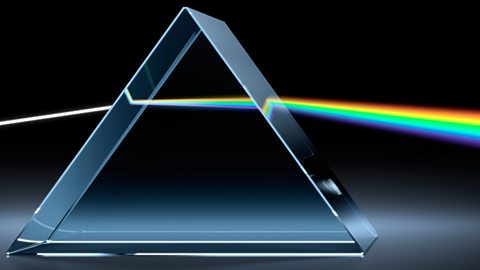
When light moves from air into glass or plastic it is Process by which a wave changes speed and sometimes direction upon entering a denser or less dense medium, eg a light ray changes direction when refracted by a lens., that is it changes direction due to the change in density.
Lenses are used in cameras, telescopes, binoculars, microscopes and corrective glasses.
A lens can be converging (convex) or diverging (concave).
What are converging (or convex) lenses?
A converging lens is thicker in the middle than it is at the edges.
Parallel light rays that enter the lens Move towards each other..
They come together at a point on the An imaginary line which runs through the centre of a lens. called the principal focus F, (or focal point).
The centre of the lens is called the optical centre C.
In a ray diagram, a converging lens is drawn as a vertical line with outward facing arrows to indicate the shape of the lens.
Key point
The focal length f of a converging lens is defined as the distance between the optical centre, C, and the principal focus, F.
Focal length is measured in m, cm or mm.
How to measure the focal length of a converging lens
Point the lens at a distance object outside the window – for instance a tree or building. The greater the distance, the better. Rays of light from this object are taken to be parallel as the object is assumed to be at infinity.
Move the position of the screen behind the lens until a sharp image is formed on it.
Parallel rays of light form an image at the principal focus of a lens, and so the screen is at the principal focus. The distance between the optical centre of the lens and the screen is the focal length, f.
Measure this distance with a 30 cm rule and record in a suitable table.
Repeat the process several times and calculate the average focal length.
What are diverging (or concave) lenses?
A diverging lens is thinner in the middle than it is at the edges.
This causes parallel rays to diverge.
They separate but appear to come from a principal focus F on the other side of the lens.
In a ray diagram, a diverging lens is drawn as a vertical line with inward facing arrows to indicate the shape of the lens.
What are real and virtual images?
The images formed by a lens can be:
upright or inverted (upside down compared to the object);
enlarged or diminished (smaller than the object);
real or virtual.
A real image is an image that can be projected onto a screen.
Rays of light actually pass through the image.
A virtual image cannot be projected onto a screen.
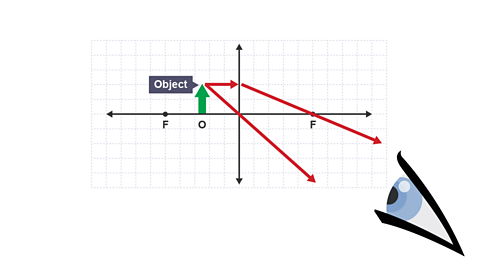
It appears to come from behind the lens and can only be seen by looking through the lens.
Rays of light appear to come from a virtual image, rather than pass through it.
Convex lenses
The type of image formed by a convex lens depends on the lens used and the distance from the object to the lens.
How to draw a lens ray diagram
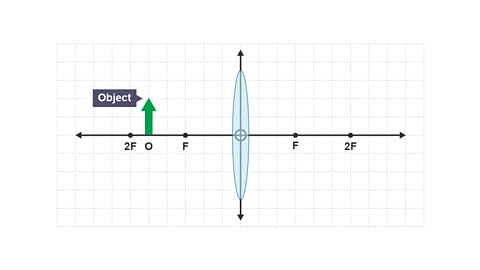
Image caption, 1. This is how to draw a lens ray diagram.
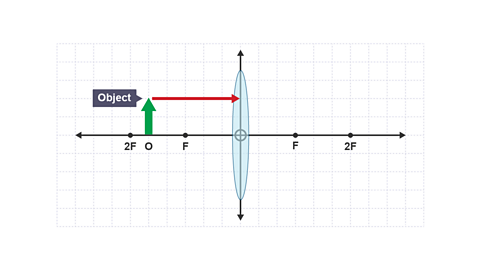
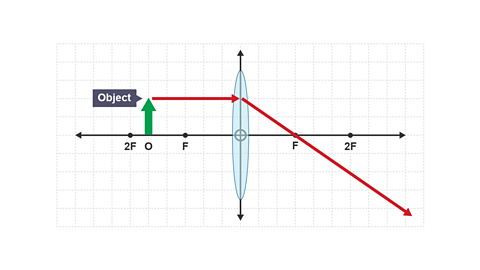
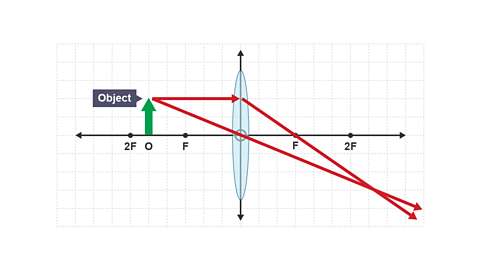
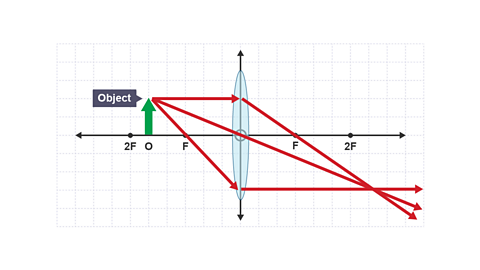
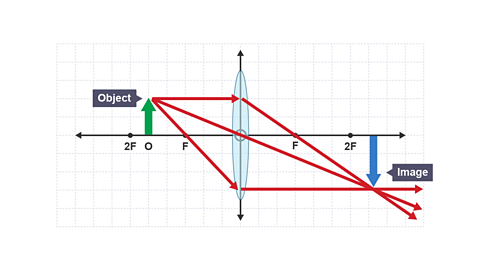
1 of 6
What type of lens is in a camera or the human eye?
Cameras and eyes contain convex lenses.
For a distant object that is placed more than twice the focal length from the lens, the image is:
between F and 2F on the opposite side of the lens to the object;
inverted;
diminished;
real.
Projector
Projectors contain convex lenses.
For an object placed between one and two focal lengths from the lens, the image is:
further away than 2F on the opposite side of the lens to the object;
inverted;
enlarged;
real.
In a film or data projector, this image is formed on a screen.
Film must be loaded into the projector upside down so the projected image is the right way up.
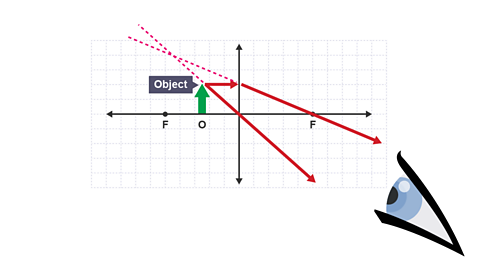
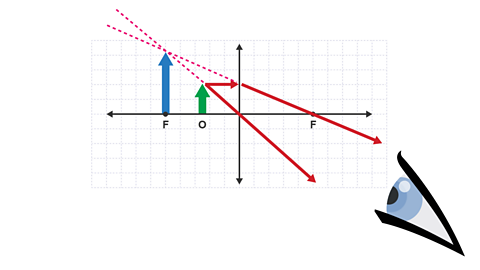
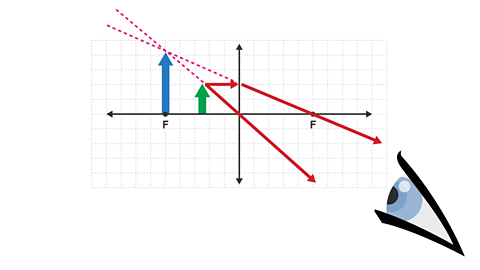
How do magnifying glasses work? (Higher tier only)
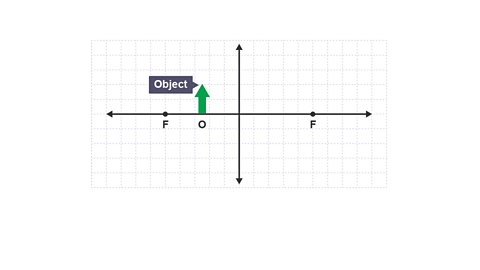
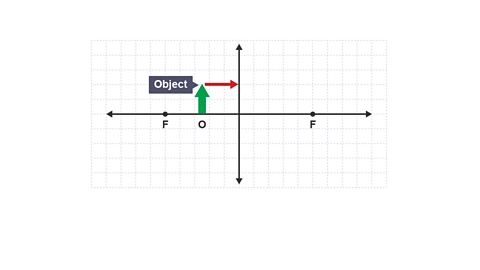
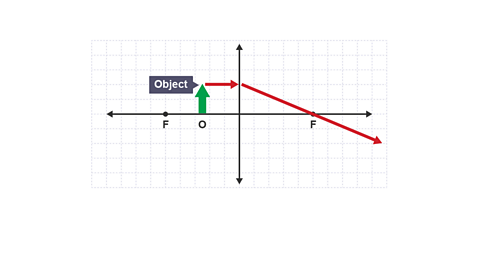
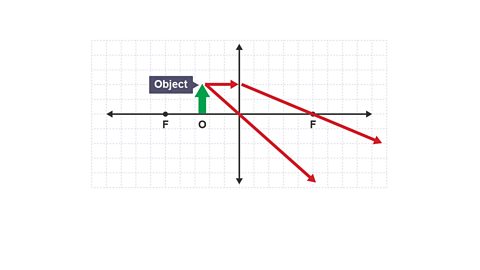
Image caption, 1. A magnifying glass is a convex lens used to make an object appear much larger than it actually is. This works when the object is placed at a distance from the lens of less than one focal length.
1 of 8
The table below summarises the nature of the images produced by a converging lens.
| Distance of object | Size | Orientation | Type | Position | Application |
|---|---|---|---|---|---|
| Further than 2F | Diminished | Inverted | Real | Between 2F and F | The eye or camera |
| 2F | Same size | Inverted | Real | 2F | |
| Between 2F and F | Enlarged | Inverted | Real | Further than 2F | Cinema projector |
| F | No image because the emerging rays are parallel to the axis | Searchlight. Or follow spot in the theatre | |||
| Closer than F | Enlarged | Upright | Virtual | Same side as object but further away | Magnifying glass |
Question
The full-scale diagram below shows a converging lens and an object. Each principal focus is marked with an F:
- Draw two rays to find the position of the image. Label the image I. Draw arrows on each ray to show its direction.
- Is the image real or virtual? Explain your answer.
- State an application for a lens in this way.
Answer
The image is real. Actual rays of light pass through the image. It can be projected on a screen.
The image is real, inverted and enlarged. An application for a lens used in this way is a cinema projector
Test your knowledge
More on Light
Find out more by working through a topic
- count1 of 2