Key facts about chromosomes and genes
Chromosomes are long strands of DNA found in the nucleus, carrying genes that determine inherited characteristics.
Genes are segments of DNA that code for specific proteins or traits, with different versions called alleles.
DNA has a double helix structure with complementary base pairs (A with T, and C with G) forming its two strands.
Genetic inheritance can be predicted using diagrams like Punnett squares, showing how traits are passed from parents to offspring.
What are chromosomes?
Chromosomes are long strands of DNA (deoxyribonucleic acid).
They are subdivided into The basic unit of genetic material inherited from our parents. A gene is a section of DNA which controls part of a cell's chemistry - particularly protein production..
In most cells, Genetic structures that usually occur in functional pairs in the nucleus of cells (except in gametes and bacteria). are found in the Control centre of a cell containing genetic material. in functional pairs.
Humans have 46 chromosomes arranged in 23 pairs.
The entire genetic material of an An organism is a living thing that shares characteristics such as the ability to move and reproduce including plants, animals, fungi, bacteria and protoctists. is known as the The complete set of DNA found in an organism..
What are genes?
A gene is a short length of DNA found on a chromosome that codes for a particular characteristic or protein.
Alleles are different forms of the same gene. For example, eye colour is the gene but blue, green, brown etc are alleles.
How is DNA structured?
DNA has a double helix structure, made up of two chains of nucleotides.
Each nucleotide contains a phosphate group, a sugar (deoxyribose), and a base.
The phosphate and sugar molecules link together to form the backbone, while the interlinking bases hold the two strands together.
There are four bases, which pair as follows:
- Adenine (A) with thymine (T)
- Cytosine ( C ) with guanine (G)
This is known as the complementary base-pair rule.
Genetics key terms
- Alleles: Different forms of a gene (eg dominant or recessive).
- Dominant allele: Always expressed when present (eg T). It overrides the recessive allele.
- Recessive allele: Only expressed when no dominant allele is present (eg tt).
- Genotype: The combination of alleles an organism has (eg TT, Tt or tt).
- Phenotype: The outward expression of a gene - the physical appearance (eg tall or short).
- Homozygous: Both alleles are the same (eg AA or aa).
- Heterozygous: The two alleles are different (eg Aa).
- Punnett squares: A grid used to determine genotype frequencies.
What is a monohybrid cross?
A genetic diagram consisting of a single characteristic controlled by a single gene with two alleles.
Crossing purebred tall (homozygous dominant – TT) and short parent plants (homozygous recessive – tt) results in all the offspring (F1) being tall (heterozygous – Tt).
Crossing two heterozygous plants (Tt) would result in the second generation having tall (TT/Tt) plants and short (tt) plants.
Example - eye colour
1:0 ratio
In these offspring the dominant allele (B) overrides the recessive allele (b), resulting in all the offspring having brown eyes – a 1:0 ratio.
1:1 ratio
In these offspring there is only one dominant allele (B) which overrides the recessive allele (b), resulting in half the offspring having brown eyes and half having blue eyes - 1:1 ratio.
3:1 ratio
When both parents are heterozygous (Bb in this example) the offspring have a 75% chance of having brown eyes and a 25% chance of having blue eyes – a 3:1 ratio.
Pedigree diagrams
Pedigree diagrams are used to show how a genetic condition is inherited in a family.
They are often used to advise individuals within a particular family if they are carriers of a condition.
Cancer
Cancer cells are produced by uncontrolled cell division.
Some variations in living organisms are due to mutations.
A mutation is a random change in the structure or number of Genetic structures that usually occur in functional pairs in the nucleus of cells (except gametes and bacteria). or The basic unit of genetic material inherited from our parents. A gene is a section of DNA which controls part of a cell's chemistry - particularly protein production..
These can be triggered by environmental factors.
For example, UV light can cause skin cancer.

Genetic conditions
Some genetic conditions are inherited – passed from parent to child.
Genetic conditions are caused by mutations.
Cystic fibrosis and Down’s syndrome are both genetic conditions.
Cystic fibrosis is caused by a gene mutation.
Down’s Syndrome is caused by a change in the chromosome number.
People with Down’s Syndrome have 47 chromosomes rather than 46.
Genetic screening
Genetic screening involves testing people or groups of people for the presence of a particular allele or other genetic abnormality.
Pregnant mothers are offered a blood test at 10–14 weeks to assess the risk of having a child with Down's syndrome.
High-risk cases may then be offered amniocentesis, which is more accurate but carries a 1% risk of miscarriage, unlike the safer blood test.
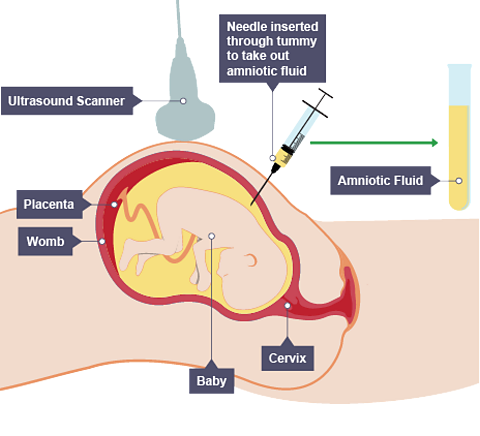
Amniocentesis procedure
- A needle is inserted into the The fluid surrounding a foetus that cushions it. that surrounds the An unborn baby. Usually eight weeks after conception. and fluid is withdrawn.
- Chromosomes in foetal cells from the fluid are examined for genetic abnormalities such as Down's syndrome and cystic fibrosis.
Mothers at greater risk include:
- those with a family history of genetic conditions
- those who previously carried a foetus with a genetic abnormality
- older mothers
- those with possible problems identified in earlier tests, such as blood tests
What are some of the ethical issues from genetic screening?
Parents can be faced with difficult decisions if genetic screening shows their foetus has a genetic condition.
Ethical issues are questions about right, wrong and fairness, especially when decisions affect others' rights, privacy or well-being.
Ethical questions:
Who decides who will be tested?
- People should have the choice to be tested
- Decisions for unborn babies are made by parents, is this right?
What are the benefits and risks of amniocentesis and blood tests?
- Amniocentesis: more accurate but involves a small risk of miscarriage.
- Blood Tests: safer but less accurate, often needing further testing.
What is the dilemma for carriers of genetic conditions?
- Parents face emotional challenges and difficult decisions if genetic screening shows their foetus has a genetic condition.
- It will allow them to access support.
- Parents may be offered an abortion:
- prevents suffering, poor quality of life, and ease the burden on parents and siblings.
- the unborn child has a right to life and cannot voice their choice
- abortion is against some religious teachings
Should genetic information be available to wider society?
- Pros: It could advance medical research.
- Cons: Insurers or employers might misuse it, causing discrimination.
- Solution: Strong laws are needed to protect privacy.
What is the role of genetic engineering?
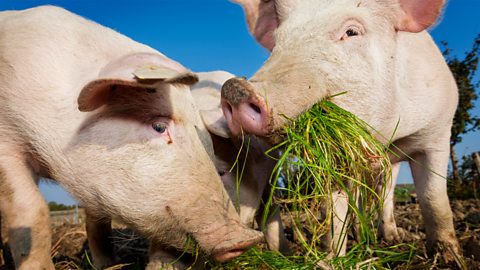
Genetic engineering changes the genome of an organism to introduce desirable traits eg increase yields, disease-resistant, and improve nutrients in food.
It is widely used in medicine, agriculture and scientific research.
It can be carried out on plants and animals.
Some extra examples are below:

Image caption, Banana vaccines
Hate injections? Scientists have discovered a way of turning the humble banana into a life saving vaccine. An engineered part of a virus is injected into the fruit where it multiplies thousands of times. When eaten, it produces antibodies which fight off deadly disease.

1 of 4
Advantages of genetic engineering
- producing human insulin and other medication
Disadvantages of genetic engineering
- unforeseen outcomes
- moral issues
- spread of genes into the wild
Test your knowledge
More on Genetics
Find out more by working through a topic
- count2 of 2