What are the key learning points about materials and their properties?
Materials have different physical properties (eg conductivity, strength or density) that determine how they are used.
They can be classified as natural (such as wood, cotton or wool) or synthetic (such as plastic or glass).
Smart materials change their properties with temperature or light, while nanoparticles have unique behaviours due to their extremely small size.
Forensic science uses materials and techniques such as fingerprint powders, UV light, and chemical developers to collect and analyse evidence.
What are the physical properties of materials?
Materials have many different physical properties that make them suitable for a range of purposes.
Some properties of materials include:
- Ability to conduct electricity.
- Ability to conduct heat.
- Hardness.
- Strength.
- All substances are made of particles. Density is a measure of how close together particles are. Closely packed particles have a higher density than particles that are spread out..
- Melting point and boiling point.
Some examples of how these properties are useful are shown below:
| Material | Physical property | Objects made from the material |
|---|---|---|
| Copper | Good conductor of electricity. | Used in electric cables and wires. |
| Iron and steel | Hard and strong. | Bridges, ships, cars, girders for buildings. |
| Plastic (PVC) | Low density, strong with resistance to rust. | Garden furniture, watering cans. |
| Gold, platinum and silver | Shiny and unreactive. | Jewellery, ornaments and coins. |
| Aluminium | Good conductor of heat, low density. | Pots and pans, aluminium foil, aircraft parts. |
What's the difference between natural and synthetic materials?
Materials can be classified into natural and synthetic materials.
Natural materials are obtained from a living thing (a plant or animal).
Examples of natural materials include: wool, cotton, wood, silk and leather.
Synthetic materials are man-made materials; they have to be manufactured through a chemical process.
Examples of synthetic materials include: plastic, nylon and glass.
What are smart materials?
Smart materials are relatively newly developed materials.
They have the ability to change their A quality, or characteristic of something. Physical properties of matter are measurable, for example melting point or boiling point. depending on a change in their surroundings.
Thermochromic materials change colour depending on a change in temperature.
These can be used in forehead strip thermometers.
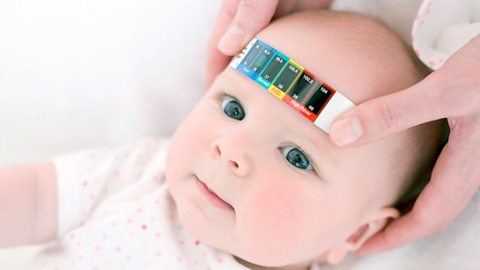
Photochromic materials change colour depending on a change in light in their surroundings.
These can be used in the lens of glasses so they darken in bright sunlight.
What are nanoparticles?
Nanoparticles are particles which are between 1 and 100 nanometres (nm) in size and are made up of a few hundred The smallest particle of an element. We often think of atoms as tiny spheres, but in fact they are made from smaller particles called protons, neutrons and electrons..
A nanoparticle has a very large surface area compared to its volume.
The A quality, or characteristic, of something. Physical properties of matter are measurable - for example, melting point or boiling point. of nanoparticulate substances are different from those of the same atoms in bulk such as powders, lumps or sheets.
For example, a nanoparticle of gold will behave differently to a lump of gold, even though they both contain the same type of atom.
One nanometre is 1 × 10⁻⁹m or 0.000000001 m.
Is it safe to use nanoparticles in sunscreen?

Nanoparticulate materials are already common in sunscreens.
There are some benefits and also some concerns about using nanoparticles in sun creams.
| Benefits | Concerns |
|---|---|
| Better skin coverage. | Nanoparticles may enter cells and cause cell damage. |
| Better protection from the sun’s ultraviolet rays. | Could wash off skin and cause harm to the environment. |
| Colourless once rubbed onto skin. | Risks are difficult to determine as nanoparticles have not been in use for very long. |
What is graphene? (Higher tier only)
Graphene is a one atom thick layer of graphite.
The carbon atoms are bonded in a hexagonal pattern.
Graphene is 200 times stronger than steel, but much lighter than steel.
Graphene is transparent and very flexible.
It is also a very good conductor of electricity and heat.
Graphene can be used to make batteries and solar cells.
What are emergent materials? (Higher tier only)
As well as graphene there are other carbon-based materials being researched.
These include a group of materials called fullerenes.
Fullerenes are being used as A substance that speeds up a chemical reaction without being used up or chemically changed. It does this by providing an alternative reaction pathway with a lower activation energy. and also to deliver drugs to specific body parts.
Many other uses are being explored.
Cylindrical fullerenes or nanotubes are very light and strong, they are used to reinforce sports equipment such as tennis racquets and golf clubs.
How is forensic science used at crime scenes?
There is a lot of useful evidence that can be collected at a crime scene, such as biological evidence, fingerprints, trace evidence and digital evidence.
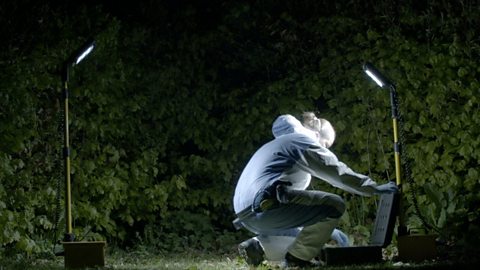
Trace evidence is small amounts of evidence that is transferable.
This includes hair, fibres, paint or glass fragments.
These can be analysed and compared to samples collected from suspects.
What are the four main types of fingerprint pattern?
Fingerprints are one type of evidence that can be collected from a crime scene.
There are four main types of fingerprint patterns: loop, whorl, arch and composite.
A composite fingerprint will be a mixture of the other three types.
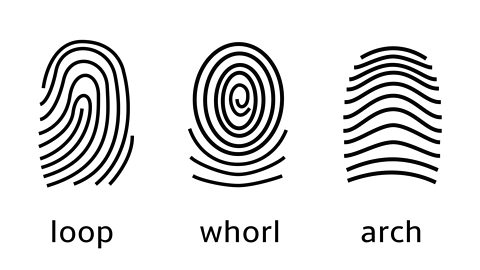
Fingerprints are unique and can be used to identify an individual.
They can also be used as a security measure, for example accessing a mobile phone.
Do you know your fingerprints patterns?
How is fingerprint evidence collected?
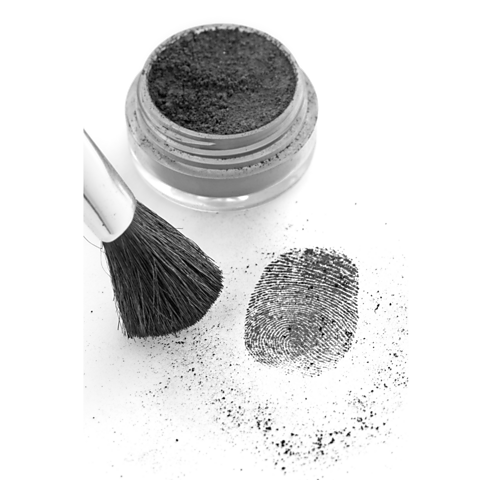
Fingerprint evidence can be collected using powders:
- on a white surface use carbon black powder;
- on a black surface use aluminium powder.
The powder is dusted on and then any excess powder brushed off.
A piece of cello tape is then used to transfer the print onto card or a glass slide for further analysis.
How is fingerprint evidence visualised?
Fingerprints can also be visualised using alternative light sources, such as UV light or chemical developers, such as iodine fumes.
A photograph or scan of the fingerprint can then be compared to a database of fingerprints to identify an individual.