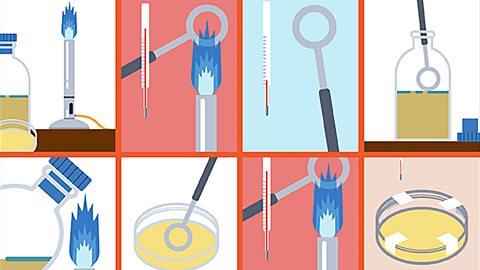
Preventing entry
Understanding the body's defence mechanisms
Our bodies have a defence system to protect us from disease-causing micro-organisms, known as pathogens.
The first line of defence is the skin: a barrier that keeps pathogens out. If the skin is cut, blood clotting can help seal the wound and stop pathogens from causing an infection.
Meanwhile, the openings into the body, like the nose and ears, are equipped with mucous membranes which trap pathogens before they get in.
If a pathogen does manage to enter the body, white blood cells called lymphocytes spring into action, producing antibodies. These antibodies have a specific shape that targets specific antigens on the surface of the invading micro-organisms.
The antibodies bind with the antigens, causing the pathogens to clump together, reducing their spread and making it easier for our immune systems to destroy them.
Another type of white blood cell, known as a phagocyte, engulfs, digests and breaks down invading micro-organisms, clearing the infection from the body.
What’s more, once the body has been exposed to a pathogen, memory lymphocytes remember the shape of the pathogen’s antigens. So, if this pathogen enters the body again, the lymphocytes act fast to produce many more antibodies. This makes a person immune to this pathogen, so it won’t make them sick again.
There are two types of immunity. First, active immunity: when the body produces antibodies in response to a pathogen after either infection or vaccination, giving long-lasting protection. Secondly, passive immunity: when antibodies are transferred from another source, like a mother passing them to her baby through the placenta or breast milk. This provides short-term protection.
Defence mechanisms help the body protect itself against the entry of Microscopic (too small to see) organisms, such as bacteria and viruses that cause A disease that can be passed from one organism to another..
These include:
the skin, which is a barrier to microorganisms
mucous membranes in the nose, ears, and eyes which trap microorganisms
blood clotting, which stops blood escaping and prevents the entry of microorganisms where the skin has been damaged
If a microorganism does enter, white blood cells will kill them.
The entry of a microorganism may cause us to be sick while our body fights the infection.
Antigens and antibodies
All cells have markers on their surface called antigens that have specific shapes.
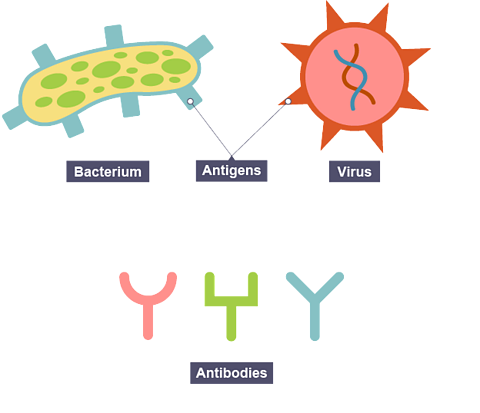
When the body recognises a foreign A marker on a microorganism that causes the body to produce antibodies. on aMicroorganisms that are harmful to humans., lymphocytes (white blood cells) produce A chemical produced by a lymphocyte in response to an antigen., which are complementary in shape to the antigen.
An antibody will only work on one type of microorganism because of this complementary shape.
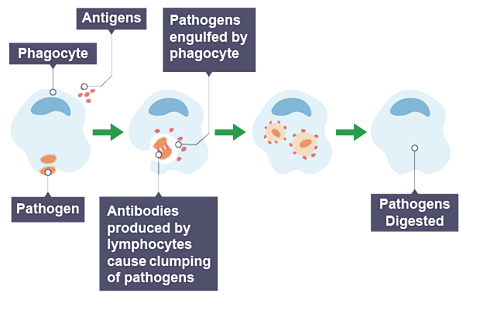
Antibodies immobilise microorganisms by clumping them together.
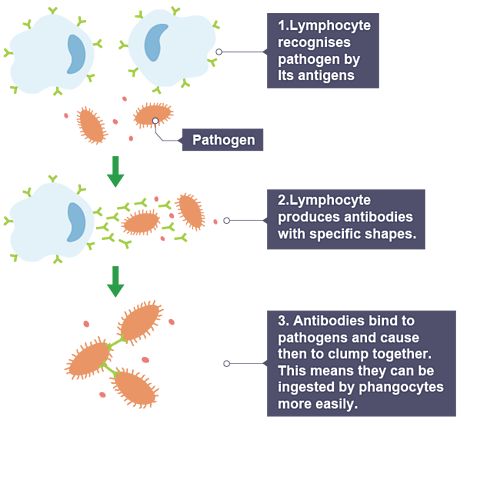
Immobilisation of the microorganism reduces symptoms and prevents the spread of infection.
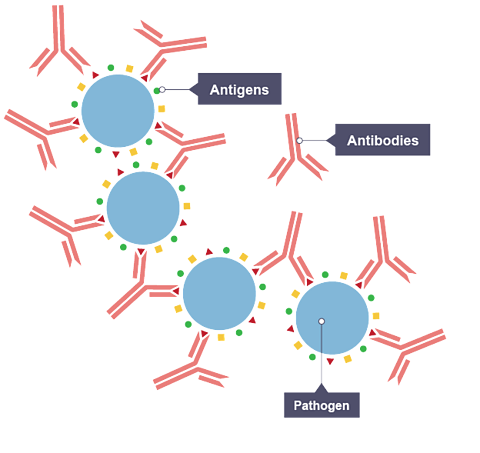
The clump of microorganisms is then destroyed by The process of the ingestion of bacteria or other material by phagocytes..
Phagocytosis is when a phagocyte (white blood cell) engulfs and digests the microorganisms.
Enzymes within the phagocyte digest the microorganism.
Primary and secondary responses
The infected individual will be sick while White blood cells which attack pathogens by producing antibodies. work to produce enough A chemical produced by a lymphocyte in response to an antigen. to provide immunity. This is the primary response.
During this response, the body will also make memory lymphocytes that remain in the body for years.
If the same pathogen is encountered again, memory lymphocytes produce high numbers of antibodies very quickly.
This is the secondary response and it prevents the person getting sick again from that pathogen or disease.
The person is now immune from that disease.
Immunity
Immunity means your body can fight off a disease. This happens when you have enough Proteins made by white blood cells that are specific to an infection. They help fight off the illness., which can protect you from getting sick from that disease.
There are two types of immunity:
Active immunity
This is when the body’s lymphocytes are activated and produce the specific antibodies needed to fight the pathogen.
Active immunity is:
slow acting
provides long-lasting protection
The primary response when a microorganism enters the body is described as natural active immunity.
A substance that stimulates the body to produce antibodies to provide immunity against a disease. provide artificial active immunity.
Passive immunity
This is when ready-made antibodies, from another source, are introduced to the body.
Passive immunity is:
fast acting
only lasts a short period of time (no memory lymphocytes are made)
Breastfeeding provides a baby with natural passive immunity.
Anti-venom provides artificial passive immunity after a poisonous bite.
Active immunity - vaccinations
How do vaccines work?
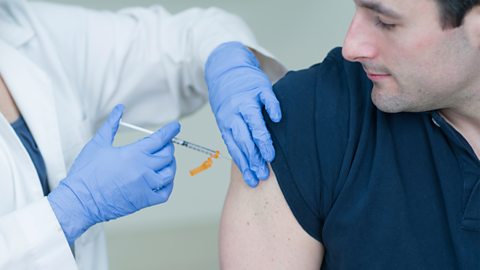
A vaccination is the injection of dead or weakened pathogens.
They stimulate the immune system to produce A chemical produced by a lymphocyte in response to an antigen. and memory White blood cells which attack pathogens by producing antibodies..
If this pathogen is encountered after the A substance that stimulates the body to produce antibodies to provide immunity against a disease., the memory lymphocytes will produce large numbers of the antibody very quickly, so the individual does not get sick.
What are booster vaccinations?
Sometimes a booster vaccination is needed to maintain the high levels of A chemical produced by a lymphocyte in response to an antigen. needed to provide immunity.
Given to maintain or increase antibody levels over time.
Ensure long-term immunity by reactivating memory White blood cells which attack pathogens by producing antibodies..
Interpreting antibody graphs:
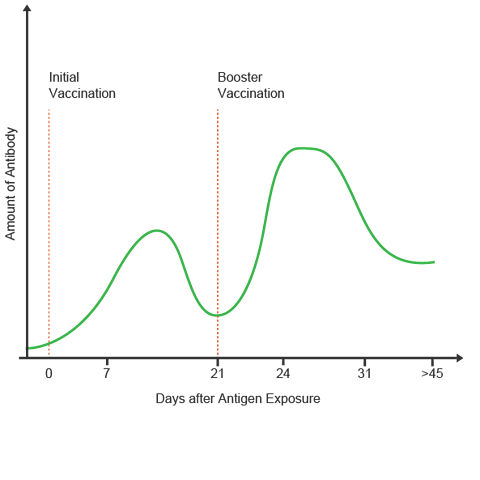
Show a rapid antibody response after boosters due to memory lymphocytes.
Highlight how antibody levels decline over time without boosters.
Antibiotics
Antibiotics such as penicillin, are chemicals or drugs made by fungi used to treat bacterial infections by killing the bacteria or reducing their growth.
Practical - Investigate the effect of different antibiotic discs on the growth of bacteria
Procedure:
- Using the aseptic technique, add bacteria to a Petri dish.
- Soak small filter paper discs in each antibiotic A, B and C.
- Place the discs apart on the bacteria in the Petri dish.
- Incubate at 25°C (safety - to ensure no pathogens grow) for 1-3 days.
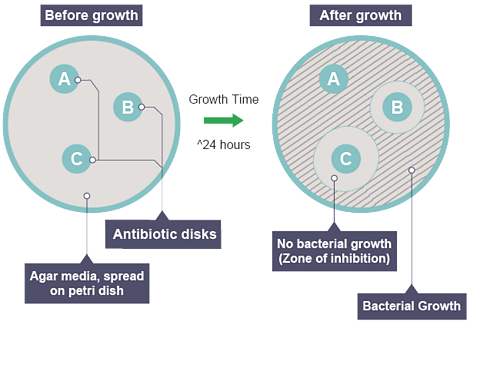
- Measure the radius/diameter of any clear zones around the discs.
Results
C is the more effective the antibiotic is at killing or preventing bacterial growth because it has a larger the clear zone.
Antibiotic-resistant bacteria
Some bacteria have developed resistance to antibiotics, meaning the drugs can no longer kill them.
The overuse of antibiotics is responsible for this process by allowing bacteria to mutate and become resistant.
Certain bacteria, known as superbugs (eg MRSA), are resistant to multiple antibiotics, making infections caused by them difficult to treat and posing serious health risks.
Reducing superbugs
Hygiene: regular handwashing and cleaning hospital environments.
Controlled antibiotic use: prescribe antibiotics only when necessary.
Isolation: keep patients infected with ‘superbugs’ separate to prevent spread.
Why superbugs are hard to eradicate:
bacteria can mutate quickly
resistant strains survive and multiply
limited development of new antibiotics
Watch a video
Watch: How have humans adapted to protect themselves?
Humans have adapted to protect ourselves against nasty infections and stopping most microorganisms getting into our bodies.
Our skin is one big, effective barrier, but the openings to our bodies, like our noses and mouths, are doors for the microorganisms to get in. But it’s not easy. Sticky mucous membranes trap the uninvited guests and prevent them from going any further in.
When we cut ourselves and the protective skin is compromised, our blood clots to seal the opening, stopping any infections and not letting any blood escape.
If a wily microorganism gets past these defenses, there’s more waiting. Microorganisms have chemicals on their surface known as antigens. The body recognises these antigens as being foreign and, in response, lymphocytes produce corresponding antibodies.
These antibodies latch onto the microorganisms, like a jigsaw piece, and clump them all together. Once this happens, it’s game over for the microorganism. Phagocytes surround the little baddies before engulfing and digesting them.
This is described as the primary response. Once we’ve been infected, our body can produce memory lymphocytes for years afterwards. This means if the same nasties get in again, they don’t get very far before being destroyed. This is called the secondary response.
Test your knowledge
More on Health, diseases and micro-organism
Find out more by working through a topic
- count4 of 4
- count1 of 4
- count2 of 4