What are biological molecules?
The food we eat – our diet – is made up of different biological molecules which give us energy and contain chemicals we need to grow and repair ourselves and help our cells function in our body.
Carbohydrates
Carbohydrates provide energy. There are two types - simple and complex.
Simple carbohydrates are sugars, like glucose and lactose, and are found in food like biscuits or energy bars.
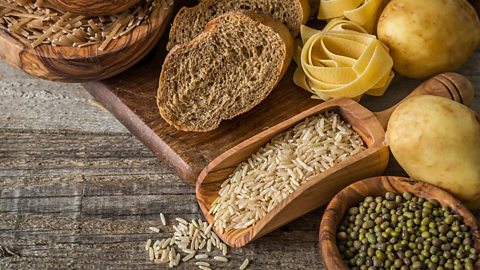
Complex carbohydrates are:
Cellulose – found in plant cell walls providing support to the cell
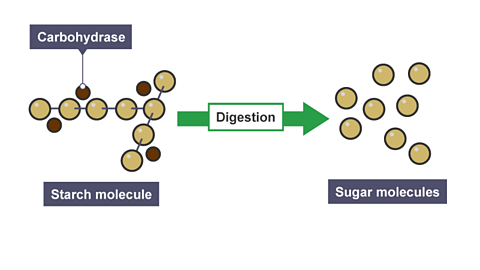
Starch – an energy store in plants. Broken down by amylase into glucose, for respiration
Glycogen – an energy store in animals. Can be broken down into glucose when needed
Fats/Lipids
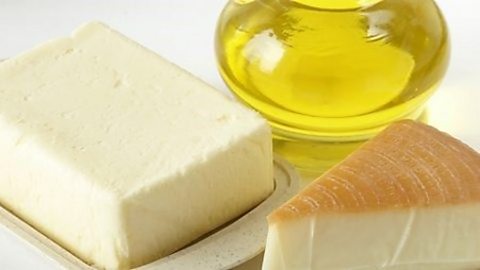
Fats are an energy store, providing twice as much energy as carbohydrates and proteins.
They are made up of fatty acids and glycerol.
Foods high in fat include cheese, butter and oils.
What are proteins made up of?
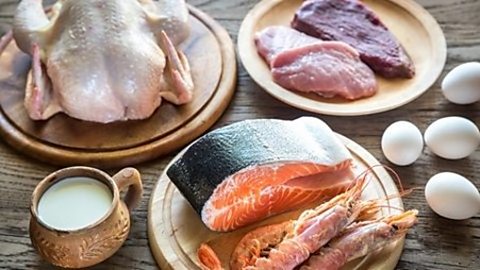
Proteins are made up of long chains of amino acids and are essential for growth and repair of cells.
They serve as:
structural molecules eg in muscles, skin, nails and
functional molecules eg enzymes, hormones, antibodies
Foods high in protein include fish and eggs.
Reagents and food testing
Different tests can detect carbohydrates, proteins, and lipids in food.
These tests use a chemical (reagent) that changes colour if certain molecules are present.
Sometimes, the food needs to be crushed or mixed with water before adding the reagent.
| Food sample | Reagent | Method | Initial colour | Colour of positive result |
|---|---|---|---|---|
| Reducing sugar | Benedict's | Add Benedict’s solution to the food and heat in a water bath | Blue | Brick red precipitate |
| Starch | Iodine solution | Add iodine solution | Yellow-brown | Blue-black |
| Protein/amino acids | Biuret | Add Biuret reagent | Blue | Lilac/purple |
| Fat | Ethanol | Add ethanol to the food, then add water | Colourless | White emulsion |
Practical - How to investigate the energy content of food
A simple investigation can be conducted to investigate the energy content of a food sample.
Procedure
- Add 20cm³ of water to a boiling tube in a retort stand.
- Record the starting temperature.
- Ignite 1g of food on a mounted needle.
- Hold the burning food under the boiling tube until fully burned (relight if needed).
- Record the final water temperature.
- Record results in a table.
- Repeat steps 1-6 with different foods.
Results:
| Food | Temperature at start (°C) | Temperature at end | Difference |
|---|---|---|---|
| Corn crisps | 20 | 42 | 22 |
| Potato crisps | 20 | 36 | 16 |
Analysis: Use the formula to calculate energy released. This formula will be provided in the exam.
1cm³ of water = 1g
Energy (J) = mass of water (g) x temp rise (°C) x 4.2.
Corn crisps = 20g x 22 x 4.2 = 1848J
= 1.8kJ
How much energy was in the potato crisps? Answer = 20g x 16 x 4.2 = 1344J
= 1.3kJ
Conclusion:
The corn crisps had more energy because they had a larger increase in temperature.
Sources of error:
The results obtained from this experiment are usually lower than the actual energy content of the food because during the experiment, the entire food sample may not be burned, some energy is lost to the air and some is used to heat the glass of the boiling tube.
Improvements:
- reduce heat loss to surroundings by using a A machine used to measure the energy involved in a chemical process.
- use a A device that measures temperature and converts it to an electrical signal. Temperature sensors are used in many applications, including air conditioning, home appliances, and industrial systems
- stir water
Independent variable: type of food
Dependent variable: temperature / °C
Controlled variables: mass of food, mass of water, distance of burning food from water
Test your knowledge
Watch: Biological Molecules
Our food is made up of biological molecules that can be divided up into three important groups: carbohydrates, fats and proteins.
Each one of these molecules contains carbon, hydrogen and oxygen.
Protein molecules also contain nitrogen.
Carbohydrates can be thought of as sugars. They are sweet and are things like lactose in your milk.
More complex carbohydrates, like the starch in potatoes or pasta, are made of long chains of sugars.
Starch is super important to our diet.
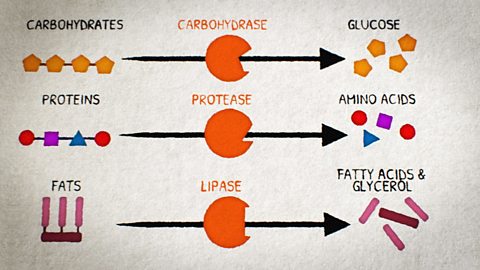
Our digestive system breaks it down to glucose for energy.
Our bodies also store carbs to be broken down for later when our energy levels get low.Cellulose found in plant cells can’t be broken down by humans but it’s still important to eat.
The fibre it provides helps our intestines push other food along.
Long story short, carbs provide energy. Simple sugars act fast and burn out quickly.
Complex carbs like starch release the energy at a much slower and stable rate.
Fat! Scientifically fats are known as lipids and they are amazing at storing energy.
Just one gram of fat has double the energy than the same amount of protein or carbs.
Protein molecules are important for repairing and maintaining our cells.
They are complex and made up of long chains of smaller molecules called amino acids.
During digestion, these amino acids are separated and connected again to form thousands of different proteins like antibodies, haemoglobin and hormones.
Pretty powerful stuff.
More on Living processes
Find out more by working through a topic
- count3 of 5
- count5 of 5
- count1 of 5