Respiration key facts
- Respiration is a chemical reaction which releases energy from food.
- It is an exothermic reaction that takes place in the mitochondria of cells.
- The respiratory system exchanges the gases which are involved in respiration.
- There are two types of respiration: aerobic and anerobic.
Respiratory surfaces
In humans
Gas exchange occurs in the alveoli which are found in the lungs.

When air is The action of breathing in., oxygen diffuses from the alveoli into the blood to be used for respiration by the body’s cells.
Carbon dioxide is a waste product made by the body’s cells during The chemical change that takes place inside living cells, which uses glucose and oxygen to release the energy that organisms need to live. Carbon dioxide is a by-product of respiration..
It The random movement of a substance from a region of high concentration to a region of low concentration. from the blood into the alveoli and is The action of breathing out..
Adaptations of the alveoli:
Large surface area - many alveoli are present in the lungs with a shape that further increases surface area.
Thin walls - alveolar walls are one cell thick providing gases with a short diffusion distance.
Moist walls - gases dissolve in the moisture helping them to pass across the gas exchange surface.
Permeable walls - allow gases to pass through.
Good blood supply - to take oxygen away from the lungs and carbon dioxide to the lungs.
A large diffusion gradient - allows efficient gas exchange as oxygen diffuses from high concentration in the alveoli to the blood, while carbon dioxide moves in the opposite direction.
In plants
Gas exchange occurs in the The plant tissue in a leaf which has loosely packed cells and air spaces between them to allow gas exchange. cells that surround air spaces in the leaves.
Adaptations of the leaf:
- Large surface area - spongy mesophyll cells are in contact with the air spaces for gas exchange.
- Thin walls - gases have a short diffusion distance.
- Moist walls - gases dissolve in the moisture helping them to pass across the gas exchange surface.
- Permeable walls - allow gases to pass through.
- A large diffusion gradient – allows efficient gas exchange as carbon dioxide diffuses from high concentration in the air space into the cells, while oxygen moves in the opposite direction.
Effect of exercise on breathing rate and depth
During exercise, muscle contraction requires more energy. Energy is released during The chemical change that takes place inside living cells, which uses glucose and oxygen to release the energy that organisms need to live. Carbon dioxide is a by-product of respiration..
Your body needs more oxygen and produces more carbon dioxide due to increased respiration.

To handle this:
- breathing rate increases: you take more breaths per minute to bring in more oxygen and remove carbon dioxide.
- breathing depth increases: allowing more air to enter and leave your lungs.
This helps supply your muscles with more oxygen and gets rid of the extra carbon dioxide. The harder you exercise, the faster and deeper you breathe.
The time taken for the breathing rate to return to normal is known as the recovery time.
This can be used as a measure of fitness as fitter people have a shorter recovery time.
Respiration
Respiration is an A chemical reaction that releases energy. reaction that occurs in the The site of cell respiration. of cells to release energy.
This energy can then be used for
- heat
- movement
- growth
- reproduction
- active uptake
There are two types of respiration - aerobic and anaerobic.
Aerobic respiration
Aerobic respiration happens in the presence of oxygen and releases more energy than anaerobic respiration.

Aerobic respiration word equation:
glucose + oxygen → carbon dioxide + water + energy
Aerobic respiration balanced chemical equation:
\(\ce{C6H12O6 + 6O2 → 6CO2 + 6H2O + energy}\)
Anaerobic respiration
Anaerobic respiration happens in the absence of oxygen.
It occurs during strenuous exercise. The build up of A toxic chemical produced during anaerobic respiration. causes muscle cramps.
Anaerobic respiration word equation (in mammalian muscle cells):
glucose → lactic acid + energy
Anaerobic respiration word equation (in yeast cells):
glucose → alcohol + carbon dioxide + energy
The alcohol produced is the basis of wine and beer production.
Compare and contrast aerobic and anaerobic respiration
Similarities - both:
- Release energy
- Occurs in both plants and animals
- Catalysed by enzymes
Differences -
| Aerobic | Anaerobic | |
|---|---|---|
| Oxygen | Needed | Not needed |
| End products | Carbon dioxide and water | Animal cells: lactic acid. Plant cells and yeast: carbon dioxide and ethanol |
| Energy released | Relatively large amount | Relatively small amount |
| Occurs in | Mitochondria | Cytoplasm |
Practical 1.5 - Investigate factors affecting the respiration of yeast
Temperature - procedure
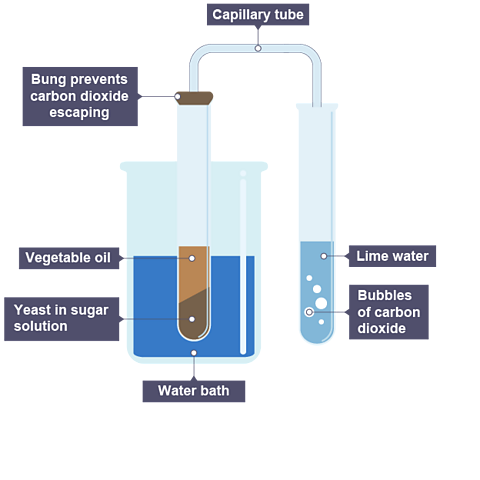
- Mix yeast, glucose and water; leave for 30 minutes at 20°C
- Place 20 ml of yeast solution in a boiling tube
- Attach a bung with a delivery tube into water
- Place the boiling tube in a water bath at 20°C
- After 5 minutes, count the bubbles produced for 1 minute
- Repeat steps 2-5 at different temperatures (eg 30°C, 40°C, 50°C, 60°C)
- Record the results in a table
Results
| Temperature / °C | Number of bubbles |
|---|---|
| 20 | 4 |
| 30 | 8 |
| 40 | 20 |
| 50 | 2 |
| 60 | 0 |
Conclusion:
The higher the temperature, the faster the rate of respiration due to increased kinetic energy. The optimum temperature was 40°C, where the most bubbles of carbon dioxide were produced. Above 50°C, enzymes become denatured, or the yeast is killed.
Independent variable : temperature / °C
Dependent variable: number of bubbles (rate of respiration)
Controlled variables: volume and concentration of yeast solution, time
Further factors to investigate: different sugars
- Follow steps 1-5 from the previous experiment, using different sugars (eg, sucrose, fructose, lactose, maltose) or varying amounts (1g, 2g, 3g, 4g, 5g).
Ensuring anaerobic respiration
- Boil the glucose solution to sterilise and remove oxygen.
- Cool it before adding the yeast (high temperatures will kill it).
- Add a layer of oil on top to prevent oxygen entry.
Test your knowledge
More on Living processes
Find out more by working through a topic
- count5 of 5
- count1 of 5
- count2 of 5
- count3 of 5