What are the body's communication systems?
The human body has two communication systems that help us to respond to changes:
- nervous system
- hormonal system
Comparisons
They both:
send messages around our body
enable the body to respond to stimuli
Differences
| Nervous system | Hormonal system | |
|---|---|---|
| Speed | fast | slow |
| Nature of response | electrical impulses | hormones / chemicals |
| Pathway | travels by neurone | travels in blood |
| Target | effector - muscle or gland | organ |
| Type of response | involuntary or voluntary | always involuntary |
The nervous system
The brain and The part of central nervous system of a mammal which runs inside its backbone form the central nervous system (CNS).
The CNS controls and coordinates responses between Organ, tissue or cell that detects a stimulus. and The organ, tissue or cell that produces a response..
Stimuli are changes in our environment that we respond to and are detected by receptors.
Receptors are sensitive to different stimuli (eg receptors in the eye are sensitive to light).
Sensory neurones (a nerve cell) carry nerve impulses from receptors to the coordinator.
The coordinator (brain or spinal cord) determines whether or not to respond to the stimulus.
Motor neurones then transmit electrical impulses from the The central nervous system, it determines the correct response to a stimulus. to an effector.
Effector (muscle or gland) produces a response.
| Sense organ | Receptor | Stimuli detected |
|---|---|---|
| eye | light receptors | light |
| ear | sound receptors | sound |
| nose | chemical receptors | chemicals (smell) |
| tongue | chemical receptors | chemicals (taste) |
| skin | thermoreceptors | temperature (hot/cold) |
| skin | pressure receptors | touch and pain |
Neurones and synapses
Organ, tissue or cell that detects a stimulus. and The organ, tissue or cell that produces a response. are connected to the The part of the nervous system made up of the brain and spinal cord. by Nerve cells. They carry an electrical message or impulse when stimulated..
Neurones To cause something to pass from one area to another. electrical impulses across the nervous system quickly.
A synapse is the gap between two neurones.
• When an impulse reaches the end of the axon, a chemical transmitter is released.
• This chemical The random movement of a substance from a region of high concentration to a region of low concentration. across the gap.
• When in high enough concentration it triggers an electrical impulse in the next neurone, allowing the signal to continue.
It functions as a junction because it links two neurones, allowing messages to pass between them and it also controls the direction of messages.
• When an impulse reaches the end of the axon, a transmitter chemical is released.
• This chemical The random movement of a substance from a region of high concentration to a region of low concentration. across the gap.
• When in high enough concentration it triggers an electrical impulse in the next neurone, allowing the signal to continue.
Reflex Actions
Voluntary actions require conscious thought and take more time due to thinking.
Reflex actions happen quickly without thinking, protecting the body from harm, for example, pulling your hand away from a hot surface.
Reflex arc (Higher tier only)
A reflex action is fast because it follows a short pathway with only three neurones and two synapses:
• A receptor detects stimuli in the environment and produces nerve impulses.
• Sensory neurone: carries impulse from the receptor to the spinal cord (coordinator).
• Association or relay neurone: connects the sensory neurone to the motor neurone.
• Motor neurone: sends impulses from the spinal cord to an effector (muscle or gland) to cause a response.
What are hormones?
Hormones are chemical messengers.
They are:
- released by glands
- travel in the blood
- carried to target organ or organs
Compared to the nervous system, hormones are much slower and act over a longer period – sex hormones such as testosterone and oestrogen act over years.
Hormones play an important role in maintaining a constant state within the internal environment of the body in response to changes both inside and out.
This is known as homeostasis and is necessary for the proper functioning of cells and enzymes.
Two examples of hormones in the homeostatic role:
- Insulin – controlling blood glucose concentrations
- ADH – controlling the water content of the body, referred to as osmoregulation
Insulin and blood glucose
Cells need glucose to release energy by respiration.
Too much or little glucose in the blood can be fatal.
The pancreas constantly monitors blood glucose levels and controls them using insulin.
How insulin works
After eating a meal, blood glucose levels increase.
Pancreas monitors blood glucose concentration.
Pancreas produces insulin in response to increasing blood glucose concentration.
Insulin causes the liver to reduce blood glucose concentration by:
- increasing glucose absorption from the blood by the liver and muscles
- respiring the absorbed glucose
- converting excess glucose to glycogen which is stored in the liver and muscles
Diabetes
Diabetes is a disorder where the body can't control its glucose concentration.
Glucose is the main energy source for all the cells of the body, so it's kind of important to keep its concentration right.
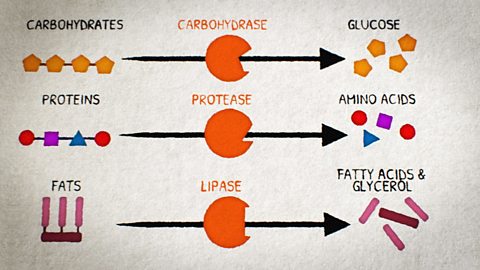
It's produced from the digestion of carbohydrates, so every time you eat something, it's absorbed into the bloodstream.
The blood is always carrying glucose, so it's available for cells as and when they need it.
The amount of glucose going into your body, and the amount you’re using changes through the day.
So the concentration of glucose -or blood sugar - changes all the time.
But if the concentration gets too high the glucose becomes dangerous and starts damaging cells, tissues and organs.
And if it gets too low your cells can't function properly.
So there has to be a glucose control system, and that's where insulin comes in.
Insulin is a protein hormone made in the pancreas and carried around the body in the blood.
The pancreas cells are sensitive to the blood sugar concentration, so as soon as it starts rising they release more insulin into the blood.
That Insulin acts like a switch, allowing cells to absorb more glucose.
The Insulin also affects your liver cells.
Liver cells convert excess soluble glucose to an insoluble carbohydrate called glycogen which is stored in the liver and the muscles.
That’s what happens when the blood glucose concentration rises, so what about when it drops?
Well, your pancreas releases less insulin, and your liver and muscle cells remove less glucose from the blood.
Glycogen may be converted back into glucose within the liver cells, and released into your blood.
Or Glycogen can also be converted back into glucose in your muscle cells they use it themselves.
So, the body's always maintaining a delicate balance, keeping glucose levels in a safe range and if that balance goes wrong, that's diabetes.
There are two types of diabetes, and they're called…'type 1'… and… 'type 2'. It's really original, right?
The symptoms are similar, but the causes are different.
Type 1 diabetes is when the body's immune system attacks the pancreas, destroying the cells which produce insulin.
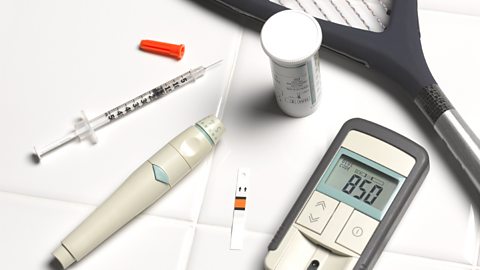
If someone has type 1 diabetes they have to inject themselves with insulin, to replace the insulin that their body can't make.
And if it is untreated, the blood glucose levels just keep rising.
They have to monitor their blood glucose concentration regularly be aware of what and how much they've eaten, and how much exercise they've done.
Type 1 affects a relatively small percentage of the population, often young people and researchers don't yet fully understand the causes.
Type 2 diabetes is much more common.
It's caused by the effects of cells in the body becoming resistant to insulin so much so that the pancreas can't compensate, however much insulin it takes.
Someone is more likely to develop type 2 if other members of their family have it.
Other factors increase the risk too though such as age, and there's also weight: 80 to 85% of people with type 2 are obese.
A lack of exercise and an unhealthy diet are therefore major risk factors.
The good news on that is that by losing weight, eating carefully and exercising, many people can completely reverse the problem.
In the most severe cases Insulin injections are needed.
Understanding diabetes really is important, because the numbers of people affected by it are rising at an alarming rate.
But hopefully if we encourage people to eat well and exercise more, we can get it under control.
Diabetes occurs when someone cannot control their blood glucose levels.
This happens because they either don’t produce enough insulin or none at all.
Symptoms:
glucose in the urine – blood glucose concentration is so high that some is filtered out by the kidneys and passed into the urine
high blood glucose levels
being thirsty
the need to go to the toilet a lot
lethargy – feeling tired / having low energy
What are the differences between Type 1 and Type 2 diabetes?
| Type 1 diabetes | Type 2 diabetes | |
|---|---|---|
| Develops | develops usually early in life | in people over 40 (a progressive disease linked to poor diet/lack of exercise/obesity) |
| Effect | pancreas stops producing insulin | pancreas gradually produces less insulin |
| Treatment | insulin injections / diet - reduce carbohydrate intake | diet - reduce carbohydrate intake / increase exercise to lose weight / insulin injections |
| Future | developing nasal insulin | rising Type 2 diabetes cases due to obesity - becoming more common in young people |
What are the long term effects of diabetes?
eye damage/blindness
heart disease
stroke
kidney damage
These complications are due to high blood glucose concentrations damaging the capillaries that supply that part of the body.
Why is the number of people with Type 2 diabetes increasing?
- Obesity: poor diet and less exercise lead to weight gain, which raises the risk of Type 2 diabetes.
- Aging population: older people are more likely to develop Type 2 diabetes.
- Less activity: modern, less active lifestyles contribute to the problem.
- Better diagnosis: better awareness and improved medical testing so more people are being diagnosed.
- Genetics predisposition: family history makes some people more likely to get Type 2 diabetes.
Osmoregulation
Osmoregulation controls water levels in the body. Poor control can damage cells.
The kidneys are essential for maintaining this water balance.
Water is gained and lost from the body in the following ways:
| Gain water | Lose water |
|---|---|
| Drinking | Evaporation in lungs |
| Eating | Evaporation of sweat by skin |
| Respiration | Production of urine by kidney |
In normal conditions, the amount of water gained balances with the amount lost.
If conditions change, osmoregulation brings the volumes back into balance.
| Change in conditions | Body water levels | Osmoregulation | Effect |
|---|---|---|---|
| Hot weather or exercise | Lose more water as sweat | Kidney produces small volume of concentrated urine. Makes us thirsty so drink more | Less water is lost; Water levels increase |
| Drink more than normal | Gain more water | Kidney produces large volume of dilute urine | More water is lost; Water levels decrease |
Hormones and the excretory system
The function of the kidneys:
remove waste from the body
osmoregulation (water balance)
How the kidney works
Blood enters kidney via the renal artery
The kidneys filter waste from the blood and removes excess water forming urine
Urine passes into the ureter
Urine is stored in the bladder
Urine is passed out the body via the urethra.
ADH – anti-diuretic hormone (Higher tier)
When the brain detects lower than normal water levels in the blood, antidiuretic hormone (ADH) is produced. It travels in the blood to its target organ – the kidneys.
It causes the kidney to reabsorb more water. This produces a lower volume of more concentrated urine and returns blood water levels to normal.
When the brain detects higher than normal water levels in the blood (eg from drinking more than normal), less or no ADH is produced. Less water is reabsorbed back into the blood by the kidneys.
This produces a larger volume of dilute urine and returns blood water levels to normal.
Plant hormones
Plant growth and development is controlled by plant hormones.
Auxin is a plant hormone that cause shoots to grow towards light. This is known as phototropism.
Phototropism
Plant responds to unidirectional light (eg plant on a windowsill)
Plant shoot bends towards light
Advantage of this response: - more light – more photosynthesis - more growth
How does a shoot bend towards unidirectional light?
Test your knowledge
More on Living processes
Find out more by working through a topic
- count1 of 5

- count2 of 5

- count3 of 5