What are enzymes?
Enzymes are proteins that act as biological catalysts.
They speed up the rate of reactions without being used up.
Enzyme action
Each enzyme has an Region of an enzyme where the substrate attaches., which is where the reaction takes place.
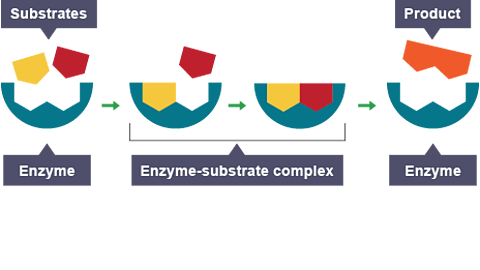
The lock and key model explains how enzymes work:
The enzyme is like a "lock".
The substrate (the molecule it reacts with) is like a "key" that fits into the lock.
Key facts about enzymes
An enzyme’s active site and its substrate are complementary in shape
Enzymes and substrates collide to form enzyme-substrate complexes
The substrates are broken down or built up quickly
The products are released
The enzyme can be used over again
Enzyme specifity
Each enzyme is specific and acts on only one substrate to catalyse one reaction.
The active site has a specific shape that is complementary to the shape of its substrate, allowing them to fit together like a lock and key, meaning each enzyme works with only one specific substrate.
Inhibitors (higher tier only)
Inhibitors are molecules that fit into an enzyme’s active site but are not broken down.
They stop the substrate from fitting into the action and prevent enzyme-substrate complexes forming so reduce the rate of reaction.
How does temperature affect enzyme activity?
As temperature increases the rate of enzyme activity increases, up to the The temperature, pH or enzyme concentration that allows the enzyme to work at its best. temperature, as more Energy which an object possesses by being in motion. causes more collisions between the enzyme and A substance on which enzymes act. forming more enzyme-substrate complexes.
Above the optimum temperature the enzyme’s Region of an enzyme where the substrate attaches. becomes When an enzyme’s active site loses its shape meaning it can no longer work..
This means the active site changes shape and can no longer form enzyme-substrate complexes, leading to a decrease in enzyme activity.
Denaturation is a permanent change.
How does pH affect enzyme activity?
pH
Deviating from the optimum Scale of acidity or alkalinity. A pH (power of hydrogen) value below 7 is acidic, a pH value above 7 is alkaline. (too high or too low) causes the enzyme’s active site to become denatured and the active site changes shape.
It can no longer form enzyme-substrate complexes, leading to a decrease in enzyme activity.
Enzyme concentration
As the enzyme concentration increases, the rate of enzyme activity increases because there are more enzymes to form enzyme-substrate complexes.
This happens up to a certain point. Enzyme activity then levels off (plateaus) as there are not enough substrate molecules to react with the extra enzymes.
Optimum
The The temperature, pH or enzyme concentration that allows the enzyme to work at its best. value is the level at which the reaction rate is at its maximum, ie, fastest.
Practical B3 - Effect of temperature on the action of an enzyme
Procedure:
Add 20ml of hydrogen peroxide (H₂O₂) to each test tube
Place each test tube in a water bath set at different temperatures (eg 10°C, 20°C, 30°C, 40°C, 50°C)
Add 2g of raw potato (which contains catalase enzyme) to each test tube
Measure the volume of oxygen gas produced using a gas syringe for 1 minute
Record results
Results
| Temperature / °C | Volume of oxygen gas produced / ml |
|---|---|
| 10 | 5 |
| 20 | 10 |
| 30 | 25 |
| 40 | 35 |
| 50 | 0 |
Conclusion
As the temperature increases, the rate of enzyme activity increases, up to 40°C, which is the optimum temperature for the enzyme. Beyond 40°C, the enzyme becomes denatured.
Independent variable: temperature / °C
Dependent variable: volume of oxygen gas produced / ml
Control variables:
- same volume and concentration of hydrogen peroxide
- same mass of potato (enzyme)
- collect gas for same time
What are the commercial and economic uses of enzymes?
Enzymes are used in biological washing powders to break down stains.
- Protease breaks down proteins (eg blood, egg stains).
- Lipase breaks down fats and oils (eg grease stains).
- Amylase breaks down starches (eg food stains).
Advantages:
- work quickly at lower temperatures, saving energy and money
Disadvantages:
- enzymes are denatured at temperatures above 40°C
- some people may be allergic to enzymes, leading to skin irritation
How much do you know about enzymes?
Digestive system activity
Play this game to explore how food is processed by the human body.
More on Living processes
Find out more by working through a topic
- count5 of 5

- count1 of 5

- count2 of 5