Key facts on reproduction, fertility and contraception
Sexual reproduction involves the fusion of a sperm and egg cell to form a diploid zygote that develops into a new individual.
The menstrual cycle, controlled by oestrogen and progesterone, prepares the uterus for pregnancy and includes ovulation around day 14.
After fertilisation in the oviduct, the embryo implants in the uterus and develops into a foetus, supported by structures like the placenta and umbilical cord.
Contraceptive methods can prevent pregnancy by stopping ovulation, fertilisation or implantation, and vary in reliability and protection against STIs.
Sexual reproduction
Sexual reproduction involves the joining of two sex cells (gametes) – the sperm (male gamete) and the egg/ovum (female gamete) to make a baby.
The male reproductive system
The male The organs and tissues involved in producing offspring. makes The male sex cell or gamete. and delivers it into the female reproductive system.
The female reproductive system
The female reproductive system makes and releases eggs/ova.
It also protects and nourishes the foetus from fertilisation until birth.
The menstrual cycle
Watch: Explaining the menstrual cycle
The menstrual cycle happens every month when the female body gets ready for a potential pregnancy.
It starts with menstruation, or a monthly period. The uterus, or womb, sheds its lining through the vagina as blood. This means that no fertilisation has taken place, so a new cycle begins.
Now, immature eggs, or ova, in the ovaries develop into mature eggs. The hormone oestrogen is made and released by the ovaries. It thickens the uterus lining ready for a possible fertilised egg and pregnancy.
On day 14, ovulation occurs. A mature egg is released from the ovary. It travels down the fallopian tube, or oviduct. This is the most fertile period of the cycle. If sperm is present in the oviduct, fertilisation can occur up to two to three days after ovulation.
From day 15, the hormone progesterone is released from the ovary. It maintains the thickness of the womb lining. This means that, if fertilisation takes place, the uterus is ready for the fertilised egg to embed itself and grow into an embryo.
If fertilisation doesn’t happen, the egg breaks down. This leads to a drop in oestrogen and progesterone levels. The body sheds the lining of the uterus and the cycle begins again.
Oestrogen and progesterone control the menstrual cycle. When levels are high, the womb lining thickens ready for fertilisation. When the levels drop, the uterus lining thins, ready to start a new cycle.
The menstrual cycle prepares the female reproductive system for pregnancy and it occurs from The physical changes a child’s body goes through when developing into an adult. until approximately age 50.
It is controlled by the hormones A female sex hormone produced in the ovaries, which is responsible for puberty in girls and the regulation of the menstrual cycle. and Sex hormone produced by the ovaries and placenta..
A 28 day cycle:
Days 1-5
Menstruation occurs – theAlso known as a womb. This is where the fertilised egg (ovum) develops. lining breaks down and is released through the A muscular tube that leads from the cervix to the outside of a woman's body..
Oestrogen levels are low.
Progesterone levels are low.
Days 6-13
- Oestrogen increases causing the initial repair of the uterus lining and its buildup.
Day 14
- The egg is released and this is called ovulation. It happens after oestrogen levels peak.
Days 15-28
Progesterone levels peak after ovulation to maintain the thick uterus lining.
If no pregnancy occurs, hormone levels decrease and the cycle restarts.
A woman can get pregnant if The male sex cell or gamete. are present in the oviduct a few days before or after ovulation (day 14), if it fertilises an egg.
Fertilisation and pregnancy
Fertilisation occurs in the A tube in the female reproductive organ through which an egg passes from an ovary to the uterus..
Fertilisation is the fusion of a haploid sperm nucleus and a haploid egg nucleus to form a diploid (normal chromosome number) zygote.
A zygote is the first cell of a new individual.
The sperm and egg cells are haploid, meaning they contain half the normal number of chromosomes.
When they fuse at fertilisation, the zygote is diploid, meaning it has a full set of chromosomes.
Fertilisation restores the diploid number of chromosomes.
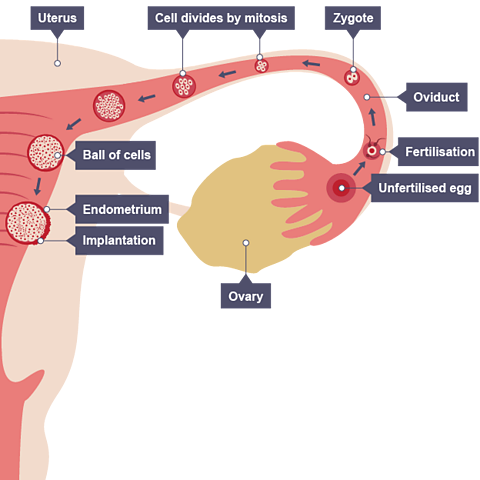
After fertilisation:
The zygote travels down the oviduct dividing by A type of cell division that produces cells that are genetically identical to the parent cell and to each other. to form a ball of cells (An organism in the early stages of development.).
Implantation occurs when the embryo reaches the Also known as a womb. This is where the fertilised egg (ovum) develops. and attaches to its thick lining to receive nourishment.
The The organ in the uterus of pregnant mammals that allows the transfer of nutrients and waste products between the mother and the foetus through the umbilical cord., The cord that connects the foetus to the placenta. It contains blood vessels., Bag surrounding the foetus in the uterus and containing the amniotic fluid. and The fluid surrounding a foetus that cushions it. form.
The embryo differentiates to produce a variety of tissues and organs.
The embryo is referred to as a foetus when all its organs start to form.
Placenta and umbilical cord
The placenta allows substances to diffuse from the mother’s blood to the foetus (eg oxygen and glucose).
Waste substances diffuse from the foetus to the mother’s blood (eg carbon dioxide and A nitrogenous waste product resulting from the breakdown of proteins. It is excreted in urine.).
The umbilical cord attaches the placenta to the foetus.
The umbilical cord carries urea and carbon dioxide from the foetus to the mother’s blood.
The umbilical cord carries oxygen and dissolved nutrients from the mother’s blood to the foetus.
Amnion and amniotic fluid
The amnion is a membrane that forms around the embryo.
Amniotic fluid surrounds the embryo inside the amnion, cushioning and protecting the developing embryo.
Care during pregnancy
It has been proven that drinking alcohol during pregnancy can cause harm to the baby.
It can cause a condition called Foetal Alcohol Syndrome.
Contraception
There are mechanical, chemical, surgical and natural contraceptive methods used to prevent a pregnancy.
Mechanical
| Example | Method | Advantage | Disadvantage |
|---|---|---|---|
| Male condom | A barrier that prevents sperm entering the vagina | Easily obtained. Protects against STIs (eg HIV) | Unreliable if not used properly. |
| Female condom | A barrier that prevents sperm passing up the female reproductive system | Protects against STIs (eg HIV) | Unreliable if not used properly |
Chemical
| Example | Method | Advantage | Disadvantage |
|---|---|---|---|
| Contraceptive pill | Taken regularly by a woman. Prevents ovulation by changing hormone levels. | Very reliable. | Essential to remember to take the pill. Side effects include weight gain, mood swings or an increased risk of blood clots. Does not protect against STIs. |
| Contraceptive implant | A small tube placed under the skin of the upper arm. Releases hormones slowly over a long period of time. Prevents ovulation. | Very reliable. Can work for up to three years. | Does not protect against STIs. Can prevent menstruation. |
Surgical
| Example | Method | Advantage | Disadvantage |
|---|---|---|---|
| Vasectomy | Sperm tubes are cut preventing sperm entering the penis. | Virtually 100% reliable. | Difficult or impossible to reverse. |
| Female sterilisation | Oviducts are cut preventing fertilisation. | Virtually 100% reliable. | Difficult or impossible to reverse. |
Natural
| Example | Method | Advantage | Disadvantage |
|---|---|---|---|
| Rhythm method | Sexual intercourse is avoided around the time of ovulation. | No chemicals are used. | Not as reliable as other methods, especially if the menstrual cycle is irregular. |
The natural method is chosen by some groups opposed to contraception for religious or ethical reasons.
Test your knowledge!
More on Body systems
Find out more by working through a topic
- count1 of 2