What are the key learning points about acids, bases and salts?
Indicators are chemicals that can change colour to identify acidic, alkaline and neutral solutions.
Universal indicator can determine the strength of an acidic or alkaline solution.
Acids and alkalis can be strong or weak depending on how much they To ionise is to convert an uncharged atom into a charged particle by adding or removing electrons. in water.
Acids can react with metals, metal carbonates, metal hydrogencarbonates, bases (metal oxides/hydroxides) and ammonia.
Practical methods can be used to prepare pure salts from acids.
How to work with acids and alkalis safely
You should always take care in the laboratory when using chemicals, but strong acids and alkalis are particularly dangerous.
Hazard symbols
Take care with chemicals carrying international chemical hazard labelling.
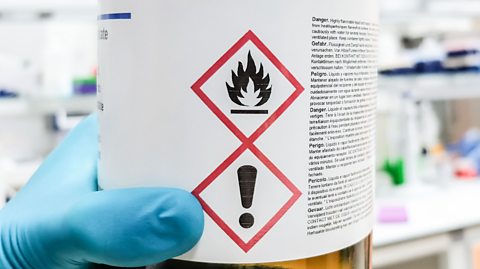
Hazard symbols are better than using words because they are:
internationally recognised (understood in all languages);
eye-catching;
useful for people who are unable to read.
Test your knowledge
What is an indicator?
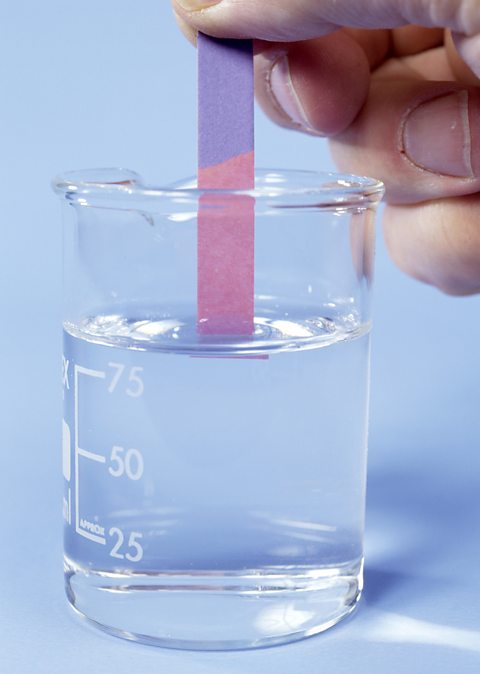
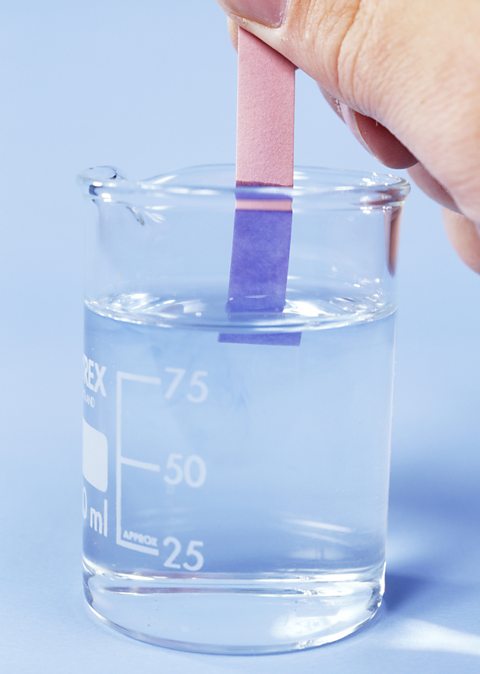
An indicator is a chemical that changes colour in When an acid is dissolved in water it makes an acidic solution., When a base dissolves in water it is an alkali and makes an alkaline solution which has a pH higher than 7. and If a solution is neither acidic nor alkaline it is neutral. Neutral solutions have a pH of 7. solutions.
Some common indicators include red litmus paper, blue litmus paper and universal indicator.
| Indicator | Acidic solution | Neutral solution | Alkaline solution |
|---|---|---|---|
| Red litmus paper | red | red | blue |
| Blue litmus paper | red | blue | blue |
These indicators allow you to easily work out if a substance is an Corrosive substance which has a pH lower than 7. Acidity is caused by a high concentration of hydrogen ions. or an A base which is soluble in water. A base is a substance which neutralises an acid. .
However, none of these indicators tell you about the strength of an acid or alkali.
How to make an indicator from plants
Indicators can be made from plants such as beetroot or red cabbage.
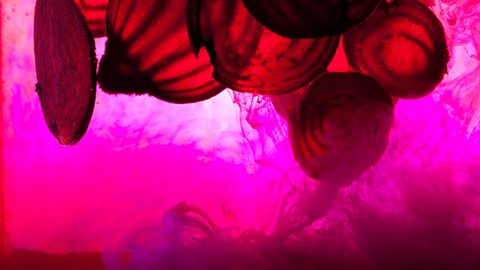
How to make an indicator from beetroot
The steps to make an indicator from beetroot are:
- Chop or crush the beetroot.
- Place the beetroot into a beaker and add water.
- Boil the mixture gently to remove the colour from the beetroot.
- Allow the solution to cool and filter off the beetroot and discard it.
- The filtrate (liquid) can now be used as an indicator.
What is the pH scale?
The pH scale gives a measure of the strength of an acidic or alkaline solution.
The range for the pH scale is 0 (strong acid) to 14 (strong alkali).
- pH 0 – 2: Strong acid (for example hydrochloric acid or sulfuric acid).
- pH 3 – 6: Weak acid (for example ethanoic acid - which is vinegar).
- pH 7: Neutral (for example, water).
- pH 8 – 11: Weak alkali (for example ammonia).
- pH 12 – 14: Strong alkali (for example sodium hydroxide or potassium hydroxide).
Universal indicator solution or paper turns a range of colours, depending on the strength of the acid or alkali.
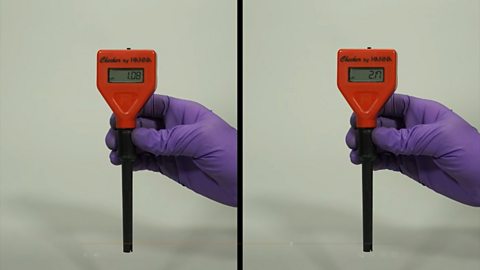
Scale of acidity or alkalinity. A pH (power of hydrogen) value below 7 is acidic, a pH value above 7 is alkaline. Neutral solutions have a pH of 7. can be accurately measured using a pH meter or pH probe.
This is an electronic device that can measure the pH of a solution to at least one decimal place.
Test your knowledge
What is an acid?
An acid is a substance that dissolves in water to produce hydrogen Electrically charged particle, formed when an atom gains or loses electrons..
Acids can be strong or weak
Strong acids include:
hydrochloric acid (HCl)
sulfuric acid (H2SO4)
Weak acids include:
- ethanoic acid (CH3COOH)
What are alkalis and bases?
A base is a metal oxide or metal hydroxide that neutralises an acid to produce a salt and water.
An alkali is a A solid is soluble if it can dissolve into a specific solvent. For example, salt and sugar are both soluble in water. base.
Strong alkalis include:
- sodium hydroxide (NaOH)
- potassium hydroxide (KOH)
Weak alkalis include:
- Ammonia (NH3)
What happens when an acid causes a reaction?
Acids can react with bases, metals, metal carbonates and metal hydrogencarbonates.
Reaction observations
Some general observations can be made during acid reactions:
- if a gas is produced, the observation is ‘bubbles’;
- if a solid such as a solid metal, base, carbonate or hydrogencarbonate reacts with the acid then the observation is ‘solid disappears and a solution is produced’;
- most acid reactions are exothermic – the observation is ‘heat released’. The exception is sodium hydrogencarbonate with acid.
What is a neutralisation reaction?
A neutralisation reaction is a reaction between an acid and a base producing a salt and water.
Neutralisation is an exothermic reaction – one in which heat is given out.
The maximum temperature is reached when the acid solution is completely neutralised by the alkali.
How to work out the name of the salt produced during a reaction
When an acid reacts it is converted into a salt.
You need to be able to work out the name (and formula for higher tier only) of a salt produced in a reaction.
Salts are A substance formed when two or more elements are chemically combined. composed of two parts.
The first word in a salt name is always the name of the metal in the equation.
The second word in a salt name comes from the acid in the equation:
| Acid name | Salt name |
|---|---|
| Hydrochloric acid | Chloride |
| Sulfuric acid | Sulfate |
For example, the salt produced in the reaction of sodium hydroxide with hydrochloric acid is sodium chloride.
Question
Name the salt produced when potassium hydroxide reacts with sulfuric acid.
Answer
Potassium sulfate.
Potassium is the metal involved in the reaction and sulfate comes from the sulfuric acid used.
Prescribed practical C3: Temperature changes during a reaction
Please use the link below to access the article on: Prescribed practical (C3) - Temperature changes during a reaction
How do acids react with metals?
Acids react with metals to produce a salt and hydrogen.
acid + metal → salt + hydrogen
Example:
hydrochloric acid + magnesium → magnesium chloride + hydrogen
2HCl(aq) + Mg(s) → MgCl2(aq) + H2(g)
Observations: grey solid magnesium disappears, colourless solution produced, heat released, bubbles.
The hydrogen in these reactions can be tested.
The test for hydrogen is:
- apply a lighted splint,
- a popping sound results.
How do acids react with bases?
Acids react with bases to form a salt and water.
acid + base → salt + water
Example
sulfuric acid + copper(II) oxide → copper(II) sulfate + water
H2SO4(aq) + CuO(s) → CuSO4(aq) + H2O(l)
Observations: black solid copper(II) oxide disappears, blue solution produced.
How do acids react with carbonates and hydrogencarbonates?
Acids react with metal carbonates and metal hydrogencarbonates in the same way.
These reactions produce a salt, water and carbon dioxide.
acid + metal carbonate → salt + water + carbon dioxide
or
acid + metal hydrogencarbonate → salt + water + carbon dioxide
Example - carbonate
hydrochloric acid + copper(II) carbonate → copper(II) chloride + water + carbon dioxide
2HCl(aq) + CuCO3(s) → CuCl2(aq) + H2O(l) + CO2(g)
Observations: green solid copper(II) carbonate disappears, blue solution produced, heat released, bubbles.
Example - hydrogencarbonate
hydrochloric acid + sodium hydrogencarbonate → sodium chloride + water + carbon dioxide
HCl(aq) + NaHCO3 (s) → NaCl(aq) + H2O(l) + CO2(g)
Observations: white solid sodium hydrogencarbonate disappears, colourless solution produced, bubbles.
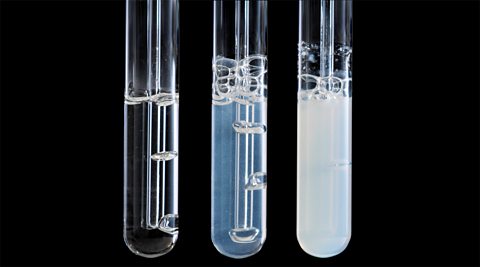
The carbon dioxide gas produced in these reactions can be tested.
The test for carbon dioxide is:
- bubble gas into colourless limewater (calcium hydroxide solution),
- the solution will change from colourless to milky if the gas is carbon dioxide.
What are everyday examples of neutralisation?
How to treat indigestion
Your stomach contains hydrochloric acid to help prevent infection and digest food.
Sometimes there can be too much acid in your stomach, this is called indigestion.
Indigestion medicines contain an alkali that helps to neutralise the excess acid.
For example, Milk of Magnesia contains magnesium hydroxide.
Magnesium hydroxide reacts with hydrochloric acid to produce magnesium chloride and water.
What happens when we use toothpaste?
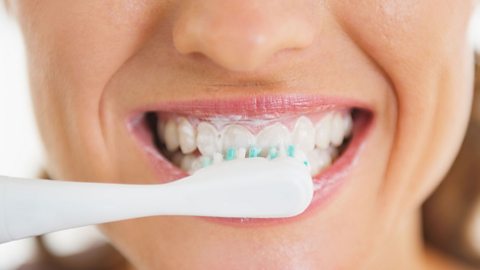
Bacteria in our mouths break down sugar in food, this produces acid.
Many foods we eat contain weak acids.
If the pH of the mouth is 5.5 then tooth decay can happen.
Toothpaste contains an alkali such as sodium hydrogencarbonate, which can neutralise the acid and help prevent tooth decay.