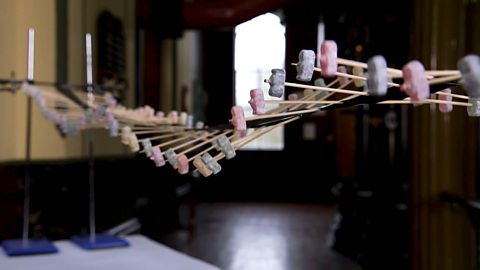
What are the key learning points about the features of waves?
To identify the different parts of a wave.
To be able to understand the different graphs used for waves.
What are the main features of a wave?
What is amplitude?
The amplitude of a wave is its maximum displacement from its undisturbed position.
Key fact
It is important to note that the amplitude is not the distance between the top and bottom of a wave.
What is wavelength λ?
The wavelength of a wave is the distance between a point on one wave and the same point on the next wave.
It is often easiest to measure this from the The bottommost point of a wave. of one wave to the trough of the next wave, or from the The topmost part of a wave. of one wave to the crest of the next wave.
But it doesn't matter where you measure it - as long as it is the same point on each wave.
The symbol for wavelength is the Greek letter lambda, λ.
Wavelength is a distance so it is measured in m.
What is frequency f?
The frequency of a wave is the number of waves that pass a point in one second.
The unit of frequency is the hertz (Hz).
It is common for kilohertz (kHz) to be used when waves have very high frequencies.
For example:
- Most people cannot hear a high-pitched sound above 20 kHz, (20,000 Hz).
Remember:
- kilo (thousand) k = 1x10³ (1,000)
The frequency of a wave can be calculated using the equation:
\(\text{frequency f =}~\frac{\text{number of waves to pass a point}}{\text{time taken in seconds}}\)
Example
6 waves pass a boat on the sea in 10 seconds.
What is the frequency of the waves?
Answer
\(\text{frequency f =}~\frac{\text{number of waves to pass a point}}{\text{time taken in seconds}}\)
\(\text{frequency f =}~\frac{\text{6}}{\text{10}}\)
\(\text{frequency f =}{\text{~0.6~Hz}}\)
The frequency of the waves is 0.6 Hz.
How are waves measured?
What is period T?
The period of a wave is the time taken for one wave to be produced or the time for one complete vibration.
It is also the time taken for one wave to pass a point.
Period is a time and so it is measured in seconds.
What is the relationship between the frequency and period of a wave?
The frequency of a wave can also be calculated using this equation:
\(\text{frequency =}~\frac{\text{1}}{\text{period}}\)
\(\text{f =}~\frac{\text{1}}{\text{T}}\)
where:
f = frequency = number of waves produced by a source per second, in hertz, Hz.
T = period = time it takes for one complete vibration in seconds, s.
Example
A sound wave has a period of 0.01 seconds.
What is its frequency?
Answer
\(\text{f =}~\frac{\text{1}}{\text{T}}\)
\(\text{f =}~\frac{\text{1}}{\text{0.01}}\)
\(\text{f = 100 Hz}\)
The frequency of the sound wave is 100 Hz.
Question
A sound wave has a frequency of 3 kHz.
What is its period?
Answer
\(\text{T=}~\frac{\text{1}}{\text{f}}\)
f = 3 kHz = 3000 Hz
\(\text{T=}~\frac{\text{1}}{\text{3000}}\)
\(\text{T = 0.00033 s}\)
This can also be written as T = 0.33 x 10-3 = 0.33 ms (milliseconds).
The period of the sound wave is 0.33 ms.
What are the different wave graphs?
You need to know about two types of graph that can be used to represent waves:
- Displacement-distance graphs.
- Displacement-time graphs.
What is a displacement-distance graph?
A displacement-distance graph is a snapshot of the wave at one particular time.
The graph can be used to work out the wavelength, λ , of the wave.
The wavelength of this wave = 40 cm.
You can also tell from the graph that:
- There are two complete waves.
- The amplitude of the waves = 10 cm.
What is a displacement-time graph for waves?
A displacement-time graph shows how the displacement of one point on the wave varies over time.
The x-axis of the graph is time, and so it is used to work out the period of the wave.
Example
Calculate the period and frequency of the waves shown in the diagram.
Answer
The time for one complete wave = 0.1 s and so the period, T = 0.1 s.
\(\text{f =}~\frac{\text{1}}{\text{T}}\)
\(\text{f =}~\frac{\text{1}}{\text{0.1}}\)
\(\text{f =}\text{~10 Hz}\)
The frequency of the wave is 10 Hz.
Key points
- If the x-axis is distance, the graph is used to work out wavelength, λ.
- If the x-axis is time, the graph is used to work out period, T.
- Both graphs can be used to work out the amplitude of the wave.
Question
A graph of displacement against distance for a wave passing through water is given below.
What is the wavelength of the wave?
What is the amplitude of the wave?
1.
Wavelength is the distance covered by one vibration of the wave, usually measured from peak to peak, or trough to trough.
The distance axis is labelled in m, and so the distance between 2 peaks is 8 m.
The wavelength of the wave is 8 m.
2.
Amplitude is the maximum displacement of a point of a wave from its rest position.
The displacement axis is labelled in mm, so the maximum displacement is 2.5 mm.
The amplitude of the wave is 2.5 mm.
What is the wave speed equation?
The speed of a wave is related to its The number of waves produced each second. The unit of frequency is hertz (Hz). and The length of a single wave, measured from one wave peak to the next., according to the equation:
\(wave~speed~(v) = frequency (f) \times wavelength (\lambda)\)
\(v = f~ \lambda\)
where:
v = wave speed in metres per second, m/s
f = frequency in hertz, Hz
\(\lambda\)(lambda) = wavelength in metres, m
All waves, including sound waves and electromagnetic waves, follow this equation.
It should be noted that some particular waves have their own specific speeds:
The speed of light and all of the electromagnetic spectrum in a vacuum is 300,000,000 m/s or 3×10⁸ m/s.
The speed of sound in air is often taken to be 340 m/s, but this can vary depending on temperature and pressure.
Question
What is the speed of a water wave that has a frequency of 0.5 Hz and a wavelength of 3 m?
Answer
v = f λ
f = 0.5 Hz
λ = 3 m
v = 0.5 Hz × 3 m
v = 1.5 m/s
The speed of the wave is 1.5 m/s
Question
A sound wave has a frequency of 10 kHz and a wavelength of 3.4 cm. What is its speed?
Answer
v = f λ
f = 10 kHz = 10,000 Hz
λ = 3.4 cm = \(\frac{\text{3.4}}{\text{100}}\) = 0.034 m
v = 10 000 Hz × 0.034 m
v = 340 m/s
The speed of the wave is 340 m/s.
Question
A radio wave has a frequency of 300 kHz and a speed of 300,000,000 m/s. What is its wavelength?
Answer
v = f λ
v = 300,000,000 m/s
f = 300 kHz = 300 x 103 = 3 x 10⁶ Hz
300,000,000 m/s = 3 x 10⁶ Hz x λ
λ = \(\frac{\text{300,000,000}}{\text{3 x 10}^6}\)
λ = 100 m
The wavelength of the radio wave is 100 m.
Question
A boat at sea bobs up and down as waves pass. The vertical distance between a crest and a trough is 52 cm and 20 waves pass the boat in 30 seconds.
- What is the amplitude of the waves?
- What is the frequency of the waves?
Answer
- The amplitude of a wave is the maximum displacement of a point of a wave from its rest position. This is exactly half the distance between a crest and trough.
The distance between a crest and trough = 52 cm.
\(\text{amplitude =}~\frac{\text{distance between a crest and trough}}{\text{2}}\) = \(\frac{\text{52 cm}}{\text{2}}\) = 26 cm.
The amplitude of the wave is 26 cm.
- \(\text{frequency f =}~\frac{\text{number of waves to pass a point}}{\text{time taken in seconds}}\)
number of waves = 20
time taken = 30 s
\(\text{f =}~\frac{\text{20}}{\text{30}}\)
f = 0.67 Hz
The frequency of the waves is 0.67 Hz.
Question
A tuning fork has a frequency of 440 Hz.
- What does a frequency of 440 Hz mean?
- Calculate the period of vibration.
Answer
A frequency of 440 Hz means that the prongs of the tuning fork vibrate 440 times every second.
\(\text{period T =}~\frac{\text{1}}{\text{f}}\)
\(\text{period T =}~\frac{\text{1}}{\text{440 Hz}}\)
T = 0.0023 s = 2.3 x 10⁻³ s or 2.3 ms.
The period of vibration is 0.0023 s.
Key point
There are three equations for calculating frequency:
\(\text{frequency f =}~\frac{\text{number of waves to pass a point}}{\text{time taken in seconds}}\)
\(\text{f =}~\frac{\text{v}}{\text{λ}}\)
\(\text{f =}~\frac{\text{1}}{\text{T}}\)
Use the information given in the question to select the appropriate equation to use.
How much do you know about the features of waves?
More on Waves
Find out more by working through a topic
- count3 of 4

- count4 of 4
- count1 of 4