How is sex determined in humans?
In humans, sex is determined by the sex Genetic structures that usually occur in functional pairs in the nucleus of cells (except in gametes and bacteria)..
Females have two X chromosomes (XX).
Males have one X and one Y chromosome (XY).
Reduction division in a cell in which the chromosome number is halved from diploid to haploid. forms Reduction division in a cell in which the chromosome number is halved from diploid to haploid. gametes (sperm and egg cells).
All eggs contain one X chromosome.
Half of sperm contain one X chromosome and half contain one Y chromosome.
A mother always passes on an X chromosome, while a father can pass either an X or a Y.
During The joining of male and female gametes (sperm and ova or eggs)., there is a 50% chance that a sperm with an X chromosome will fuse with the egg, resulting in a girl (XX), and a 50% chance that a sperm with a Y chromosome will fuse, resulting in a boy (XY).
What are some genetic conditions?
Watch: An explanation of different types of genetic conditions
Genetic conditions are inherited and passed from parent to child.
They are caused by mutations in genes or chromosomes, which can impact how our bodies function.
Cystic fibrosis is a genetic condition, producing a thick mucus which negatively affects the lungs and digestion.
It's caused by a recessive allele.
To inherit the condition, both parents must pass on the faulty recessive allele.
This gives their child a 25% chance of having cystic fibrosis.
There is no cure yet.
Huntington's disease is caused by the presence of one dominant allele.
Parents affected by the gene have a 50% chance of passing the condition on.
If a child inherits one copy of the faulty gene, they will develop the condition.
Huntington's disease impacts the brain, causing progressive degeneration of the nervous system.
Symptoms only show after the age of 40.
By this time, the person may have passed the dominant allele onto their children.
Haemophilia affects the body's ability to make blood clot, leading to excessive bleeding.
It is a sex-linked recessive disorder mainly affecting males.
Haemophilia passes from mother to son because it's caused by a recessive allele on the X chromosome.
Fathers only pass on Y chromosomes to their sons, which don't carry these alleles.
Down syndrome is caused by an extra copy of chromosome 21.
Having an extra copy of a chromosome is known as trisomy.
Down syndrome is not inherited. It is randomly caused during meiosis when the egg is made.
People with Down syndrome have reduced muscle tone and some develop learning delays.
They may also have health issues, like heart defects.
Some genetic conditions are inherited, meaning they are passed from parent to child.
They are caused by mutations, which are random changes in the DNA or the number of Genetic structures that usually occur in functional pairs in the nucleus of cells (except in gametes and bacteria)..
Currently, there are no cures for genetics conditions.
Haemophilia
Haemophilia is a blood disorder where people cannot A clump of platelets and blood cells that forms when a blood vessel is damaged. their blood, leading to excessive bleeding.
It is caused by a An allele that will only show in the phenotype if there is no dominant allele present (i.e. when two recessive alleles are present). allele on the X chromosome, so it is sex-linked.
Sufferers are almost exclusively males because they only have one X chromosome and need just one recessive allele to show the condition.
Only in very rare cases a female will have two recessive alleles and be a sufferer.
Females with one normal and one recessive allele are Someone who does not suffer from a condition but carries the allele and can pass it to his or her offspring.. They do not have Haemophilia symptoms but can pass the recessive allele to half of their children and pass the condition to their sons.
| Genotype | Phenotype |
|---|---|
| XHY | Normal male |
| XhY | Haemophiliac male |
| XHXH | Normal female |
| XHXh | Carrier female |
| XhXh | Haemophiliac female (very rare) |
Alleles:
- H = normal
- h = haemophilia
Example of how it is inherited:
| Parents | Normal Dad | Carrier Mum |
|---|---|---|
| Genotype | XHY | XHXh |
| Gametes: | XH, Y | XH, Xh |
| XH | Xh | |
|---|---|---|
| XH | XHXH | XHXh |
| Y | XHY | XhY |
With these parents there is a 25% chance of producing a sufferer.
Cystic fibrosis
Mainly affects the lungs and digestive system, which become clogged with A sticky substance produced by specialised cells in the body to trap dirt and microbes. leading to frequent infections.
It is caused by a recessive allele, which means only When the two alleles are the same (e.g. BB) recessive individuals (ff) will be affected.
| Genotype | Phenotype |
|---|---|
| FF | Normal |
| Ff | Carrier |
| ff | Sufferer |
Alleles:
- F = normal
- f = cystic fibrosis
Example of how it is inherited:
| Parents | Carrier | Carrier |
|---|---|---|
| Genotype | Ff | Ff |
| Gametes: | F, f | F, f |
| F | f | |
|---|---|---|
| F | FF | Ff |
| f | Ff | ff |
With these parents there is a 25% chance of producing a sufferer.
Huntington's disease
Affects nerve cells in the brain, leading to brain damage.
It is caused by a dominant allele.
It usually becomes apparent after 40 years old by which time the person may have passed the allele onto their children
| Genotype | Phenotype |
|---|---|
| hh | Normal |
| Hh | Carrier |
| HH | Sufferer |
Alleles:
- h = normal
- H = Huntington’s
Example of how it is inherited:
| Parents | Normal | Heterozygous sufferer |
|---|---|---|
| Genotype | hh | Hh |
| Gametes: | h, h | H, h |
| H | h | |
|---|---|---|
| h | Hh | hh |
| h | Hh | hh |
With these parents there is a 50% chance of producing a sufferer.
Down's syndrome
Individuals with Down's syndrome have reduced muscle tone and learning difficulties.
It is caused by an extra chromosome at chromosome 21.
This is not inherited and happens by chance during the formation of egg cells, giving them an extra chromosome (24 total). When fertilised by a sperm cell with 23 chromosomes, this results in a total of 47 chromosomes instead of 46.
Genetic screening
Genetic screening involves testing people or groups of people for the presence of a particular allele or other genetic abnormality.
Pregnant mothers are offered a blood test at 10–14 weeks to assess the risk of having a child with Down's syndrome.
High-risk cases may then be offered amniocentesis, which is more accurate but carries a 1% risk of miscarriage, unlike the safer blood test.
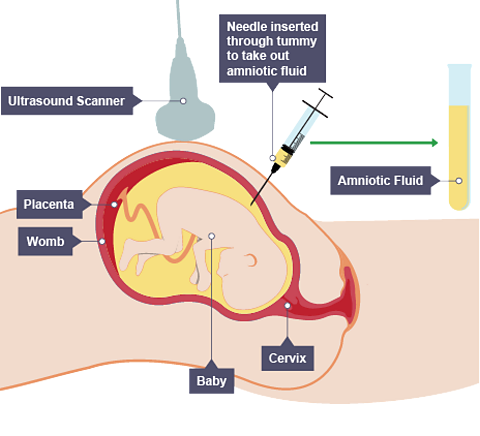
Amniocentesis procedure:
A needle is inserted into the The fluid surrounding a foetus that cushions it. that surrounds the An unborn baby. Usually eight weeks after conception. and fluid is withdrawn.
Chromosomes in foetal cells from the fluid are examined for genetic abnormalities such as Down's syndrome and cystic fibrosis.
Mothers at greater risk include:
Those with a family history of genetic conditions.
Those who previously carried a foetus with a genetic abnormality.
Older mothers.
Those with possible problems identified in earlier tests, such as blood tests.
What are some of the ethical issues from genetic screening?
Parents can be faced with difficult decisions if genetic screening shows their foetus has a genetic condition.
Ethical issues are questions about right, wrong and fairness, especially when decisions affect others' rights, privacy, or well-being.
Ethical questions:
Who decides who will be tested?
People should have the choice to be tested
Decisions for unborn babies are made by parents, is this right?
What are the benefits and risks of amniocentesis and blood tests?
Amniocentesis: more accurate but involves a small risk of miscarriage.
Blood Tests: safer but less accurate, often needing further testing.
What is the dilemma for carriers of genetic conditions?
Parents face emotional challenges and difficult decisions if genetic screening shows their foetus has a genetic condition.
It will allow them to access support.
Parents may be offered an abortion, but is this the best choice?
Yes - prevents suffering, poor quality of life, and ease the burden on parents and siblings.
No - the unborn child has a right to life and cannot voice their choice.
Abortion is against some religious teachings.
Should genetic information be available to wider society?
Pros: It could advance medical research.
Cons: Insurers or employers might misuse it, causing discrimination.
Solution: Strong laws are needed to protect privacy.
Quiz time!
More on Genetics
Find out more by working through a topic
- count5 of 6

- count6 of 6

- count1 of 6
- count2 of 6