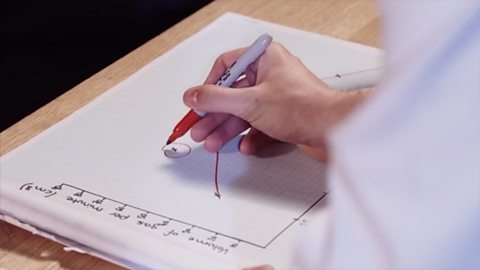
How do you identify the variables?
Independent variable – the variable that is changed during a scientific experiment.
Dependent variable – the variable being recorded or measured during a scientific investigation.
Controlled variable – a variable that is kept the same during a scientific investigation to ensure a fair test so that results can be compared.

Example
Practical 1.4 - Investigating the effect of temperature on the action of an enzyme
Independent variable – temperature
Dependent variable – time taken for starch to be digested
Controlled variables – pH, enzyme concentration, volume and type of Proteins that act as biological catalysts, meaning they speed up reactions without being used up themselves.
What is a hypothesis?
A hypothesis or prediction is made with limited evidence at the beginning of a scientific investigation.
Biological knowledge should be used to justify the prediction.
Practical 1.4 - Investigating the effect of temperature on the action of an enzyme
At low temperatures the enzyme will break starch down slowly due to a lack of kinetic energy and at very high temperatures starch will not be broken down, as the enzyme will be denatured.
Method
Various methods are outlined in study guides and they are planned to test predictions.
A control experiment is often set up for comparison, ensuring any changes in results are due to the independent variable.
Methods should produce accurate and reliable results.
Accuracy depends on the quality of measuring tools and the scientist's skill. For data to be reliable, variations should be minimal.
Repeating an experiment increases its reliability.
Example
Practical 1.4 - Investigating the effect of temperature on the action of an enzyme
An appropriate control experiment would be to replace the enzyme with water at 40°C.
This will allow comparisons to be made and prove it is the changing temperature affecting the breakdown of starch.
Accuracy can be improved by using a syringe to measure liquids rather than a measuring cylinder.
Reliability can be improved by completing the experiment at each temperature more than once and calculating an average.
What is a risk assessment used for?
A risk assessment is a careful examination of what could cause harm to people during a scientific investigation.
A hazard is anything that may cause harm, such as chemicals, electricity, extreme heat etc.
The risk is the harm that could be caused by the hazards identified.
The prevention methods are strategies put in place to avoid any injuries.
Example
Practical 1.4 - Investigating the effect of temperature on the action of an enzyme
| Hazard | Risk | Prevention |
|---|---|---|
| Iodine | Irritation of the eyes/skin | Wear goggles |
Diagram of equipment
Diagrams are drawn to show the setup of the equipment being used.
Diagrams should be:
- drawn in pencil. Lines should be firm and continuous with no gaps (not sketchy).
- as large as possible.
- labelled using separate ruled lines. These should be spread out with a bullet point on one end and a clearly written label on the other.
Recording results
Any data collected from a scientific investigation should be recorded in a results table.
A results table needs to include:
- appropriate headings
- appropriate units (written in the column heading only)
- all data collected
- any repeats obtained
- appropriate calculations (eg average)
Example
Practical 1.4 - Investigating the effect of temperature on the action of an enzyme
The table below could be used to record the results obtained from the investigation. It also includes columns for two sets of repeats and the average to be recorded.
| Temperature /°C | Time taken to break down starch /secs | Time taken to break down starch /secs | Time taken to break down starch /secs | Average time taken to break down starch /secs |
|---|---|---|---|---|
| 0 | ||||
| 20 | ||||
| 40 | ||||
| 60 | ||||
| 80 |
Quiz time!
Watch a video
SHINI SOMARA:
Today, we’re going to be talking about the steps involved in planning an investigation.
SIMON CLARK:Now it doesn't matter what the investigation is, all investigations need to follow certain steps in the planning stage.
To show you how this works, we are going to be carrying out an investigation to find out whether the length of a pendulum determines its period.
So in other words, the length of time it takes for a pendulum to complete one whole swing from one side to the other and then back.
Now, in order to do this I’ve got us some equipment.
SHINI SOMARA:
No, no Simon, I don’t think we need any of this… I was thinking of something a lot bigger.
SIMON CLARK:
Oh, cool—a trapeze!
I see what you’re going for!
SHINI SOMARA:
So, the first thing to do before beginning practical work is to develop a hypothesis.
A hypothesis is an idea or an explanation that we think might be right.
In this case I’m going to hypothesise that the length of time it takes for a pendulum to complete one whole swing from one side to the other and back depends on the length of the pendulum, and in particular that the longer the pendulum, the greater the time it will take.
SIMON CLARK:
And what are you basing that on?
SIMON CLARK (continuing):
Well… can I borrow your necklace a sec?
SHINI SOMARA:
Yeah.
SIMON CLARK:
So notice how if I hold the necklace up here it takes longer to complete a whole swing than if I hold it close down the bottom like this.
SHINI SOMARA:
Yeah, yeah it does.
SHINI SOMARA (continuing):
So I’m guessing that the trapeze is our pendulum, but what are we swinging?
SIMON CLARK:
Well that’s something I wanted to ask you.
Er, how do you feel about heights?
SHINI SOMARA:
What happened to you? (laughs)
SIMON CLARK:
I don’t want to talk about it.
SHINI SOMARA:
The next step is to plan the investigation, which means we need to work out how we can test if our hypothesis is correct or not.
And to do that we need to identify all of the variables—the things that we can control, alter, and measure.
Now in science we talk about the controlled, dependent, and independent variables.
SHINI SOMARA (continuing):
In our experiment, the independent variable is the length of the trapeze, because that is what changes.
The control variable is your mass hanging off the trapeze. So, how much do you weigh?
SIMON CLARK:
About eighty‑five kilos.
SHINI SOMARA:
OK, so that’s unlikely to change throughout the experiment.
You also need to make sure that when you start the pendulum, you start it from the same point every time—that’s another control variable.
SIMON CLARK:
Definitely.
SHINI SOMARA:
And then finally the dependent variable is what we measure in this investigation.
The dependent variable is dependent on the independent variable.
So in this case, it is the time it takes for the trapeze to complete one complete swing.
So that’s all the variables. The next thing we need to do is predict what is going to happen.
SIMON CLARK:
Well I predict that I’m going to freeze and then fall off the trapeze.
SHINI SOMARA:
Well hopefully not, but for example, how long do you think it’s going to take for the trapeze to complete one full swing when the trapeze is at its longest?
SIMON CLARK:
Well it’s definitely going to be longer than when the length was shorter. It’s like with Shini’s necklace.
SHINI SOMARA:
OK, well let’s see what happens.
The final stage in planning an investigation is to select the appropriate range of values to record your measurements.
We’re using the longest length, which is 7.7 metres, and the shortest possible length of 6.5 metres.
Now if we were to do this in a lab setting, we’d probably want to do a pre-test to determine the long and short range that’s most practical, taking great care with safety when it comes to choosing a longer pendulum length.
SIMON CLARK:
Keep going, Shini—there’s no rush!
SHINI SOMARA:
I think we might have to skip out that step though.
Alright Simon, off you go!
SIMON CLARK:
Here we go!
SHINI SOMARA:
Try not to jiggle around too much because that’s going to skew the readings.
SIMON CLARK:
You try being up here!
What’s the time, Shini?
SHINI SOMARA:
4.10 seconds.
SIMON CLARK:
Do you want to try it? It’s really fun!
SHINI SOMARA:
So now we’ve increased the length of the trapeze. We’ve lowered it so it now measures 7.7 metres in length.
Are you ready to go, Simon?
Right—three, two, one.
So the time taken for the shorter trapeze to complete one full swing is 4.49 seconds.
And the time taken for the longer trapeze to complete one full swing is 5.08 seconds.
SIMON CLARK:
So my hypothesis was correct.
SHINI SOMARA:
Yeah, spot on. How are you feeling?
SIMON CLARK:
Pretty great actually—it was really fun!
SHINI SOMARA:Well in that case, can we repeat the readings? It is best practice, after all.
SIMON CLARK:
But why? The data looked great!
SHINI SOMARA:
Yeah, but repeatable readings confirm how precise they are.
So to recap, the five key points when planning an investigation:
Develop a hypothesis—an explanation that you think will apply to the situation you’re looking at.
Identify your variables: what you’re going to change, what you think might vary as a result, and what you’re going to keep constant.
Make and justify your predictions—what you think is going to happen.
Select an appropriate range of values.
And lastly, decide if you need to repeat any readings.
Are you going to practise your quadrupole backflips now?
SIMON CLARK:Well I thought you could do that. Do you want to try on the bodysuit?
Come on, there is one here in your size.
SHINI SOMARA:
No, no…
More on Practical skills
Find out more by working through a topic
- count2 of 4
- count3 of 4
- count4 of 4