What can conclusions tell us about an investigation?
A conclusion identifies what has been learned from the investigation and may agree or disagree with the hypothesis made during planning.
Reliability
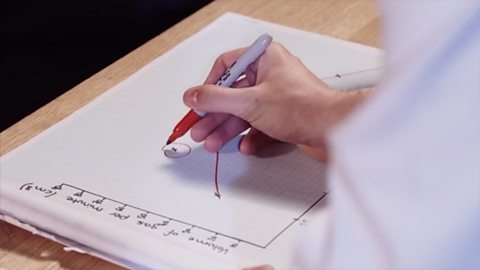
For data to be considered reliable, repeats must be carried out.
Repeating a scientific investigation makes it more reliable.
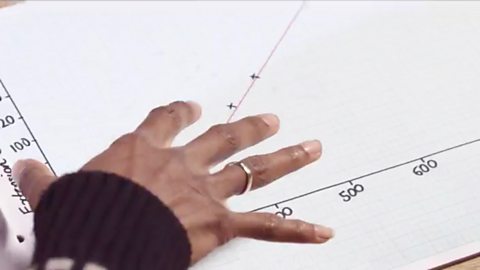
When analysing a set of results or graph, an anomalous result can be identified as one that does not follow the trend or lie on the line of best fit.
Once identified, When something is unexpected, or deviates from what is considered normal under those circumstances. can be removed and repeated.
Anomalous results can occur due to:
- human error
- an inadequately controlled variable
- the use of inappropriate measuring equipment
It is important to address anomalous results as they can make a conclusion unreliable.
Develop arguments and explanations
Scientific arguments are based on evidence gathered during an investigation.
Evidence can be used to produce an explanation.
Data often allows more than one possible explanation. Different scientists can have different explanations about the same evidence collected.
Quiz time!
Watch a video
Watch: Practical skills - evaluating
SIMON CLARK: We’re going to show you the key skills you need when evaluating an investigation.
SHINI SOMARA: And the investigation we’re going to carry out is the reaction of hydrogen peroxide using a catalyst to produce oxygen and water.
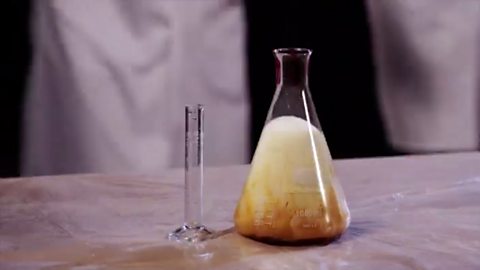
SHINI SOMARA: Now this is sometimes called the Elephant’s Toothpaste reaction and you’ll see why in just a second….
SHINI SOMARA: So, in these flasks we have our hydrogen peroxide along with some food colouring at the top just to make it colourful and a splash of washing‑up liquid. Now it’s time for us to add our catalyst, and the catalyst we’re going to be using today is potassium iodide. Ready, Simon?
SIMON CLARK: Ready, Shini! 3, 2, 1…
SIMON CLARK: That’s all steam, isn’t it? It’s still going! That food colouring is really making it look like toothpaste!
SHINI SOMARA: Well now you know why it’s called the Elephant’s Toothpaste reaction.
SHINI SOMARA: So the oxygen gas that’s being produced by the reaction is being captured in bubble form by the washing‑up liquid that we put in, so you can see with your own eyes just how much oxygen is being produced.
SIMON CLARK: Yeah it’s absolutely spectacular… and I can’t believe that this process is happening in our bodies every single day.
SHINI SOMARA: Minus the food colouring and the washing‑up liquid. Yes, I mean our livers contain an enzyme called catalase that has a similar effect to breaking down harmful hydrogen peroxide, which can be found in foods like potatoes.
SHINI SOMARA: We’ve cleared up all of that mess and we’re left with two test tubes full of hydrogen peroxide. Now I’m going to add some of this sludge to one of the test tubes. This has been made in a food processor and it’s fresh beef liver mixed with water.
SHINI SOMARA: Now in the test tube I’ve also added a squirt of washing‑up liquid and that’s to help us see the reaction as the gas gets generated. So a lump of it goes in there—
SIMON CLARK: Oh wow!
SHINI SOMARA: Now this sludge contains the natural enzyme catalase, which is very similar in effect to the catalyst that we used—potassium iodide—in the previous demonstration.
SIMON CLARK: So you can see it happening, but how are you going to measure the rate of reaction?
SHINI SOMARA: Ok, good question. So I’m going to add the sludge to this test tube of hydrogen peroxide and I’m going to stick the bung on top. And the gas that’s generated is going to push down, and hopefully push the syringe. And you’ll be able to measure the quantity of gas using this cubic‑centimetre scale. So, ready to do that?
SIMON CLARK: Yeah, we could measure it for, say, a minute? Put the bung on and I’ll start the stopwatch.
SHINI SOMARA: OK. Right, bung goes on.
SIMON CLARK: Stopwatch started. There it goes. Yeah.
SHINI SOMARA: So you can see the syringe being pushed back because of the gas—
SIMON CLARK: It’s really, really pumping out a lot of gas. It’s quite fast, isn’t it! Well, we’ve only been going for 10 seconds and it’s made over 20 cubic centimetres—
SHINI SOMARA: Gosh! Go! 59 cubic centimetres. Just shy of 60.
SIMON CLARK: I wonder if the rate of reaction will change if we change the temperature!
SHINI SOMARA: I think you’re right. I think at higher temperatures the reaction is going to be a lot more vigorous. That’s my prediction. Let’s find out.
SHINI SOMARA: So we’ve done these experiments twice using seven different temperatures and we’ve recorded the gas produced at each temperature, and I’ve plotted the results on a graph and you’re going to draw the line of best fit.
SIMON CLARK: Okey‑dokey! So something a bit… like this. What about this point—this one doesn’t seem to match the trend of all the others?
SHINI SOMARA: Yeah, this is an outlier or an anomaly, and that suggests that there was some kind of mistake made when taking that reading.
SIMON CLARK: Second reading? That’s my fault, sorry; I think I messed up the temperature dial on the heat bath. Can we forget about that?
SHINI SOMARA: Yeah, we can discard it for now, but in an ideal world we’d want to re‑do that reading. But your hypothesis was correct—up until a point. As we increased the temperature, the volume of gas did increase.
SIMON CLARK: Yes, but then it started decreasing. Why is that?
SHINI SOMARA: Well, the enzyme that we were considering comes from our bodies, which are at about 40°C, so it would make sense if it was the most efficient at breaking down hydrogen peroxide at that temperature. So the enzyme would start to denature and become less effective as an enzyme.
SHINI SOMARA: So in terms of this investigation, what improvements would you suggest?
SIMON CLARK: Well, I could definitely be a bit more careful with the heat bath!
SHINI SOMARA: Yeah, but I also think we should take a lot more readings. Oh, and decrease the temperature increment.
SIMON CLARK: Absolutely!
SHINI SOMARA: The main points you should remember when evaluating your investigation are: decide on whether your data is of good quality; check for any outliers and anomalies and decide how you’re going to treat them; compare your conclusions with your predictions; and finally suggest ways that you may be able to improve your investigation.
SIMON CLARK: I can’t believe you used that liver, you know I’m vegetarian.
SHINI SOMARA: Well, I was actually going to fry it up for dinner tonight!
More on Practical skills
Find out more by working through a topic
- count1 of 4
- count2 of 4
- count3 of 4