What are the key learning points about qualitative analysis?
There are different tests for hydrogen, oxygen and carbon dioxide: hydrogen makes a lit splint pop, oxygen relights a glowing splint, and carbon dioxide turns limewater milky.
Flame tests identify metal Electrically charged particle, formed when an atom gains or loses electrons. by the colour they produce in a blue Bunsen flame.
Lithium, sodium, potassium, calcium and copper ions each give distinctive flame colours.
How to test for hydrogen, oxygen and carbon dioxide
What is hydrogen?
Hydrogen is a colourless, odourless gas.
What is the test for hydrogen?
- A lit splint applied to hydrogen gas will result in a popping sound.
This is because hydrogen is flammable and burns in oxygen once lit.
hydrogen + oxygen → water
2H₂ + O₂ → 2H₂O
What is oxygen?
Oxygen is a colourless, odourless gas.
What is the test for oxygen?
A glowing splint applied to a sample of oxygen gas will relight.
What is carbon dioxide?
Carbon dioxide is a colourless, odourless gas.
What is the test for carbon dioxide?
When carbon dioxide is bubbled through limewater (calcium hydroxide solution) the limewater changes from colourless to milky.
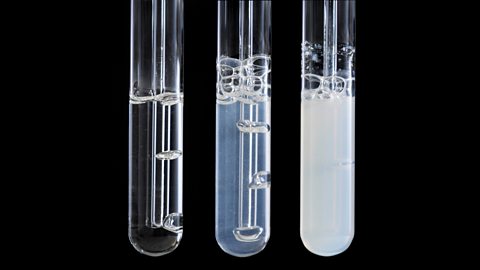
Summary: Gas tests
How to test for ions
Chemists are often asked to test a substance to find out if it contains specific Electrically charged particle, formed when an atom gains or loses electrons. or A compound is a substance made from two or more different elements chemically bonded to each other in a fixed ratio of atoms..
A positive ion. in metal compounds can be identified using a flame test.
Most metal ions produce a strong colour when put into a blue Bunsen burner flame.
The colour of the flame can be used to identify which metal cation are present in an unknown sample.
Method:
Take a clean nichrome wire.
Dip the loop into concentrated hydrochloric acid and then into the sample.
Hold the nichrome wire in a blue Bunsen burner flame and observe the colour.
What are some examples of different flame tests?
Different metal ions produce different coloured flames.
| Ion present | Flame colour |
|---|---|
| Lithium, Li+ | Crimson |
| Sodium, Na+ | Yellow/orange |
| Potassium, K+ | Lilac |
| Calcium, Ca2+ | Brick red |
| Copper, Cu2+ | Blue-green/green-blue |
It is important to clean the nichrome wire in between testing different samples.
To do this, dip the wire into concentrated acid and place it in the blue Bunsen flame until no colour change is observed
Question
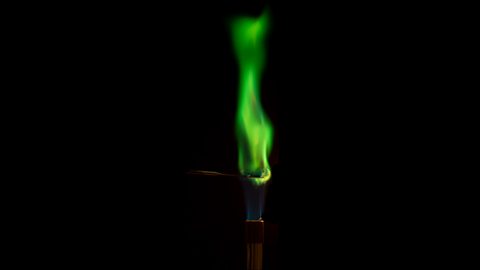
Look at the flame colour below.
What metal ion is being tested?
Answer
Copper ions are being tested.
Copper ions burn producing a blue-green colour.