What are the key learning points about electricity in the home?
The equation power = current × voltage can be used to calculate and select the appropriate rating of a fuse.
The unit used in the cost of electricity to the consumer is the kilowatt-hour. One kilowatt-hour (kWh) is the energy supplied when an appliance with a power of 1kW is used for 1 hour.
What happens when an electric charge flows through wires?
As charge flows through wires they heat up.
Electrical energy carried by the charge is converted to heat energy.
This lets a kettle heat water or an electric fire heat a room.
What is electric power?
Electric power is the amount of electrical energy converted into other forms of energy in one second.
It be calculated using the equation:
electric power = current × voltage
P = VI
where:
P = electric power in watts, W
I = current in amperes, A
V = voltage in volts, V
| \({P} = {VI}\) | \({P} = {V}\times{I}\) |
| \({I} =\frac{\text{P}}{\text{V}}\) | \({I} = {P} \div {V}\) |
| \({V} = \frac{\text{P}}{\text{I}}\) | \({V} = {P} \div {I}\) |
Remember that one watt is equal to one joule per second (1 W = J/s).
Example question
What is the power of a small electric motor if a current of 2 A flows when connected to a 12 V power supply?
Answer
P = VI
I = 2 A
V = 12 V
P = 2 A x 12 V
P = 24 W
The power of the electric motor is 24 W.
In the example above the power of the electric motor is 24 W, but what does a power of 24 W mean?
It means that the electric motor converts 24 J of electric energy into other forms of energy (kinetic energy, heat energy, sound energy), every second.
Question
A light bulb is rated 60 W, 240 V. What does that mean?
Answer
When the voltage across the bulb is 240 V, the bulb has a power of 60 W.
It converts 60 J of electrical energy into light and heat energy every second.
Question
A kettle has a power of 2.2 kW and is connected to mains voltage of 240 V.
- What current flows when the kettle is operating normally?
- What is the resistance of the kettle’s heating element?
Answer
\({I} =\frac{\text{P}}{\text{V}}\)
P = 2.2 kW = 2200 W
V = 240 V
\({I} =\frac{\text{2200 W}}{\text{240 V}}\)
I = 9.17 A
\({R} =\frac{\text{V}}{\text{I}}\)
V = 240 V
I = 9.17 A
\({R} =\frac{\text{240 W}}{\text{9.17 A}}\)
R = 26.2 \(\Omega\)
The resistance of the kettle’s heating element is 26.2 \(\Omega\)
What do fuses do?
A fuse breaks the circuit if a fault in an appliance causes too much current to flow.
This protects the wiring and the appliance from overheating, and possibly starting a fire, if something goes wrong.
The fuse contains a piece of wire that melts easily.
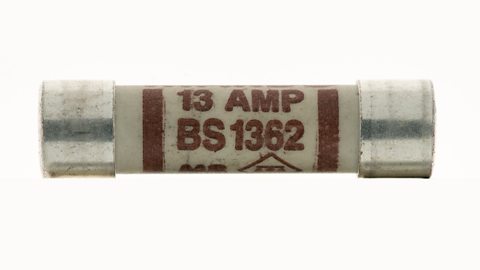
If the current going through the fuse is too great, the wire heats up until it melts and breaks the circuit.
Once the fuse has melted, the circuit is broken and no more current flows through the circuit.
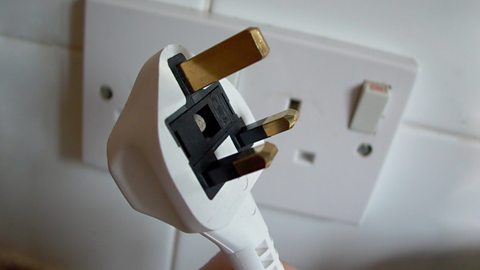
Fuses in plugs are made in standard ratings.
The most common are 3 A, 5 A and 13 A.
The fuse should be rated at a slightly higher current than the device needs:
if the device works below 3 A, use a 3 A fuse;
if the device works above 3 A but below 5 A, use a 5 A fuse;
if the device works above 5 A, but below 13 A, use a 13 A fuse.
How to select the correct fuse
The current flowing through an appliance can be calculated by rearranging the equation:
electric power = voltage x current
P = VI
or
I = \(\frac{P}{V}\)
Once the current is known the next highest fuse rating is chosen.
A fuse rated below the normal operating current would “blow”.
A fuse rated too much above the normal operating current would allow dangerously high current to flow without “blowing”.
This could cause the wiring and the appliance to overheat and start a fire.
Example
A toaster has a power rating of 750 W, 230 V.
I = \(\frac{P}{V}\)
P = 750 W
V = 230 V
I = \(\frac{750}{230}\)
I = 3.26 A
The normal current for the toaster is 3.26 A. Hence a 5 A fuse would be selected.
A 3 A fuse would “blow” when the normal operating current flowed.
A 13 A fuse would allow dangerously high current to flow and still not blow.
This could cause the toaster to overheat and start a fire.
Question
A bed side lamp is rated 60 W, 240 V.
Calculate the size of fuse that should be fitted to the lamp for it to operate safely.
The fuse available are 3 A, 5 A and 13 A.
Answer
I = \(\frac{P}{V}\)
P = 60 W
V = 240 V
I = \(\frac{\text{60 W}}{\text{240 V}}\)
I = 0.25 A
The normal current for the lamp is 0.25 A.
Hence a 3 A fuse would be selected.
Key points
A fuse is a safety feature.
The wire inside a fuse melts if something goes wrong and the current is too large - this protects the wiring and the device from overheating, and possibly starting a fire.
Once the fuse has melted, the circuit is broken and no more current flows.
The most common fuses are 3 A, 5 A and 13 A.
The fuse selected should be rated slightly higher than the current the device needs to operate normally.
How is the cost of electricity calculated for households?
Electricity companies bill customers for the electrical energy they use.
A The unit of work or energy, written as J. is much too small a unit of energy and so the electricity companies use units called The energy supplied when an appliance with a power of 1kW is used for 1 hour, written as kWh..
One unit of electrical energy is one kilowatt-hour, or 1 kWh.
One kilowatt-hour (kWh) is the energy supplied when an appliance with a power of 1kW is used for 1 hour.
1 unit = 1 kWh
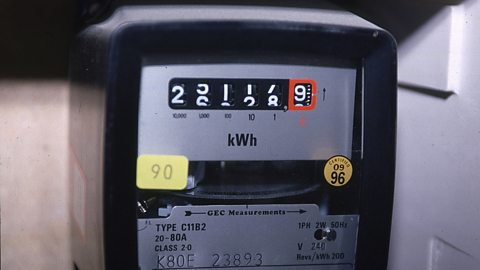
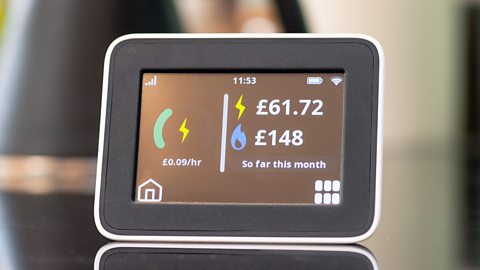
Domestic electricity meters, similar to those above, measure the number of kilowatt-hours of electrical energy used in a home or other building.
The more kilowatt-hours (or units) used, the greater the cost.
The cost of the electricity used is calculated using this equation:
total cost = energy in kWh × cost per unit
The cost per unit is set by the electricity company, for example 30 p per kWh.
This means that each unit, or kilowatt-hour, of electricity costs 30 p.
An electricity bill has two important numbers: present meter reading and previous meter reading.
The number of units used is the difference between these two readings.
Present reading = 40745 kWh
Previous reading = 39990 kWh
Number of units used = present meter reading - previous meter reading
= 40745 – 39990
= 755 kWh
total cost = number of units used × cost per unit
= 755 x 30p
= 22650p
The cost of electricity used is £226.50.
Question
Use the following information to calculate the cost of electricity used.
Previous reading = 37070 kWh.
Present reading = 38217 kWh.
Units at 30p per kWh.
Answer
Number of units used = present meter reading - previous meter reading
= 38217 – 37070
= 1147 kWh
total cost = number of units used × cost per unit
= 1147 x 30p
= 34410p
= £344.10
The cost of electricity used is £344.10.
How to reduce household electricity bills
Use energy efficient light bulbs such as Light-Emitting Diode. LEDs glow when current passes through them. bulbs.
Switch off and unplug devices on stand-by.
Switch off and unplug chargers when not in use.
If you are replacing an electrical appliance such as a tumble dryer, kettle or hair dryer choose an energy efficient model.
Minimize the time spent in an electric shower.
If possible, hang washing out to dry rather than use a tumble dryer.
How to calculate the cost of using an appliance? (Higher tier only)
The power rating of electrical appliances can be used to calculate the cost of using them.
The following equation enables the number of units used to be calculated:
energy in kWh = power rating in kW x time in hours
When using this equation it is important to remember that:
the power must be in kW (1 kW = 1000 W);
the time must be in hours.
Example
Calculate the cost of using a 2 kW heater for 6 hours if the price of a unit is 30 p.
energy in kWh = power rating in kW x time in hours
Time = 6 hours
Power rating = 2 kW
energy in kWh = 2 kWh x 6 h = 12 kWh
total cost = energy in kWh × cost per unit
= 12 kWh x 30 p
= 360 p
= £3.60
The cost of using the heater is £3.60.
Question
Calculate the total cost a using a 100 W lamp and a 300 W hair dryer for 10 minutes if a unit of electricity is 30p.
Answer
For the lamp:
Number of units used = power rating in kW x time in hours
Power rating = 100 W = \(\frac{\text{100~kW}}{\text{1000}} = {0.1~kW}\)
time = 10 minutes = \(\frac{\text{10~hours}}{\text{60}} = {0.167~hours}\)
Number of units used = 0.1 kWh x 0.167 h = 0.0167 kWh
total cost = number of units used × cost per unit
= 0.0167 kWh x 30p
= 0.5p
For the hair drier:
Number of units used = power rating in kW x time in hours
Power rating = 300 W = \(\frac{\text{300~kW}}{\text{1000}} = {0.3~kW}\)
time = 10 minutes = \(\frac{\text{10~hours}}{\text{60}} = {0.167~hours}\)
Number of units used = 0.3 kWh x 0.167 h = 0.0501 kWh
total cost = number of units used × cost per unit
= 0.0501 kWh x 30p
= 1.5p
Total cost = 0.5p + 1.5p = 2p
The cost of using the lamp and hair dryer is 2p.
Question
A TV needs 250 W.
It is switched on for 30 minutes.
If each kWh costs 30p, how much does it cost to run the TV?
Answer
Number of units used = power rating in kW x time in hours.
Power rating = 250 W = \(\frac{\text{250~kW}}{\text{1000}} = {0.25~kW}\)
Time = 30 minutes = \(\frac{\text{30}}{\text{60}} = {0.5~hours}\)
Number of units used = 0.25 kWh x 0.5 h = 0.125 kWh
Total cost = number of units used × cost per unit
= 0.125 kWh x 30p
= 3.75p
The cost of running the TV is 3.75p.
Key points
- Electric power is the amount of electrical energy converted into other forms of energy in one second.
- Power is measured in watts, W.
- Electrical energy is measured in joules.
- 1 watt = 1 joule per second.
- A joule is too small a unit of energy for household electricity, so the unit used for household electrical energy is the kilowatt-hour, kWh.
- The cost of the electricity used is calculated using this equation: total cost = energy in kWh × cost per unit.
- Higher tier only: energy in kWh = power rating in kW x time in hours.
- Higher tier only: when using this equation it is important to remember that:
- the power must be in kW;
- 1 kW = 1000 W;
- the time must be in hours.
How much do you know about household electricity?
More on Electrical circuits
Find out more by working through a topic
- count5 of 5
- count1 of 5

- count2 of 5

- count3 of 5