What are the key learning points about protection from electric shock?
The wiring inside a fused three-pin plug contains the live, neutral and earth wires.
Appliances with metal cases are usually earthed and the earth wire and fuse together protect the user from electric shock and the apparatus from potential damage.
Double insulation protects the user from electric shock by encasing appliances in an insulating plastic case or body.
What are the key parts of a three-pin plug?
The electricity coming into your home is called mains electricity.
Mains voltage in Northern Ireland is 230 V.
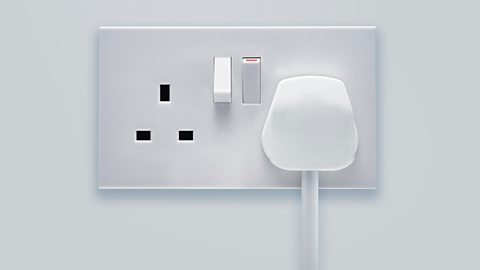
A plug connects a device to the mains electricity supply.
The cable between the device and the three-pin plug contains three copper wires that are coated with plastic.
Copper wires are good conductors.
Plastic is a good insulator.
Each part of the plug has a function.
| Features of a plug | Function |
|---|---|
| Outer insulation | All three wires in the cable are bundled together and there is extra plastic insulation wrapped round them all for safety. |
| Cable grip | This holds the cable tightly in place so that wires do not become loose. |
| Live wire | Copper wire coated with brown plastic along which the current enters the device. |
| Fuse | A glass or ceramic canister containing a thin wire that melts if the current gets too high. |
| Neutral wire | Copper wire coated with blue plastic that also connects to the cable in the wall and completes the circuit. |
| Earth wire | Copper wire coated in striped plastic that provides a path for current to flow from the case of the device to the ground if there is a fault. |
| Wire | Colour | Position |
|---|---|---|
| Live | Brown | Bottom right (connected to fuse) |
| Neutral | Blue | Bottom left |
| Earth | Yellow and green stripes | Top |
One way of remembering the position of the wires is:
| Colour | Position |
|---|---|
| BLue | Bottom Left |
| BRown | Bottom Right |
| sTripes | Top |
What is earthing?
Without the earth wire, if a fault occurs and the live wire becomes loose, there is a danger that it will touch the metal case.
The next person who uses the appliance could get electrocuted.
The earth pin on the three pin plug is connected by a wire to the metal body of the appliance.
This wire is connected to earth via the plug socket to a metal plate or water pipe underground.
As the wire is made of copper, the earth wire provides a low resistance path to the ground.
In the event of a fault, the live current passing through the case will follow this path to the ground instead of passing through a person.
As the earth wire has virtually no resistance, a large current flows.
This causes the fuse to blow, preventing any further current flow.
Key points
The earth wire is a safety feature.
It provides a low resistance path to earth.
A large current flows in the earth wire which causes the fuse to melt, helping to protect the user from electric shock and the appliance from overheating and starting a fire.
Current only flows in the earth wire when a fault occurs and the live wire touches the metal casing of the appliance.
What is double insulation?
Appliances encased in an insulating plastic case or body, such as hair dryers, mobile phone chargers and hand whisks do not need an earth wire.
Such appliances are designed so that there are two levels of insulating material between the electrical parts of the appliance and any parts on the outside that can be touched.
These two layers are normally the insulating plastic case and the insulated cable carrying the live and neutral wires.
A metal attachment, such as a whisk blade, is fitted into a plastic case so that it does not make direct contact with the internal electrical parts.
Even though the device contains a live wire at mains voltage, there are two layers of plastic separating the user from this live wire.
The symbol for double insulation on an appliance is:
How much do you know about protection from electric shock?
More on Electrical circuits
Find out more by working through a topic
- count1 of 5

- count2 of 5

- count3 of 5
- count4 of 5