Quick version
Urban areas means towns and cities.
Cities are made up of different land use zones. Generally, these grow outwards in a series of rings.
These rings can be divided in different ways but there are four main land use zones. Each has different characteristics:
- CBD (central business district) - Central, accessible area with transport hubs, public buildings, retail, leisure and offices.
- Inner city - Area of workers' housing and traditional industry - some of which may be derelict or unused.
- Suburbs - Larger houses with gardens, with more open space and local amenities.
- Rural/urban fringe - More open countryside with some housing, industrial and retail development.
Outside the rural/urban fringe there is often an area of green belt. This is open land that is protected from development. This can help protect countryside and prevent urban sprawl.
Urban environments in developed countries
Watch this video to learn more about urban land use zones and their key features, with examples based on Glasgow.
Video
Land use zones
Different areas within towns and cities can be recognised according to their land use:
- central business district (CBD)
- inner city (old housing and old industrial zones)
- new housing zone
- new industrial zone
- new business district
The diagram below highlights these different land use zones in a town/city.
Central business district (CBD)
Location of CBD
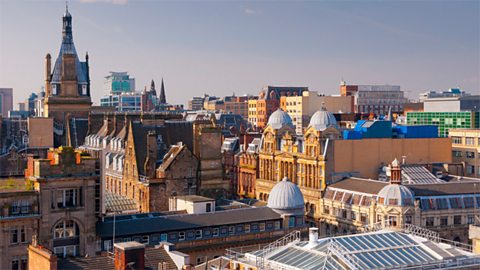
- in the centre of a city
- at the most accessible location such as at a crossing point of a river, like Glasgow's River Clyde
- near the oldest part of town
Reasons for CBD location
- central location for road/railways to converge
- most accessible location for workers
- accessible to most people for shops and businesses
Identifying features of the CBD
- tall/multi-storey buildings
- expensive land values
- high density of roads and buildings
- lack of open space
- shops, eg department stores
- modern shopping malls and pedestrian precincts
- cultural/historical buildings,eg museums and castles
- offices, eg business sector
- entertainments, eg theatres and clubs
- bus and railway stations
- high traffic and pedestrian flows, eg commuter rush-hour
- multi-storey car parks
- grid iron street pattern
Examples in Glasgow
| Feature of CBD | Example in Glasgow |
|---|---|
| High/multi-storey buildings | Hilton Hotel |
| Modern shopping mall/pedestrian precinct | Buchanan Galleries |
| Lack of open space | Merchant City |
| Cultural/historical buildings | Gallery of Modern Art |
| Transport centres | Buchanan Bus Station |
| Grid iron street pattern | Sauchiehall Street, Bath Street and Renfield Street |
Inner city
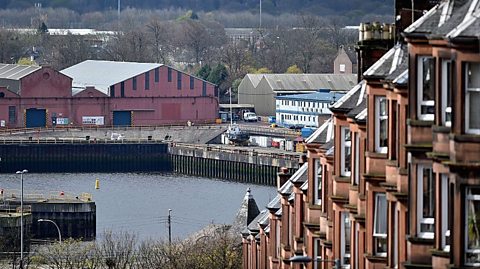 Image source, Jeff J Mitchell / Getty images
Location
- in older cities, the inner city area is near the centre and surrounding the Central business district
- inner city areas are identified not only by their physical features but often associated with negative socio-economic features, eg derelict buildings, waste ground and run-down housing.
Reasons
- old heavy industrial factories were near the city centre
- low-cost housing like tenements were built quickly for poorly paid workers who needed to live close to work
- people in poor inner city areas were able to make use of city centre amenities
Identifying features
- high density of buildings and lack of good quality open space, eg parks.
- grid iron street pattern
- older, 19th century, low-cost housing - likely to be tenements in Scotland and terraced housing in England
- poor quality housing with a lack of gardens
- derelict land
- old industry in decline or shut down
- a declining population with high unemployment
- large areas of redevelopment or urban regeneration
- limited convenience shopping facilities
- high levels of air pollution from traffic
- visual pollution in the form of vandalism and graffiti
- areas demolished and used for motorways and ring roads
An example of an inner city area in Glasgow is Govan.
Image source, Jeff J Mitchell / Getty imagesSuburbs
New housing zone
Location
- on the outskirts of the town/city in the Land around the edge of a city or town. Suburbs contain lots of land uses, such as housing, shops and offices.
- where there is more space to build
- beside main transport routes for access into Central business district
Reasons for new housing zone location
- towns and cities grow outwards, so newest houses tends to be further away from the oldest part of the town in the CBD
- more space and cheaper land to build larger family homes with gardens and garages
Identifying features of a new housing zone
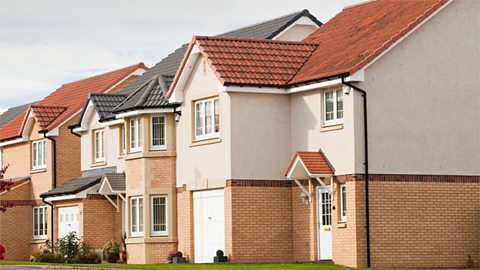
- low density and larger houses as the land is cheaper away from the CBD
- street pattern designed by town planners in modern cul-de-sacs and crescents to reduce the speed of traffic and create a safer environment for children
- good quality open space, eg parks
- newer, 20th and 21st century housing - likely to be detached or semi-detached houses
- good quality housing with gardens and space for extensions like conservatories.
- surrounded by green land
- separated from industry
- convenience shopping facilities, eg corner shops
- nearby schools
- low levels of air pollution as far away from CBD traffic
- quieter area with nicer scenery because of its proximity to the countryside
An example of a new housing area in Glasgow is Newton Mearns.
Rural/urban fringe
New industrial zone
Location
- on the outskirts of the town at the edge of suburbs or in the rural/urban fringe
- beside main roads for access
- on flat land with open space
Reasons for new industrial zone location
- away from the congestion of the CBD
- room to expand
- land is cheaper so low density factories can be built
Identifying features of a new industrial zone
- low density – one or two storey buildings
- modern buildings built of brick and finished with glass
- separated from housing
- landscaped with trees and shrubs
- factories are grouped together in industrial estates
- main roads are nearby to import/export
- large car parks for workers and delivery lorries
An example of a modern industrial estate in Glasgow is Hillington Industrial Estate.
New business district
Location
- on spacious sites on the outskirts of a town/city - at the edge of suburbs, in the rural/urban fringe, or greenbelt locations.
- beside main roads/motorways
Reasons for new business district location
- plenty of space to build large supermarkets, furniture stores and entertainment facilities like bowling alleys and cinemas
- motorways provide easy access for shoppers
Identifying features of a new business district
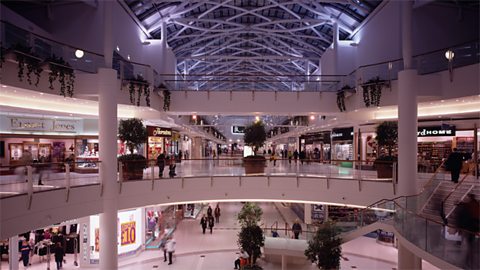
- very large buildings, eg cinemas and supermarkets
- shops and services grouped together in retail parks
- separated from housing and industry
- thousands of free parking spaces
- beside motorway or where main roads meet
- built on cheap land with space to expand
- low modern buildings
- wide roads to accommodate many cars and delivery trucks
Examples of new business districts in Glasgow include Braehead and Glasgow Business Park.
Definitions
- Commuter settlement – a place where people live and travel elsewhere for work.
- Greenbelt – the area around a city where development is restricted so that town and cities do not merge.
- Rural/urban fringe – the area at the very edge of the city beside the countryside.
- Urban regeneration – a programme designed to improve inner city areas by upgrading existing housing, building industrial estates and health centres, and landscaping.
- Urban sprawl – the growth of towns and cities spreading and taking over areas of the countryside.
Recap
Glasgow is an example of a developed world city.
Cities are made up of different land use zones. Generally, these grow outwards in a series of rings.
These rings can be divided in different ways but there are four main land use zones. Each has different characteristics:
- CBD (central business district) - Central, accessible area with transport hubs, public buildings, retail, leisure and offices.
- Inner city - Area of workers' housing and traditional industry - some of which may be derelict or unused.
- Suburbs - Larger houses with gardens, with more open space and local amenities.
- Rural/urban fringe - More open countryside with some housing, industrial, business and retail development.
Outside the rural/urban fringe there is often an area of green belt. This is open land that is protected from development. This can help protect countryside and prevent urban sprawl.
More on Revision guides: urban environments
Find out more by working through a topic