What are the key learning points about heat transfer?
Heat can be transferred from place to place by The transfer of heat through a material by transferring kinetic energy from one particle to another. The transfer of heat energy through a moving liquid or gas. and This is when heat energy is transferred through electromagnetic waves generated by an object's temperature. Unlike conduction and convection, this type of heat transfer occurs even in the absence of a medium, such as in a vacuum..
The transfer of energy by conduction and convection involves All substances are made of particles. Particles could be atoms, molecules or ions..
Metals are the best conductors of heat because they contain Negatively charged sub-atomic particles that can move through the structure of a substance, usually a metal or graphite. A material with many free electrons is a good conductor..
Convection occurs in liquids and gases.
The transfer of energy by radiation does not require particles.
Dark matt surfaces are better at absorbing and radiating heat energy than light shiny surfaces.
Heat energy can be lost from homes mainly through conduction and convection, but these losses can be reduced by methods of A layer put around a building or in a roof space to retain heat during colder weather or to keep a building cool during warmer weather..
What is the difference between temperature and heat?
Temperature and heat are not the same thing because:
Temperature is a measure of how hot something is.
Heat is a measure of the thermal energy contained in an object.
Temperature is measured in oC.
Heat energy is measured in J.
Key fact
Heat energy can flow by The transfer of heat through a material by transferring kinetic energy from one particle to another., The transfer of heat energy through a moving liquid or gas. or This is when heat energy is transferred through electromagnetic waves generated by an object's temperature. Unlike conduction and convection, this type of heat transfer occurs even in the absence of a medium, such as in a vacuum..
It always flows from a region of high temperature to a region of low temperature i.e. from hot to cold.
What is conduction?
Conduction is the flow of heat energy through a material without overall movement of the material itself.
Prescribed practical P3: Heat conductivity
What is the purpose of this prescribed practical?
This practical is about comparing the heat conductivity of different materials by measuring the time it takes heat to travel through a variety of conductors and at least one insulator.
What are the variables?
In this experiment:
- the independent variable is the material of the conducting rod.
- the dependent variable is the time taken for the pin to drop off.
- the control variables are the length and cross section area of each conducting rod, the mass of the drawing pin and the amount of Vaseline used to attach the pin to each rod.
The control variables are kept the same by:
- ensuring each rod is the same length and has the same cross section area.
- ensuring that the same region of each rod is in the Bunsen flame.
- attaching the pin at the end of each rod.
- using the same amount of Vaseline to attach each pin.
- using identical pins.
Remember - these variables are controlled (or kept the same) because to make it a fair test, only one variable can be changed, which in this case is the material of the conductor.
What is the prediction?
Metals will conduct faster than non-metals and some metals will conduct faster than other metals.
What is the justification for the prediction?
Different metals have different properties, for example different density, and so they will not all conduct heat energy at the same rate.
What is the risk assessment for this practical?
| Hazard | Consequence | Control measures |
|---|---|---|
| The Bunsen flame is very hot. | Burn skin. Damage to eyes. | - Work at arm’s length from the Bunsen Burner. - Wear safety glasses |
| The Bunsen flame could start a fire. | Hair singed or set alight. Paper set on fire. | - Tie back long hair. - Work at arm’s length from the Bunsen. - Clear the workspace. |
| The tripod, Bunsen burner and conducting rods become hot. | Burn skin. | - Use heat proof gloves when lifting apparatus. - Use tongs to lift hot conducting rods. - At the end allow the apparatus to cool down naturally before putting away. |
| The conducting rods could fall off the tripod. | Falling hot rods could burn lap, legs and arms. | - Stand up when heating the rods. - Place the tripod well away from the edge of the bench. - Keep the workspace, including the floor clear and dry. - Wear safety glasses. |
What apparatus is used in prescribed practical P3?
A Bunsen burner, tripod, bench mat, identical copper, aluminium, iron and glass rods, a stop clock, four identical drawing pins, Vaseline, a gas lighter, safety glasses, tongs and/or heat proof gloves.
What method is used in carrying out prescribed practical P3?
- Fix the drawing pin to the end of each rods using identical spots of Vaseline.
- Arrange the rods carefully on top of the tripod. They could rest on a heat proof mat if necessary.
- Position the other end of each rod over the Bunsen.
- Using the gas lighter, light the Bunsen flame and adjust the hole to half open.
- Start the stop clock.
- Record the time taken for the wax to melt and the drawing pin to drop off each rod in a suitable table. The fastest time shows the best conductor of heat.
How to avoid errors
Ensure that the Bunsen flame heats the same part of each rod and that each rod is evenly in the flame.
How to record the results
| Material | Time taken for pin to fall off in seconds |
|---|---|
| Aluminium | |
| Copper | |
| Glass | |
| Iron |
Graph
Draw a bar chart with time in seconds (time /s) on the y-axis and material on the x-axis.
Give the graph a suitable title.
What conclusion can be drawn from prescribed practical P3?
The drawing pin fell off the copper rod in the shortest time followed by the aluminium and then the iron.
The glass rod is last.
The glass rod should be removed from the heat approximately 30 seconds after the pin falls off the iron to prevent the glass from melting.
From this we can conclude that copper conducts heat energy better than aluminium, while aluminium conducts better than iron and glass.
We say that copper has a high thermal conductivity.
This agrees with our prediction.
We can now also conclude that the non-metal, glass, is a very poor conductor of heat.
Evaluation
To ensure the reliability of the investigation the method should be repeated to check that the pins fall off the rods in the same order.
An average time could be calculated.
A way of improving the accuracy of this investigation would be to use temperature probes attached to the end of each rod and connected to a data logger.
The time could then be recorded for each rod to reach the same temperature, for example, 50oC.
The rods could be heated by placing them into a water bath maintained at 90oC.
This would help to ensure even heating of the rods.
What is thermal conductivity?
The material that heats the quickest in the above investigation is said to have a high thermal conductivity.
Key facts
Thermal conductivity is a measure of how well a material conducts heat energy when it is heated.
Thermal conductivity is measured in W/m/oC (watts per metre per degree Celsius).
Some typical values of conductivities are:
| Material | Thermal conductivity (watts per metre per degree Celsius (W/m/oC)) |
|---|---|
| Copper | 386 |
| Iron | 80 |
| Aluminium | 239 |
| Glass | 0.17 |
| Brick | 0.15 |
| Air | 0.024 |
The higher the thermal conductivity the better the conductor.
Copper is a good conductor of heat, air is a poor conductor of heat.
Generally, metals have high thermal conductivity and are good conductors; non-metals have low thermal conductivity and are poor conductors.
How important are conductors in insulating homes?
When trying to keep houses warm, the choice is between materials that are poor conductors such as brick, wood, plastic and glass.
A house built of conducting materials like copper would be very cold to live in as energy would be able to leave the house easily.
Question
Referring to the table of conductivities above, why is it better to have a window made of two layers of glass with a layer of air trapped between them?
Answer
Both glass and air are poor conductors, or insulators, because they have low thermal conductivities.
The layer of air has the lowest thermal conductivity and reduces the overall heat loss through the window.
Since air and glass are both transparent people can still see through the window.
What are the best conductors and insulators?
Metals are good A material which allows heat energy to move easily by conduction. Metals are good conductors because they contain free electrons. of heat energy.
Non-metals and gases are usually poor conductors.
Poor conductors are called insulators.
Heat energy is conducted from the hot end of an object to the cold end.
Applications
The handle of a metal spoon feels colder than the handle of a wooden spoon even though they are side-by-side in the kitchen, and both are at room temperature, which is about 20oC.
Metal is a better conductor than wood, so it conducts heat away from your hand faster than the wooden spoon, making your hand holding the metal feel colder.
Saucepan and frying pan handles are made from plastic or wood which are insulators so that heat does not conduct easily from the hot pan to your hand.
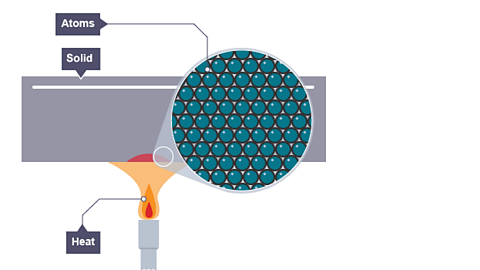
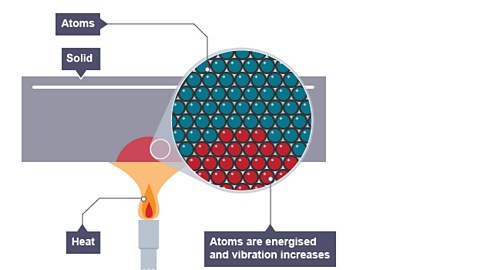
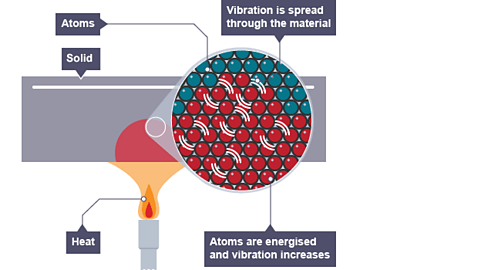
Image caption, Conduction in a solid
A solid is heated up
1 of 3
How well do liquids conduct heat?
Insert a lump of ice at the bottom of a boiling tube and put a piece of wire gauze on top of it.
Fill the tube with water – the wire gauze will stop the ice floating to the top.
Heat the boiling tube at the top with a Bunsen burner as shown in the diagram.
After a short time, the water at the top of the boiling tube boils but the ice cube does not melt.
This shows that water is a bad conductor of heat energy.
How well do gases conduct heat?
Read the thermometers and record the temperatures at A and B in a suitable table.
Switch on the heater and leave for eight minutes.
Read the thermometers again and record the temperatures at A and B.
Results
| Thermometer | A | B |
|---|---|---|
| Initial temperature in oC | 20 | 20 |
| Final temperature in oC | 46 | 23 |
Conclusion
Heat has not conducted easily through the trapped air to position B.
This shows that trapped air is a poor conductor (or good insulator).
Applications
Trapped air is a good, natural insulator.
That is why we wear layers of clothes when it is cold.
A string vest keeps you warm because it traps a layer of air between your skin and your shirt.
Additional layers provided by shirt, fleece and coat help to trap more air, providing more insulation.
Hair is a good insulator too, trapping air between individual hairs on your head.
Wearing a woollen hat on top helps to trap even more air.
Each layer of trapped air helps us to stop losing heat energy by conduction.
Fur, feathers and wool trap air between individual stands and fibres.
This helps animals such as sheep and polar bears and birds like robins, insulate themselves against cold winter conditions
How do solids conduct heat? (Higher tier only)
The All elements are made of atoms. An atom consists of a nucleus containing protons and neutrons, surrounded by electrons. of a solid are held together by chemical bonds.
The atoms are fixed in place but are free to vibrate.
When part of a solid absorbs heat energy the atoms vibrate faster and with bigger amplitude.
These vibrations pass from atom to atom transferring heat energy as they do so.
This process happens in all solids when heated but is a slow process.
Image caption, Conduction in a solid
A solid is heated up
1 of 3
Conduction in metals (Higher tier only)
Some of the Subatomic particle, with a negative charge and a very small mass relative to protons and neutrons. in a piece of metal can leave their atoms and move about in the metal as Negatively charged sub-atomic particles that can move through the structure of a substance, usually a metal or graphite. A material with many free electrons is a good conductor..
The parts of the metal atoms left behind are now positively charged metal Electrically charged particle, formed when an atom gains or loses electrons..
When the free electrons absorb heat energy, they move much faster.
As they move through the metal, free electrons crash into metal ions.
Some of the The energy an object possesses by being in motion. of the free electron is absorbed by the ions and it vibrates faster and with greater amplitude.
This process is very much faster than conduction caused by just passing vibrations from atom to atom.
Hence, conduction in metals is faster than in non-metals.
Key points
Key points
Conduction in insulators (non-metals) is only caused by passing vibrations from atom to atom.
Conduction in good conductors (metals) is caused by collisions between fast moving free electrons and metal ions and by passing vibrations from atom to atom.
Conduction by collisions between fast moving free electrons is much faster than conduction by passing vibrations from atom to atom.
Metals are good conductors because they contain free electrons.
Summary
Conduction is the flow of heat energy from a region of high temperature to a region of low temperature without overall movement of the material itself.
Conduction occurs mainly in solids – most liquids are really poor conductors and hardly any conduction occurs in gases.
A poor conductor of heat is called an insulator.
Metals are good conductors of heat.
Higher tier only: Metals are good conductors because they contain free electrons.
Trapped air is a very good natural insulator.
Hair, fur, feathers and wool are good insulators because they trap air.
What is convection?
Convection is the flow of heat energy from a region of high temperature to a region of low temperature by movement of a fluid.
Convection only occurs in fluids (liquids and gases).
Liquids and gases are fluids because they can be made to flow.
Convection in a liquid
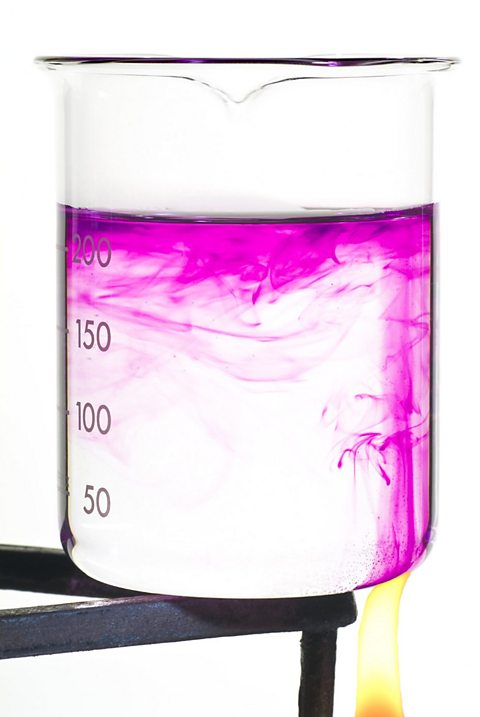
Convection in a liquid can be seen by putting a crystal of potassium permanganate in a beaker of water and gently heating it with a Bunsen flame.
Results
Heat is initially transferred through the glass wall of the beaker by The transfer of heat through a material by transferring kinetic energy from one particle to another..
The water in the region of the Bunsen flame is heated.
It expands, becomes less dense and rises.
It is replaced by the cooler, denser water which surrounds it.
This water is in turn heated, expands becomes less dense and rises.
The process continues, a convection current is set up and heat is transferred through the liquid.
The transfer of heat energy through a moving liquid or gas. currents can be seen in lava lamps.
The wax inside the lamp warms up, becomes less dense than the liquid and so rises.
Convection in a gas
A convection current in air can be demonstrated using the following apparatus.
- A burning splint or piece of rope is blown out so that it is smoky.
- When the smoky rope is held in air the smoke rises.
- The rope is then held over both chimneys in turn as shown above.
- When the rope is held above the candle the smoke rises.
- When the rope is held above the other chimney the smoke is drawn down the chimney. It then passes across the horizontal section and up through the chimney above the candle.
What is happening?
- The candle flame heats the air around it.
- The hot air expands and increases in volume.
- The density of the air decreases, and it floats upwards, rising through the chimney.
- Cooler air is sucked in through the other chimney to replace the rising, warm air – a convection current has been set up.
- The smoke from the smouldering rope shows the path of the cool air.
Early coal mines were ventilated with fresh air using a similar method.
Two shafts were dug down from ground level to the mine and a fire was lit beneath one of them.
As hot air rose upwards, fresh, clean, cool air was sucked down the other shaft and across the coal mine.
How do radiators generate convection currents?
Air close to the radiator is heated.
It expands, becomes less dense and rises.
It is replaced by the cooler, denser air which surrounds it.
This air is in turn heated, expands becomes less dense and rises.
The process continues, a convection current is set up and heat is transferred through the air and hence through the room.
A radiator heats mainly by convection – not by radiation.
Summary
- Convection is the flow of heat energy from a region of high temperature to a region of low temperature by movement of a fluid.
- Convection only occurs in fluids - liquids and gases.
- When part of a liquid or gas is heated it expands, becomes less dense and rises.
- It is replaced by the cooler, denser fluid.
- This liquid or gas is in turn heated, expands becomes less dense and rises.
- This sets up a convection current.
- Wall heaters (“radiators”) heat mainly by convection.
- Trapped air prevents heat loss by conduction and convection.
How is heat energy transferred by radiation?
Radiation is the transfer of heat energy from a region of high temperature to a region of low temperature by Electromagnetic radiation emitted from a hot object..
Unlike conduction and convection, radiation takes place without the need of any A general term for a small piece of matter. For example, protons, neutrons, electrons, atoms, ions or molecules..
Because no particles are involved, radiation can work through the vacuum of space.
This is why we can still feel the heat of the Sun even though it is 150 million km away from the Earth.

The sun's energy is carried to Earth by radiation.
As electromagnetic waves, to be precise, like a giant radiator, the sun is the major source of heat energy here on Earth.
Heat flow by radiation doesn't need anything to travel through. It doesn't need particles of air, liquid, or anything solid.
It can travel through nothing at all. So this is how the sun's energy travels through the vacuum of space.
Having reached the Earth by radiation, this energy may be absorbed by the Earth's surface as well as by things on it, and they warm up.
The energy flows and spreads through these things in one of two ways, either by conduction or convection.
When heat is transferred through a solid, like this knife that's out in the sun, this kind of energy flow is called conduction.
The particles inside metals are especially good at conducting heat. When these tightly packed particles are heated, they gain more energy, vibrate more quickly, and the heat energy is swiftly passed along from one particle to another.
By touching the hot metal object, the heat energy flows once again very quickly from the metal to Orianne's skin.
The more energy there is, the hotter it feels. Heat flows because there is a difference in temperature.
It always transfers from warmer objects or places, here the knife, to cooler ones to Rishil or Orianne's skin.
The third way that heat is transferred is by convection.
Convection is how heat energy travels in moving currents through liquids and gases.
Molecules actually move away from the source of heat, carrying energy with them.
When a glass of water is placed on. Hot sun heat will be transferred through the water by convection.
When the particles of water in the bottom of the glass heat up, they move more quickly, spread out, and become less densely packed together than the cooler particles around them.
They rise up through dense air and cooler water to the top of the glass. And this cooler water sinks to the bottom where it also gets heated up.
This movement sets up a convection current and eventually all of the liquid is heated up to the same temperature.
How to investigate the emission of heat radiation experimentally
The transfer of infrared radiation from a hot object to cooler surroundings can be investigated using a piece of apparatus called Leslie’s cube.
This is a metal cube with four sides prepared in different ways: black, white, shiny, or dull.
It can be filled with hot water or heated on an electrical hot plate so that all four sides are at the same temperature.
Method
Measure the temperature a fixed distance from each side of a Leslie's cube using four identical thermometers.
Heat the Leslie’s cube by filling it with boiling water.
Continue to measure and record the temperatures every 30 seconds for five minutes, then plot a graph of temperature on the y-axis, against time on the x-axis, for each side.
Compare the four graphs obtained.
In this experiment:
Independent variable: the type of surface of the side
Dependent variable: the temperature rise of each surface
Control variables
Distance of each thermometer from the sides of the cube, the type of thermometer used and the time taken for each reading.
Results
The temperature of the thermometer opposite the dull, black side reaches the highest temperature in the same time interval.
From this we can say that dark matt surfaces are better at radiating heat energy than light shiny surfaces.
Key point
- Dark matt surfaces are better at radiating heat energy than light shiny surfaces.
Experiment: Absorption of heat radiation
When an object absorbs radiation, it heats up and its temperature will rise.
You feel the heat of the sun when you absorb the infrared radiation from it.
If a cloud passes in front of the sun, you absorb less infrared, and it feels cooler.
How infrared radiation is absorbed can be investigated using the apparatus shown below.
Two squares of aluminium are arranged as shown above.
One is painted dull black, the other is polished and shiny.
To ensure a fair test they are the same area and thickness and are placed the same distance from the Bunsen flame.
Two identical corks are stuck to the back of the plates using equal amounts of Vaseline or candle wax (control variables).
The Bunsen is lit.
Quite quickly the cork attached to the black plate falls off.
The cork behind the polished plate takes much longer to fall off.
Conclusion
Both plates receive the same quantity of radiation, but the black plate heated up more quickly.
This tells us that a dull, black surface is a better absorber of radiation than a shiny, polished surface.
Key points
- Dark matt surfaces are better at absorbing heat energy than light shiny surfaces.
- Dark matt surfaces are better at radiating heat energy than light shiny surfaces.
| Surface | Absorption | Emission |
|---|---|---|
| Dull, matt or rough | Good absorber of heat radiation | Good emitter of heat radiation |
| Shiny | Poor absorber of heat radiation | Poor emitter of heat radiation |
What are everyday examples of heat transfer by radiation?
Teapots and saucepans are shiny so that they don’t emit too much radiation and cool down too quickly.
Cricketers wear white to remain cool in summer as white it is a good reflector (poor absorber) of radiation.
Shiny silver blankets are used to stop heat loss from a person pulled from a cold sea or evacuated from a swimming pool.
Solar panels should be black because black is a good absorber of radiation.
Radiators are often painted with white gloss paint, but they would be better at radiating heat if they were painted with matt black paint.
They are painted white to make them look nicer.
However, despite their name, radiators actually transfer most of their heat to a room by convection not radiation.
So, radiators are the wrong colour, and have the wrong name.
Normally heaters need to be red hot before they are any good at heating by radiation.
How does a vacuum flask work?
The vacuum flask is made from a glass bottle with two walls separated by a A volume of space that contains no matter. which prevents heat transfer by The transfer of heat through a material by transferring kinetic energy from one particle to another. and The transfer of heat energy through a moving liquid or gas. through the sides.
The glass walls are made of shiny silver to prevent heat transfer by This is when heat energy is transferred through electromagnetic waves generated by an object's temperature. Unlike conduction and convection, this type of heat transfer occurs even in the absence of a medium, such as in a vacuum..
The plastic screw top stopper usually contains cork or foam with trapped air to reduce heat loss by convection and conduction.
It can also be used to keep a cold drink cold, in this situation the heat is trying to enter the flask from the warmer outside region.
| Feature | Job |
|---|---|
| Vacuum between the two glass walls. | Prevents conduction and convection through the sides. |
| Silvered surfaces. | Minimises heat transfer by radiation. |
| Plastic cap. | Minimises conduction and convection through the top of the flask. |
| Outer plastic case and sponge/cork filling. | Protects the fragile glass bottle from becoming damaged by knocks and bumps. |
| Feature | Conduction | Convection | Radiation |
|---|---|---|---|
| Vacuum | \(\checkmark\) | \(\checkmark\) | \(\text{X}\) |
| Silvered surfaces | \(\text{X}\) | \(\text{X}\) | \(\checkmark\) |
| Plastic cap | \(\checkmark\) | \(\checkmark\) | \(\text{X}\) |
Speaker 1: Ok, imagine we had something that we wanted to keep nice and hot.
Speaker 2: Like… a cup of tea.
Speaker 1: Perfect, if we’re going to insulate our cup of tea, and stop it from cooling down, we need to prevent heat loss. So, we have to prevent…
Speaker 2: Conduction, convection, evaporation and radiation.
Speaker 1: You have been paying attention.
Ok, to get down conduction, we need to make small air pockets around the tea, because air is a poor conductor.
To cut down convection, we need to trap the air, and stop it from circulating.
To cut down evaporation, we need to make sure the hot liquid of the tea isn’t exposed to the air.
To cut down radiation, we need to make sure the inside of our container is silver and not black.
So, what do you think we should use to insulate our cup of tea?
Speaker 2: Well, putting together all the things that we want, I would say that the perfect container would be a vacuum flask.
Speaker 1: Spot on! Ok, let’s take a closer look at the vacuum flask. Examiners love asking questions about it, it’s such a good exam subject.
Speaker 2: What do you mean?
Speaker 1: Well, because it tests our knowledge of heat energy and how it travels.
The container has a vacuum in it, this is an area with no particles whatsoever. So, you can’t get conduction, convection or evaporation.
The inside is silver, to prevent radiation, with a stopper to prevent evaporation and convection.
It’s a clever little design, and a good exam question, so learn it.
Speaker 2: I will, in a minute.
Speaker 1: Why not now?
Speaker 2: Because my tea’s getting cold.
How to reduce heat loss from houses
Your home loses heat through the walls, windows, doors and roof.
The colder the outside temperature or the stronger the wind, the greater the amount of heat lost.
There are several ways to help reduce heat loss from your home, making it more comfortable and reducing energy bills.
| Area | \(\percent\) heat loss | Method | How it works |
|---|---|---|---|
| Roof | 25 | Insulate loft with mineral wool or fibre glass. | Trapped air between glass or mineral wool fibres reduces heat loss by conduction and convection. |
| Walls | 35 | Cavity wall insulation fills the cavity between the outside walls with mineral wool, polystyrene beads or foam. | Trapped air between fibres, beads or within foam reduces heat loss by conduction and convection. |
| Floor | 15 | Thick carpets on floors. Mineral wool beneath ground floor floorboards. For concrete floors rigid foam insulation can be used. | Trapped air between carpet threads, wool fibres and within foam reduces heat loss by conduction. |
| Windows, doors and unused chimneys. | 25 | Fit double or triple glazing. Heavy curtains on windows. Block up unused chimneys. Draught excluders around doors and windows. | Layers of glass reduce heat loss by conduction. Trapped air between the layers of glass reduces heat loss by conduction and convection. Curtains trap air reducing heat loss by conduction and convection. Draught excluders and blocked chimneys trap air preventing heat loss by conduction and convection. |
What is cavity wall insulation?
How much do you know about heat transfer?
More on Energy
Find out more by working through a topic
- count1 of 4

- count2 of 4
- count3 of 4