What are the key learning points about electricity generation?
An electric current can be induced in a coil of wire by moving a magnet in and out of the coil.
The size of the induced current is increased by increasing the speed of the moving magnet, using a stronger magnet or by having more turns on the coil of wire.
AC generators are used in the generation of electricity and in their simplest form consist of a coil of wire rotated between the poles of a magnet.
Transformers come in two types;
step-up transformers increase the The potential difference across a cell, electrical supply or electrical component. It is measured in volts (V). (and decrease the current)
step-down transformers decrease the voltage.
Transformers consist of a primary coil, secondary coil and an iron core.
The output voltage depends on the number of turns on the secondary coil compared to the primary coil.
The input and output voltages are both alternating.
How is electricity generated?
The electrical energy that we use in our homes and schools may be generated in a power station or wind Revolving machine with blades that are turned by wind, water or steam. Turbines in a power station turn the generators..
Because it is a form of energy, electrical energy cannot be “made”.
It must be converted from a different form of energy.
How this can be done is shown below.
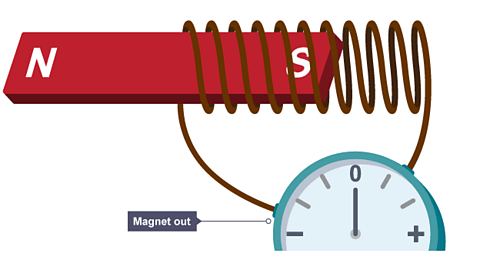
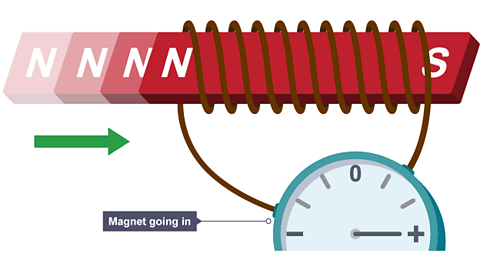
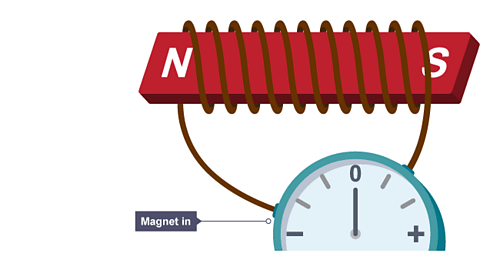
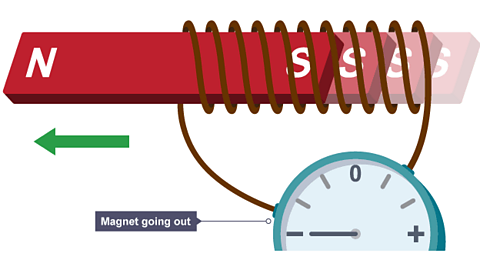
When one of the Either of the two points of a magnet to and from which the lines of magnetic force are directed. of a permanent magnet is moving into, or out of, a coil of wire connected to a sensitive centre-zero A device used to measure electric current., the pointer on the ammeter deflects to one side.
This indicates that a current is being induced in the coil.
This can be demonstrated using the apparatus shown below:
1 of 4
As the magnet moves into and out of the coil of wire, the The energy an object possesses by being in motion. of the moving magnet is converted to electrical energy.
The process is known as electromagnetic induction.
We say that electricity is generated when the magnet moves near or inside the coils of wire and electric current flows.
Notice that no current is induced when the magnet is not moving, even if it is inside the coil.
We say that a current is induced when the magnet moves relative to the coil.
Key point
- The direction of the current can be reversed by reversing the direction the magnet moves or by turning the magnet around and reversing the poles of the magnet.
Summary of observations
| Direction of movement of magnet | Needle of ammeter | Current is induced? Yes or No |
|---|---|---|
| Magnet is stationary outside of coil | Remains at zero | No |
| South pole moves into coil | Deflects in one direction and then returns to zero | Yes, while the magnet is moving |
| Magnet is stationary inside of coil | Remains at zero | No |
| South pole moves out of coil | Deflects in the opposite direction and then returns to zero | Yes, while the magnet is moving |
Key points
The size of the induced current can be increased by:
Moving the magnet faster into and out of the coil.
Adding more turns to the coil.
Increasing the strength of the magnet.
The current induced when a magnet moves into and out of a coil is an alternating current.
The process is the basis of electricity generation in power stations and generators.
The energy change is:
kinetic energy → electrical energy.
How do AC generators work?
Cars use a type of AC generator, called an An electrical generator which produces alternating current, an ac generator., to keep the battery charged and to run the electrical system while the engine is working.
A dynamo is another type of generator sometimes found on the back wheel of a bicycle to run the lights.
Both convert kinetic energy to electrical energy when a coil of wire rotates inside a magnet.
A simple generator
The diagram shows a simple generator.
The size of the induced voltage, and hence induced current, can be increased by:
Increasing the speed of rotation of the coil.
Using a stronger magnet.
Increasing the number of turns on the coil.
Large scale a.c. generators in power stations are used to generate electricity.
The coil of these generators rotates 50 times a second and that is why our mains supply has a frequency of 50 Hz.
In Northern Ireland, large scale AC generators are used to produce electricity, like the ones at Ballylumford and Kilroot in Co. Antrim, which is then transmitted across country to consumers.
How do we turn fossil fuels into energy?
Soon natural gas will be used in all of Northern Ireland’s power stations.
It is found under the sea bed, for instance in the North Sea, off the coast of Scotland, and Norway, or in the Atlantic Ocean, off the coast of County Mayo in Ireland.
- A natural gas pipeline pumps the gas to a power station.
- Combustion chambers fire hot compressed air into the gas.
- The gas burns and its chemical energy changes to heat energy.
- The hot gas heats the air which gets hotter and expands.
- Heat energy changes to The energy an object possesses by being in motion. as the expanding hot air is pushed through pipes to the turbines.
- The hot air turns turbines.
- Finally, the spinning turbines turn generators which convert kinetic energy into electricity.
The main energy changes are:
- Chemical energy → heat energy (as the gas burns).
- Heat energy → kinetic energy (as the hot air rotates the turbine).
- Kinetic energy → electrical energy (as the generator spins).
What are transformers? (Higher tier only)
Transformers are used to increase or decrease the The potential difference (or voltage) of a supply is a measure of the energy given to the charge carriers in a circuit. Units = volts (V). This is the voltage between two points that makes an electric current flow between them. of Alternating current occurs when electric charges continually change direction whilst moving through a conductor. Mains AC supply alternates with a frequency of 50Hz..
A transformer consists of three main parts:
A primary coil.
A secondary coil.
An iron core on which the two coils are wound.
What are the different types of transformers?
Transformers are used to convert, or transform, voltages from low to high or high to low.
They only work with alternating current, AC.
This has a similar role to the moving magnet or coil in a generator.
The size of the output voltage depends on the number of turns on the secondary compared to the primary coil.
There are two types of transformer:
A step-up transformer, which steps-up voltage, has more turns in the secondary than in the primary.
A step-down transformer, which steps-down voltage, has fewer turns in the secondary than in the primary.
The transformer in the diagram above is a step-down transformer – there are fewer turns on the secondary coil than on the primary coil.
| Type of transformer | Size of output voltage | Number of turns on the secondary compared to the primary |
|---|---|---|
| Step-up | Increased | More |
| Step-down | Decreased | Fewer |
Question
The primary coil of a transformer has 1,000 turns.
What type of An electrical device that increases, or decreases, the potential difference (voltage) of an alternating current. is it if the secondary coil has 500 turns?
Answer
The secondary coil has fewer turns than the primary coil and so this is a step-down transformer.
It will step-down voltage.
How do transformers affect electric current?
When a transformer steps-up voltage it has exactly the opposite effect on the current.
The current is stepped-down or decreased in size.
As we will see, this is very useful when transmitting electricity from a power station across country to your home.
Likewise, a step-down transformer steps-down the voltage but steps-up the current.
Key points
A step-up transformer:
- Steps-up voltage.
- Steps-down current.
- Has more turns of wire on the secondary coil.
A step-down transformer:
- Steps-down voltage.
- Steps-up current.
- Has fewer turns of wire on the secondary coil.
What do transformers do in the transmission of electricity?
Electricity is distributed from power stations to consumers through the National Grid, which allows distant power stations to be used.
It also allows a mix of different energy resources to be used efficiently to supply the country’s electricity, whatever the local demand.
The National Grid ensures a reliable supply of electricity.
If one power station breaks down, the grid will continue to supply electricity from other power stations in the grid.
The National Grid also responds to the demand for electricity – supplying more at peak times.
What are the main features of the National Grid?
The diagram below shows the main features of the National Grid.
The greater the current in a cable, the greater the heat loss to the surroundings.
This means that high currents waste more energy than low currents.
Why use high voltage?
When a transformer steps up voltage, current is stepped down.
A step-up transformer at the power station steps up the voltage and consequently steps down the current.
This means that the current flowing in the overhead cables is relatively small and can be distributed long distances across country.
Transmitting small current greatly reduces heat lost in the cables, which in turn reduces the number of power stations needed.
The main features of the Grid are:
Power station which generates electricity at 25,000 V.
A A transformer that increases the voltage of the ac supply. beside the power station to step-up the voltage and consequently step-down the current reducing electrical energy wasted as heat energy in the overhead cables. Electricity is sent through these at 400,000 V.
A A transformer that decreases the voltage of the ac supply. close to domestic consumers to step the voltage down to 230 V for safe use in the home
How to stay safe when near power lines
High voltage overhead power cables are very dangerous.
The cables are supported high above the general public on pylons.
However, electricity can kill even if you do not touch the line itself.
The voltage levels are so high that accidents can occur several meters from the power line.
It is important that nobody or anything is too close to a power line.
Pylons and transformers are not playgrounds or climbing frames.
Do not play with kites near power lines.
Do not use an outdoor trampoline near power lines.
Do not fish near power lines.
Never refuel a vehicle or machine closer than 60 meters from a power line.
How much do you know about electricity generation?
More on Energy
Find out more by working through a topic
- count4 of 4
- count1 of 4

- count2 of 4