What are the key learning points about energy forms?
Energy can exist in many forms such as chemical, heat, electrical, sound, light, magnetic, Energy stored in squashed, stretched or twisted materials., The energy an object possesses by being in motion. and The energy an object possesses due to its position above the ground..
The Principle of Conservation of Energy states that energy can be changed from one form to another but the total amount of energy does not change.
Energy is measured in joules (J) and 1 J is approximately the energy needed to lift an apple vertically 1 m.
Energy transfer diagrams show the energy conversions that occur in a range of common devices found in everyday life.
An object has gravitational potential energy \(E_{p}\) because of its position above the ground.
The equation \(E_{p}\) = mgh is used to calculate the potential energy in joules, where m is the mass in kilograms, h is the vertical height in metres and g is 10 N/kg.
Kinetic energy \(E_{k}\) is the energy possessed by a moving object.
The equation \(E_{k}\) = \(\frac{1}{2}\) mv2 is used to calculate kinetic energy in joules, where m is the The amount of matter an object contains. Mass is measured in kilograms (kg) or grams (g). of the object in kg and v is the speed of the object in m/s.
What are the different types of energy?
JONNY NELSON: Energy. There are lots of different types and lots of different ways of storing it.
Chemical energy in a sparkler, elastic potential energy that fires a toy into the air, and many, many more.
NARRATOR: Energy can be transferred. But energy can never ever, under any circumstances, be created or destroyed.
Yeah, never ever.
There are though, lots of different ways to store energy including:
Kinetic energy
Internal energy
Elastic potential energy
Gravitational potential energy
Nuclear energy
Magnetic energy
Let's look at some of these in more detail.
Moving objects have kinetic energy. The more mass and speed they have, the more kinetic energy they have.
All objects have internal energy, including both thermal energy contained in the vibration of its particles and also chemical energy stored in the bonds between particles.
Elastic potential energy is stored when an elastic object changes shape in a reversible way, like a catapult. The stretching or squashing stores energy.
Gravitational potential energy is stored when an object is moved higher than or away from a gravitational field. The amount of energy stored depends on:
The vertical height of the object
The strength of the gravitational field
The mass of the object
Batteries are stores of chemical energy that create current and some objects, like a Van der Graaf generator, are statically charged,while others can be magnetised and store magnetic energy.
As mentioned, although energy cannot be created or destroyed, it can be transferred or converted from one type to another.
For instance, one object can heat another cooler object, transferring heat energy.
Energy can also be transferred mechanically through movement when the motion or position of an object changes, such as one ball hitting another on a pool table.
Mechanical waves such as sound waves or the seismic waves created in an earthquake can also transfer energy mechanically.
Electrical energy can be transferred when an electrical circuit is completed. The internal energy stored in a battery is transferred to moving charged particles in the wire.
Lamps transfer visible light and thermal radiation to the surroundings, and when an object falls to the ground, the gravitational potential energy it possessed is converted to kinetic energy.
Even food transfers energy. It contains chemical energy stored in the bonds between particles, and eating and metabolising food creates an energy conversion in the body.
In a similar way, burning an object like wood causes the internal energy in the wood to be converted into heat, sound, and light given out by the flames.
When it comes to energy, there are three main equations that we need to understand and remember:
Kinetic Energy
Kinetic energy = ½ × mass × velocity²
Because velocity is squared, it has a huge impact on the total kinetic energy.
Gravitational Potential Energy
Gravitational potential energy = mass × gravitational field strength × height
Elastic Potential Energy
Elastic potential energy = ½ × force × extension
or
Elastic potential energy = ½ × spring constant × extension²
JONNY: Energy can't be created or destroyed, but it can be and is stored and transferred.
Forms of energy are just different types of energy such as chemical, heat, electrical, sound, light, magnetic, Energy stored in squashed, stretched or twisted materials., The energy an object possesses by being in motion. and The energy an object possesses due to its position above the ground..
Energy resources are stores of a particular form of energy.
Chemical energy is a form of energy.
Coal is an example of an energy resource - it is a store of chemical energy.
Energy forms
The main forms of energy are:
- chemical
- heat
- electrical
- sound
- light
- magnetic
- strain energy
- kinetic
- gravitational potential
- nuclear
Energy is measured in joules, J.
Remember that 1000 J = 1 kJ.
1 J is approximately the energy needed to lift an average sized apple 1 m vertically above a table.
Key points
Energy is measured in Joules (J).
1J is approximately the energy needed to lift an apple vertically 1 m.
What are examples of energy forms?
| Energy store | Description | Examples |
|---|---|---|
| Magnetic | The energy stored when repelling poles have been pushed closer together or when attracting poles have been pulled further apart. | Fridge magnets, compasses, maglev trains which use magnetic levitation. |
| Heat energy | The total kinetic and potential energy of the particles in an object, in most cases this is the vibrations - also known as the kinetic energy - of particles. In hotter objects, the particles have more internal energy and vibrate faster. | Human bodies, hot coffees, stoves or hobs. Ice particles vibrate slower, but still have energy. |
| Chemical | The energy stored in chemical bonds, such as those between molecules. | Foods, muscles, electrical cells. |
| Kinetic | The energy of a moving object. | Runners, buses, comets. |
| Electrical or electrostatic | The energy stored when repelling charges have been moved closer together or when attracting charges have been pulled further apart. | Thunderclouds, Van De Graaff generators. |
| Strain energy | The energy stored when an object is stretched or squashed. | Drawn catapults, compressed springs, inflated balloons. |
| Sound | Sound is caused by a vibrating object. The vibrations pass to surrounding particles of matter and then from one particle to another in waves. Sound energy moves through solids, liquids and gases as these all have particles to pass on the vibrations. | Music playing through earbuds, a plucked guitar string, someone talking. |
| Gravitational potential | The energy of an object at height. | Aeroplanes, kites, mugs on a table. |
What are energy transfers?
Different forms of energy can be transferred from one form to another.
Plants, animals and machines all transfer energy.
Energy transfer diagrams show each form of energy - whether it is stored or not - and the processes taking place as energy is transferred.
The energy transfer diagram below shows the useful energy transfer in a car engine.
You can see that a car engine transfers chemical energy, which is stored in the fuel, into The energy an object possesses by being in motion. in the engine and wheels.
Chemical energy \(\rightarrow\) kinetic energy
\(\rightarrow\) means "is converted to".
This diagram shows the energy transfer for the useful energy transfer in an electric lamp.
You can see that the electric lamp transfers or converts electrical energy into light energy.
Electrical energy \(\rightarrow\) light energy
Note that these energy transfer diagrams only show the useful energy transfers.
However, when energy is changed some is always converted into less useful forms, or “wasted”.
Car engines are noisy and hot, and so some of the chemical energy is converted to heat and sound.
The electric lamp heats up and so some of the electrical energy is converted to heat energy.
In this simple circuit below there are two energy changes.
In the cell, a chemical reaction occurs and chemical energy is converted into electrical energy.
Cell: chemical energy \(\rightarrow\) electrical energy.
The lamp converts electrical energy to light energy.
Lamp: electrical energy \(\rightarrow\) light energy
In both the cell and the lamp there is wasted heat energy.
Sometimes your mobile phone feels warm.
In the battery, chemical energy is converted to electrical energy and heat energy.
The phone uses the electrical energy, and you feel the results of the wasted heat energy.
What are some examples of energy transfers?
Energy transfers
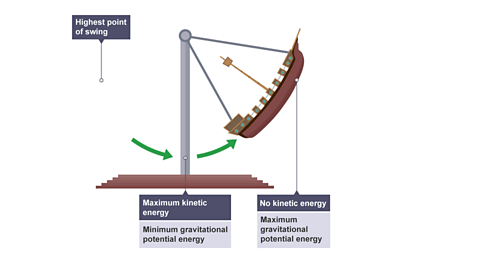
Image caption, A swinging pirate ship ride at a theme park
Kinetic energy is transferred into gravitational potential energy
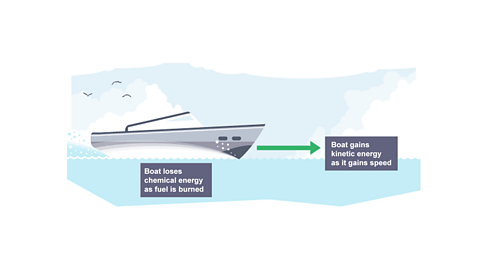
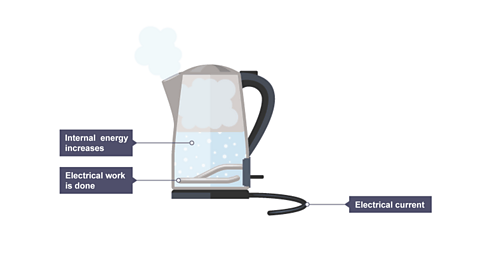
1 of 3
Some more everyday energy transfers
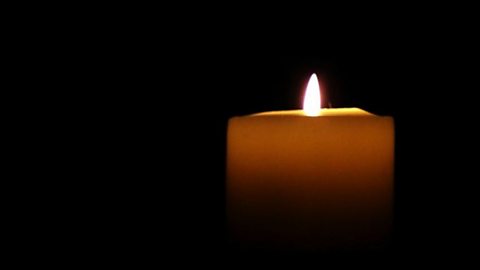


A candle
Chemical energy \(\rightarrow\) light energy
There is wasted heat energy as the candle burns.
A microphone
Sound energy \(\rightarrow\) electrical energy
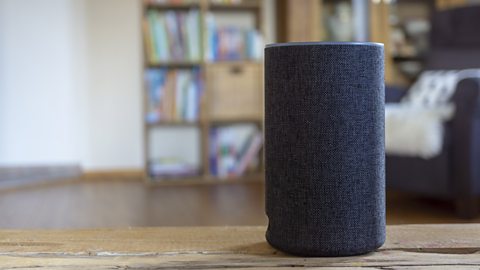
A loudspeaker
Electrical energy \(\rightarrow\) sound energy
There is wasted heat energy as the speaker becomes warm.
A green plant leaf
Light energy \(\rightarrow\) chemical energy
What is the Principle of Conservation of Energy?
Key fact
- Energy can be changed from one form to another but cannot be created or destroyed.
The Principle of Conservation of Energy states that: energy can be changed from one form to another but the total amount of energy does not change.
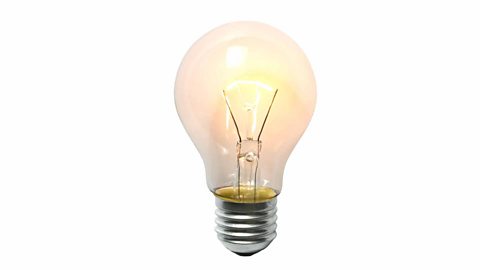
This energy transfer diagram below for an electric filament lamp shows that most of the electrical energy is transferred as heat energy rather than light energy.
Note that 100 J of electrical energy is supplied to the lamp.
Of this, 10 J is transferred to the surroundings as useful light energy.
The remainder, 90 J (100 J – 10 J) is transferred to the surroundings as wasted heat energy.
The energy transfer to light energy is the useful transfer.
The rest is ‘wasted’.
It is eventually transferred to the surroundings, making them warmer.
This ‘wasted’ energy eventually becomes so spread out that it becomes very difficult to do anything useful with it.
Question
A bulb in an electrical circuit uses 100J of electrical energy.
According to the principle of conservation of energy, what must the total energy output from the bulb be?
Answer
100J.
Energy cannot be created or destroyed so the total energy output from the bulb must be equal to the energy used by the bulb.
Question
If 20J is converted to light energy how much energy is converted to heat?
Answer
80J.
If the bulb used 100J of energy and 20J converted to light energy then the remainder (100 - 20 = 80) must be converted to heat.
How do electric lamps work?
Ordinary electric lamps contain a thin metal filament that glows when electricity passes through it.
However, most of the electrical energy is transferred as heat energy instead of light energy.
Modern energy-saving lamps and LEDs (light-emitting diodes) work in a different way.
They transfer a greater proportion of electrical energy as light energy.
This is the Sankey diagram for a typical LED lamp:
From the diagram, you can see that much less electrical energy is transferred, or 'wasted', as heat energy from the energy-saving lamp.
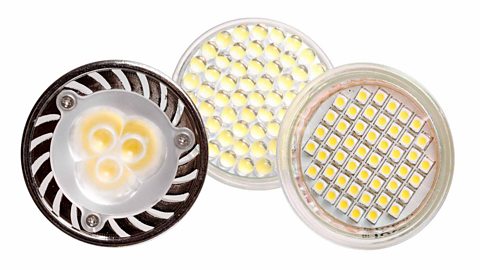
As the LED bulbs convert more of the input electrical energy into light, they are more efficient than the filament lamp.
What is kinetic energy? (Higher tier only)
Kinetic energy is the energy of a moving object.
Any object that is moving has kinetic energy.
The amount of kinetic energy of an object has depends on its:
- mass;
- speed of the object.
What would have more kinetic energy - a bird or an aeroplane?

The aeroplane above would typically have more kinetic energy than the bird for two reasons:
It has more mass.
It has a greater speed.
Another example is space junk.
A small bolt in orbit could be dangerous because even though it has a small mass, it has a huge speed, therefore a huge amount of kinetic energy.
How to calculate kinetic energy (Higher tier only)
The kinetic energy of a moving object can be calculated using the equation:
Kinetic energy = \(\frac{1}{2}\) x mass x (speed)2
Kinetic energy = \(\frac{1}{2}\) mv2
or
\(E_{k}\) = \(\frac{1}{2}\) mv2
where:
\(E_{k}\) = kinetic energy in joules, J
m = mass in kg
v = speed in m/s
Question
What is the kinetic energy of a 1000 kg car travelling at 5 m/s?
Answer
\(E_{k}\) = \(\frac{1}{2}\) mv2
m = 1000 kg
v = 5 m/s
\(E_{k}\) = \(\frac{1}{2}\) 1000 kg x (5 m/s)2
\(E_{k}\) = 12,500 J
The car has 12,500 J of kinetic energy
Question
A car of mass 1200 kg, travelling at a steady speed, has a kinetic energy of 175 kJ. What is the speed of the car?
Answer
\(E_{k}\) = \(\frac{1}{2}\) mv2
The car has 175 kJ of kinetic energy. This must be converted into J to use in the equation for kinetic energy.
175 kJ = 175,000 J
\(E_{k}\) = 175,000 J
m = 1200 kg
175,000 = \(\frac{1}{2}\) x 1200 kg x v2
175,000 = 600 kg x v2
v2 = \(\frac{175,000 J}{600 kg}\)
v2 = 291.67
v = \(\sqrt{291.67}\)
v = 17.1 m/s
The car has a speed of 17.1 m/s.
The car in the above question has 175,000 J of kinetic energy when travelling at a speed of 17.1 m/s.
When it stops it has zero kinetic energy.
So, where has the kinetic energy gone?
From the principle of conservation of energy, energy can never be destroyed; it can only be transferred from one form to another.
If the car is stopped using the brakes, the kinetic energy is mainly converted to heat energy in the brakes, and they become hot.
This heat energy then spreads out to the surroundings.
There is some sound energy which also spreads out.
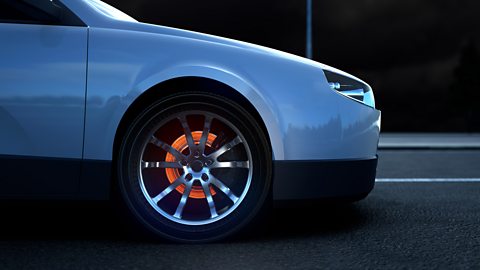
As the car brakes: kinetic energy \(\rightarrow\) heat energy.
What is gravitational potential energy? (Higher tier only)
Any object lifted above the ground has gravitational potential energy ( Ep) or GPE).
The amount of gravitational potential energy an object has on Earth depends on its:
- mass;
- height above the ground.
In the diagram:
- all the books on a shelf have GPE;
- books A and B have more GPE than book C because they are higher;
- book B has more GPE than book A because it has a greater mass.
How is gravitational potential energy calculated? (Higher tier only)
The gravitational potential energy of an object raised above the Earth’s surface can be calculated using the equation:
gravitational potential energy = mass x gravitational field strength x vertical height raised
gravitational potential energy = mgh.
or
Ep = mgh
where:
Ep is the gravitational potential energy in joules, J
m is the mass in kilograms, kg
g is the gravitational field strength in newtons per kilogram, N/kg
h is the change in height in metres, m.
On Earth, g = 10 N/kg.
Question
A book with a mass of 0.25 kg is lifted 2 m onto a bookshelf. If g is 10 N/kg, how much gravitational potential energy does it gain?
Answer
\(E_{p}\) = mgh
m = 0.25 kg
g = 10 N/kg
h = 2 m
\(E_{p}\) = 0.25 kg x 10 N/kg x 2 m
\(E_{p}\) = 5 J
The gravitational potential energy gained by the book is 5 J.
Question
A book of mass 600 g has 12 J of gravitational potential energy. How high is it above the Earth’s surface? (g = 10 N/kg)?
Answer
The book has mass 600 g.
This must be converted into kg to use in the equation for gravitational potential energy.
600 g = \(\frac{600~kg}{1000}\) = 0.6 kg
\(E_{p}\) = mgh
\(E_{p}\) = 12 J
m = 0.6 kg
g = 10 N/kg
12 J = 0.6 kg x 10 N/kg x h
h = \(\frac {12~J}{{0.6~kg} \times {10~N/kg}}\)
h = 2 m
The book is 2 m above the surface of the Earth.
Conservation of energy and gravitational potential energy
The book in the above question has 12 J of gravitational potential energy when it is 2 m above the ground.
If the book falls to the floor, it loses its GPE.
So, where has it gone?
From the principle of conservation of energy, energy can never be destroyed; it can only be transferred from one form to another.
When the book starts to fall its gravitational potential energy is converted to kinetic energy.
As the book gets faster it gains more kinetic energy and loses more potential energy.
Just before it hits the floor all the gravitational potential energy has been converted to kinetic energy.
When the book hits the floor it stops – the kinetic energy of the book is converted into heat and sound energy.
As the book falls:
gravitational potential energy \(\rightarrow\) kinetic energy.
When the book hits the ground:
kinetic energy \(\rightarrow\) heat energy + sound energy.
Rollercoasters use these energy transfers too.
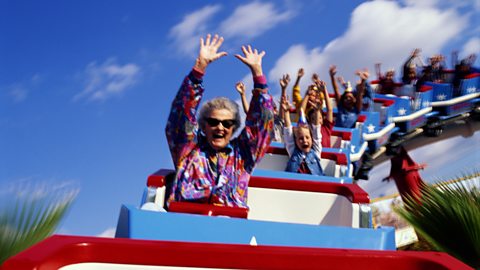
The rollercoaster car gains GPE as it travels to the top.
Once over the top, the car gains speed as GPE is transferred to kinetic energy.
As it travels to the top of another loop, kinetic energy is transferred to GPE.
Not all the energy is transferred to or from GPE – some is transferred to the surroundings as heat and sound.
Other theme park rides use the transfer of gravitational potential energy to kinetic energy and kinetic energy to gravitational potential energy.
As the pirate ship falls, GPE is transferred into kinetic energy.
At the bottom of the swing, it's travelling at its highest speed.
As it swings back up the other side it slows down as its kinetic energy is transferred back into GPE.
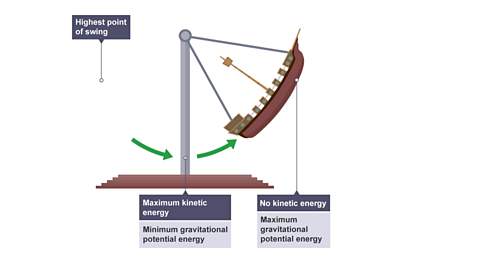
Kinetic energy, gravitational potential energy and conservation of energy
If an object, such as a ball is lifted above the ground it has gravitational potential energy.
If the ball is then dropped from rest it will fall back to the ground.
The gravitational potential energy is converted to kinetic energy.
Due to the principle of conservation of energy we can say that:
gravitational potential energy at the top = kinetic energy at the bottom
GPEtop = KEbottom
Note: this assumes we are ignoring energy transferred to the surroundings as heat or sound.
How much do you know about energy forms?
More on Energy
Find out more by working through a topic
- count2 of 4
- count3 of 4
- count4 of 4