What are the key points about the dangers and uses of radiation?
To identify and understand the dangers of exposure to The process where certain material decay and emit one of 3 different types of radiation (alpha, beta or gamma). sources.
To state ways to reduce the risk when using radioactive sources.
To identify the correct radioactive source for different applications.
How is radiation used in medicine?
Sterilisation of surgical instruments
Gamma rays are high energy electromagnetic waves which are only stopped by thick lead or concrete.
This means they can easily pass through medical equipment, such as syringes.
As gamma rays pass through the packaging and syringe, they will kill viruses and bacteria which contaminate the syringe.
As long as the equipment remains in a sealed plastic pack, it will remain free of viruses and bacteria and be safe for use with patients.
The gamma ray source used should have a long The half-life of a radioactive source is the time taken for its activity to fall to half of the original activity. so that the hospital does not have to replace it too frequently.
Advantages:
Sterilisation can be done without high temperatures.
It can be used to kill bacteria on things that would melt eg plastic syringes.
Disadvantages:
It may not kill all bacteria on an object.
It can be very harmful - standing in the environment where objects are being treated by radiation could expose people’s cells to damage and possibly cancer.
What is radiotherapy?
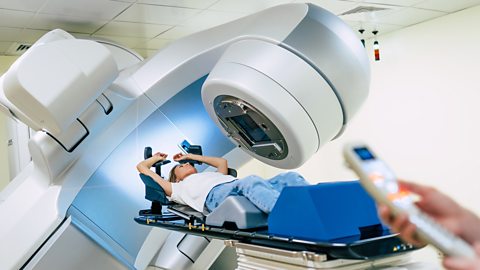
Although Radiation that is able to remove electrons from atoms or molecules to produce positively charged particles called ions. can cause cancer, high doses can be directed at cancerous cells to kill them.
This is called radiotherapy.
About 40 per cent of people with cancer undergo radiotherapy as part of their treatment.
It is administered in two main ways:
From outside the body using High frequency electromagnetic radiation, used for medical imaging. or A type of ionising radiation that is also part of the EM spectrum. It has no mass. from radioactive cobalt.
From inside the body by putting radioactive materials into the The lump of cells formed as a result of uncontrolled cell division. or close to it.
What is a gamma knife?
Beams of gamma rays, called a gamma knife, can be used to kill the cancerous tumour deep inside the body.
These beams are aimed at the tumour from many different directions to maximise the dose on the tumour but to minimise the dose on the surrounding soft tissue.
This technique can damage healthy tissue, so careful calculations are done to establish the best dose enough to kill the tumour, but not so much so that the healthy tissue is damaged.
The gamma ray source used should have a long half-life so that the hospital does not have to replace it too frequently.
What are radioactive tracers?
In some cases, injected radioactive sources (such as technetium-99) can be used as tracers to make soft tissues, such as blood vessels or the kidneys, show up through medical imaging processes.
The radioactive source emits gamma rays that easily pass through the body to a detector outside the body, for example a ‘gamma camera’.
In this way, the radioactive source can be followed as it flows through a particular organ in the body.
Changes in the amount of gamma emitted from different parts would indicate how well the isotope is flowing, or if there is a blockage.
The source used must:
Be a source of gamma rays so that they pass out through the body to be detected by the gamma camera or G-M tube.
Have very short half-lives - sources used typically have half-lives of hours so after a couple of days there will hardly be any radioactive material left in a person’s body.
Not be poisonous.
How is radiation used in industry?
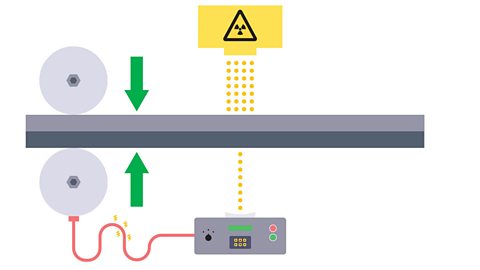
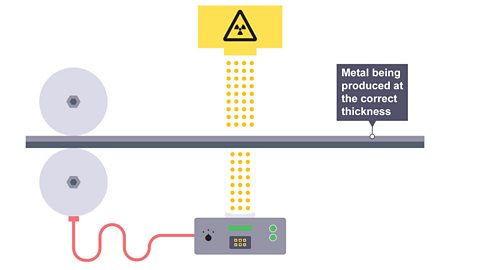
To control the thickness of metal or paper
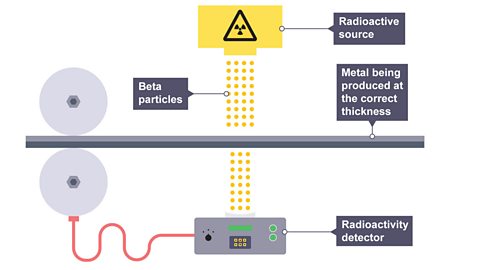
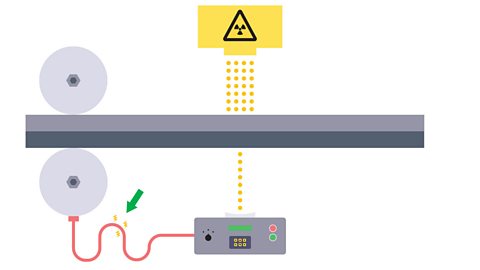
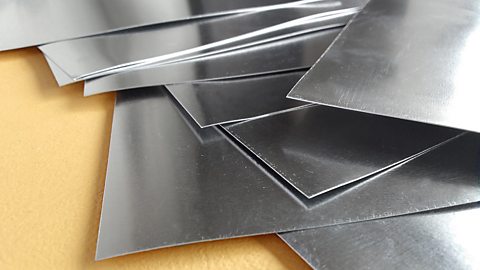
Image caption, 1. Radioactive isotopes are used in industry to control the thickness of metal or paper as it is rolled into thin sheets. An emitter is placed on one side of a sheet and a detector on the other. If the thickness of the sheet remains constant the activity will not change.
1 of 6
To check for leaks in water pipes
Water supplies can be contaminated with a gamma-emitting radioactive source to find leaks in pipes.
Where there is a leak, contaminated water seeps into the ground, causing a build-up of gamma emissions in that area.
The build-up of gamma emissions can be found using a Device used to detect and measure the quantity of ionising radiation in an area.
This makes it easier to decide where to dig to find the leak without having to dig along the whole length of the pipe.
The radioactive source used for this purpose must:
Be a gamma emitter to penetrate the ground and road surface.
Have a half-life of at least several days to allow the emissions to build up in the soil but not too long so that exposure is limited and will not be poisonous to humans as it will form part of the water supply.
How is radiation used in the home?
Smoke detectors
One type of smoke detector uses Americium-241, an Subatomic particle comprising two protons and two neutrons (the same as a helium nucleus). source, to detect smoke.
The alpha particles pass between the two charged metal plates, causing air particles to ionise (split into positive and negative ions).
The ions are attracted to the oppositely charged metal plates causing a current to flow.
When smoke enters between the plates, some of the alpha particles are absorbed causing less ionisation to take place.
This means a smaller than normal current flows so the alarm sounds.
An alpha source is used because alpha radiation does not penetrate very far.
It is absorbed by a few cm of air.
This means that as long as the detector is high up on a wall, or the ceiling, it is safe for humans to be in the same room.
The source should have a long half-life so that the smoke detector does not have to be replaced too frequently, and so that the count rate remains almost constant each day.
How is radiation used in agriculture?
In agriculture, radiation is used to improve food production and packaging.
The radioactive source, phosphorus-32, is used to study the uptake of fertilisers by plants.
It is mixed with fertiliser and fed to plants through the soil.
Phosphorus-32 emits beta particles and has a The half-life of a radioactive source is the time taken for its activity to fall to half of the original activity. of 14 days.
By measuring the radiation given out by the leaves, a researcher can find out how much fertiliser has reached them.
This information can be used to make grass and cow farming more productive.

How are gamma rays used in food preservation?
Gamma radiation from a radioactive source such as cobalt-60 can be used to kill bacteria on fresh food and enable it to keep for longer.
Harmful bacteria, moulds and yeasts grow on foods, and can be killed by gamma rays.
This helps to prolong the shelf life of fresh fruit, vegetables, spices, fish and chicken, reduces food poisoning and food waste, and helps to keep prices down.
Using radiation in this way does not make the food radioactive as the food itself never comes into contact with the radioactive source.
It is the energy from the radioactive source in the form of gamma rays that kills the bacteria that can cause food poisoning in a similar way that heat energy kills bacteria when food is heated.
Once the radiation treatment has stopped, the food quickly loses this energy in the same way that cooked food quickly cools down.
What other ways is radiation used in agriculture?
Other uses of radiation in agriculture include:
- Plant seeds can be exposed to radiation to produce new, stronger and better plants.
- Radiation can be used to control the number of dangerous insects. This decreases the use of dangerous pesticides.
- Radioactive sources are used in machines that measure the thickness of eggshells to screen out thin, breakable eggs before they are packaged in egg cartons.
- Many of our foods are packaged in polyethylene shrinkwrap. This is exposed to radiation so that it can be heated above its usual melting point and wrapped around foods to provide an airtight protective covering.
What is carbon dating?
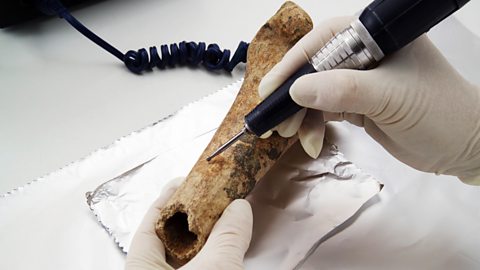
Carbon-14 is radioactive and is found in all living organisms.
Plants absorb carbon dioxide from the atmosphere and animals eat plants.
This means all living things have radioactive carbon-14 in them.
When an organism, eg a tree, dies it stops taking in carbon dioxide.
The amount of carbon-14 in the wood decreases with time as it decays into nitrogen with a half-life of about 5730 years.
By comparing how much carbon-14 there is in the dead organism with the amount in a living one, the age of the dead organism can be determined.
WATCH: How is radiation used in everyday life?
Here are three examples of how radiation is used in everyday life.
Radiation can be used in many ways.
Using the correct isotope is important to ensure the task can be carried out efficiently while also minimising potential harm to people or the environment.
This is why knowing if an isotope has a long or short half-life is crucial.
Example one: smoke alarms.
All day long, a smoke alarm uses alpha particles within the detector to ionise the air particles it comes into contact with.
This releases electrons that flow through the alarm circuit as an electrical current.
But when smoke enters the detector, it captures the ions and electrons, preventing the electric current from flowing, which sets the alarm off.
We don’t want our smoke alarms to stop working too quickly, so the alpha particle source used in them has a long half-life, allowing them to work for many years without needing replacement.
Example two: in factories.
Beta radiation is used to control the thickness of sheet materials like paper and aluminium foil by monitoring how much radiation passes through the material.
Beta particles are used because they can penetrate thin materials but are absorbed by changes in thickness.
Sources with a long half-life are used so the activity rate remains constant over time and doesn’t need replaced often.
Example three: in medicine.
Gamma rays are used to monitor the function of organs by injecting a small amount of a gamma ray source into the bloodstream and using a gamma camera that detects the gamma rays as they pass out of the body.
A short half-life allows enough time for imaging while ensuring any radioactivity leaves the body quickly.
So to recap, radiation is used every day in industry, medicine and more, but knowing the half-life of isotopes is crucial for getting the task done efficiently and reducing potential harm.
What is ionising radiation? (Higher tier only)
The radiation emitted from unstable nuclei is called ionising radiation because as it passes through Sub-atomic particles and anything made from them, such as atoms and molecules, are matter. Energy and forces are not matter. it can dislodge outer A subatomic particle with relative mass of ¹⁄₁₈₄₀. The relative charge of an electron is -1. from atoms causing them to become Electrically charged particle, formed when an atom gains or loses electrons..
Normally, atoms are neutral.
They have the same number of protons in the nucleus as they have electrons orbiting in the energy levels around the nucleus.
Atoms can, however, lose or gain electrons due to collisions or other interactions, often with nuclear radiation.
When they do, they form charged particles called ions:
if the atom loses one or more electrons, it becomes a positively-charged ion,
if the atom gains one or more electrons, it becomes a negatively-charged ion.
What is the effect of radiation on the human body? (Higher tier only)
Radioactive materials are hazardous.
Radioactive emissions cause dangerous Process by which electrons can be added or removed from an atom to create an ion. by removing A subatomic particle with relative mass of ¹⁄₁₈₄₀. The relative charge of an electron is -1. from atoms.
When this happens with A collection of two or more atoms held together by chemical bonds. in living cells, the genetic material of a cell (the The part of the cells of living things that carries information about how they look and function. Everyone’s DNA is different, except identical twins who share the same DNA.) is damaged.
This can lead to A disease caused by normal cells changing so that they grow and divide in an uncontrolled way. The uncontrolled growth causes a lump called a tumour to form. .
Radiation can also deposit large amounts of energy into the body, which can damage or destroy cells completely.
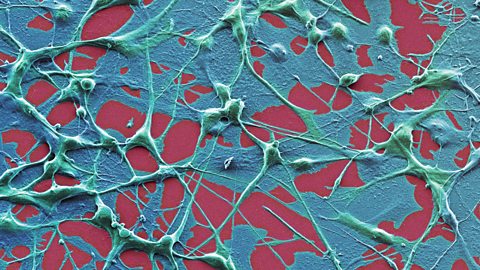
Very high doses of radiation can kill cells completely.
We use this property of radiation to kill cancer cells as well as harmful bacteria and other micro-organisms.
Alpha, beta and gamma radiations are all examples of Radiation that is able to remove electrons from atoms or molecules to produce positively charged particles called ions..
- Alpha particles are highly ionizing but are easily stopped and don’t travel very far.
- The ionizing power of gamma rays is low, but they are difficult to stop and travel long distances.
The degree to which each different type of radiation is most dangerous to the body depends on whether the source is outside or inside the body.
If the radioactive source is inside the body, perhaps after being swallowed or breathed in:
- alpha radiation is the most dangerous because it is highly ionizing and is easily absorbed by cells;
- beta and gamma radiation are not as dangerous because they are less ionizing and unlikely to be absorbed by a cell. They will usually just pass right through it.
If the radioactive source is outside the body:
- alpha radiation is not as dangerous because it is doesn’t travel very far and is unlikely to reach living cells inside the body;
- beta and gamma radiation are the most dangerous sources because they can penetrate the skin and damage the cells inside.
How to manage the risk from radiation (Higher tier only)
The risk associated with radioactive materials depends on the amount of exposure.
Being exposed to highly radioactive materials or being exposed to radioactive materials for long periods of time or on a regular basis increases the dose received which, in turn,increases the risk.
Given that radioactive materials are hazardous, certain precautions can be taken to reduce the risk of using radioactive sources.
These include:
- wearing protective clothing to prevent the body becoming contaminated should radioactive sources leak out and also to protect against absorbing radiation eg a lead apron, face masks, etc,
- keeping the source as far away from the body as possible by using tongs,
- being exposed to the source for as short a time as possible,
- keeping radioactive materials in lead-lined containers.
How much do you know about the dangers and uses of radiation?
More on Radioactivity
Find out more by working through a topic
- count1 of 2