What are the key points about radioactive decay and half-life?
To understand why some Nuclei is the plural of nucleus. The nucleus is the central part of an atom. It contains protons and neutrons, and has most of the mass of the atom. are The process where certain material decay and emit one of 3 different types of radiation (alpha, beta or gamma). .
What is A type of ionising radiation consisting of 2 protons and 2 neutrons., A type of ionising radiation consisting of a single electron. and radiation - and what are the differences between them?
How to measure the activity of radioactive sources.
How to calculate The half-life of a radioactive source is the time taken for its activity to fall to half of the original activity. (Higher tier only).
What is the structure of the atom?
All elements are made of atoms. An atom consists of a nucleus containing protons and neutrons, surrounded by electrons. are very small.
The modern view of the atom is of a The central part of an atom. It contains protons and neutrons, and has most of the mass of the atom. The plural of nucleus is nuclei. containing Subatomic particle with a positive charge and a relative mass of 1. The relative charge of a proton is +1. and Uncharged subatomic particle, with a relative mass of 1. The relative charge of a neutron is 0 (neutral). with A subatomic particle with relative mass of ¹⁄₁₈₄₀. The relative charge of an electron is -1. orbiting around the nucleus.
Each particle has its own charge and its own mass.
| Particle | Relative mass | Relative charge | Location |
|---|---|---|---|
| Proton | 1 | +1 | In the nucleus |
| Neutron | 1 | 0 (neutral) | In the nucleus |
| Electron | \(\frac{1}{1840}\) (Close to 0) | -1 | Orbiting the nucleus |
Atoms are electrically neutral as they contain the same number of positive protons and negative electrons.
Summary
- Atoms contain 3 types of particle: protons, neutrons and electrons.
- Protons and neutrons are found in the nucleus of an atom.
- Electrons orbit the nucleus.
Example
There are two protons and two neutrons in the nucleus of this helium atom.
Two electrons orbit the nucleus.
What is radioactive decay?
Stable and unstable nuclei
The The central part of an atom. It contains protons and neutrons, and has most of the mass of the atom. The plural of nucleus is nuclei. of some atoms can be “unstable”, this causes them to disintegrate (fall apart).
In the process they emit radiation.
This is called radioactive decay.
It is important to realise that radioactive nuclei disintegrate:
spontaneously
and randomly.
Spontaneously means that the process of radioactive decay can not be speeded up or slowed down by physical factors, eg temperature or pressure etc.
Randomly means that we cannot predict when an individual unstable nucleus will decay.
Key facts
Some nuclei are unstable.
They disintegrate In relation to radioactive decay, this means it is a process which cannot be sped up or slowed down by physical conditions (e.g. temperature and pressure). and In relation to radioactive decay, this means it is impossible to predict when it will happen (for a particular nucleus). emitting radiation.
Such nuclei are described as radioactive.
What are the different types of radioactive decay?
An unstable nucleus can decay by emitting an alpha particle, a beta particle, or a gamma ray.
WATCH: What is radioactive decay?
Right, I'm going to explain what radioactive decay is in 60 seconds.
Here's the deal with atoms. Some have stable nuclei, while others have unstable nuclei.
A nucleus is unstable if it has the wrong number of neutrons.
Take a helium isotope: we know it's stable when it has two protons and two neutrons, this is called helium‑4.
But if we were to add one more neutron, we get the isotope helium‑5 which is highly unstable.
The extra neutron unbalances the nucleus and makes it unstable.
Now, unstable atoms like our helium‑5 all want to become stable, and they do this through a process called radioactive decay.
This is when the unstable nucleus loses energy by releasing radiation in the form of alpha particles, beta particles or gamma rays until it becomes stable again.
We can't predict exactly when an atom will decay, it's a completely random and spontaneous process.
Think of it like microwave popcorn, you can't tell when each kernel will pop or in what order, it just happens.
So let's recap.
Some atoms are unstable because they have the wrong number of neutrons, they become stable by emitting either alpha particles, beta particles or gamma rays, and radioactive decay is a completely random and spontaneous process.
What is ionising radiation? (Higher tier only)
The radiation emitted from unstable nuclei is called ionising radiation because as it passes through Sub-atomic particles and anything made from them, such as atoms and molecules, are matter. Energy and forces are not matter. it can dislodge outer A subatomic particle with relative mass of ¹⁄₁₈₄₀. The relative charge of an electron is -1. from atoms causing them to become Electrically charged particle, formed when an atom gains or loses electrons..
What is alpha radiation?
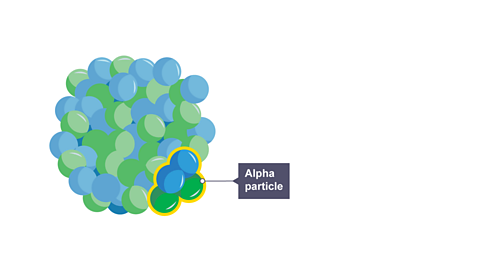
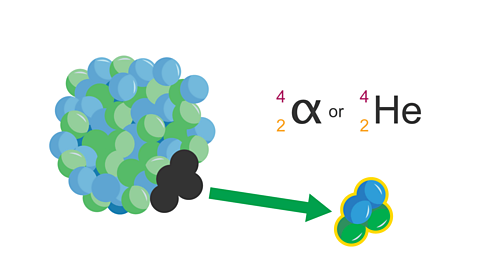
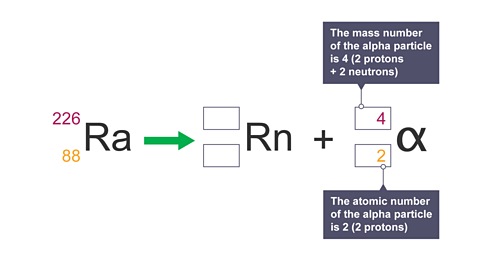
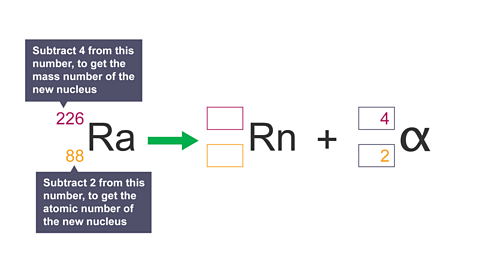
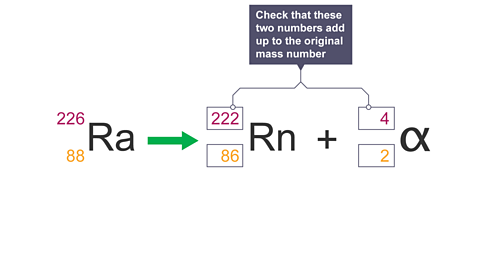
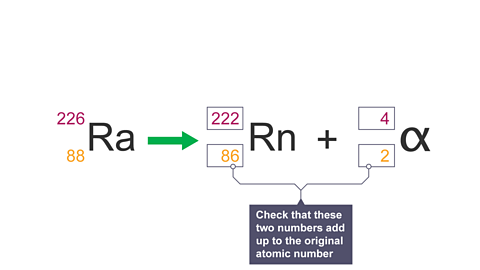
An unstable nucleus can emit a ‘package’ of two protons and two neutrons, called an alpha particle, to become more stable.
Alpha radiation is made up of a stream of alpha particles emitted from unstable nuclei within a radioactive substance.
An alpha particle is made up of two protons and two neutrons which is the same as a helium nucleus.
For this reason, an alpha particle is sometimes called a helium-4 nucleus.
It is written as \(_{2}^{4}\textrm{He}\) or \(_{2}^{4}\alpha\).

Image caption, 1. An unstable nucleus can decay by the emitting an alpha particle to become more stable.

1 of 9
What is an example of alpha decay?
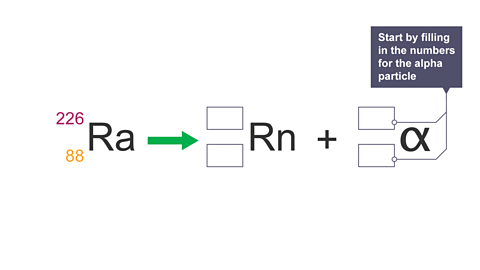
Alpha decay of Uranium-238
\(_{92}^{238}\textrm{U} \rightarrow _{90}^{234}\textrm{Th} +_{2}^{4}\textrm{He}\)
What are the key features of alpha particles?
Alpha particles are relatively:
large
heavy
slow
What is beta radiation?
An unstable nucleus can emit a fast-moving electron called a beta (β) particle, to become more stable.
It can be written as: \(_{-1}^{~0}\textrm{e}\) or \(_{-1}^{~0}\beta\).
Beta radiation is a stream of beta particles emitted from unstable nuclei within a radioactive substance.
Electrons are not normally found in the nucleus but, in an unstable nucleus, a neutron can split into a positive proton and a negative electron.
The proton remains inside the nucleus, but the electron is ejected at high speed.
This is called beta decay.
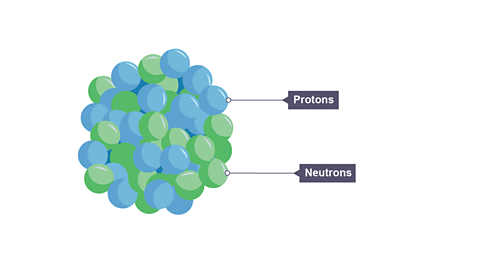
Image caption, 1. An unstable nucleus that has too many neutrons can decay by the emitting a beta particle to become more stable.
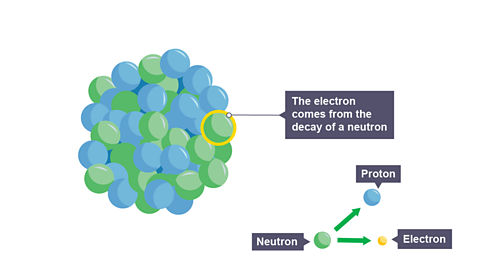
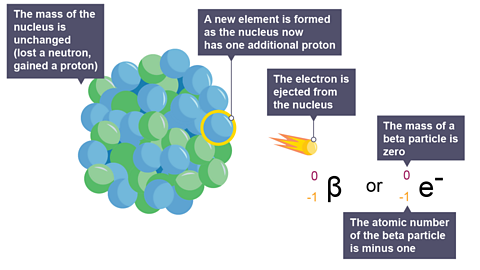
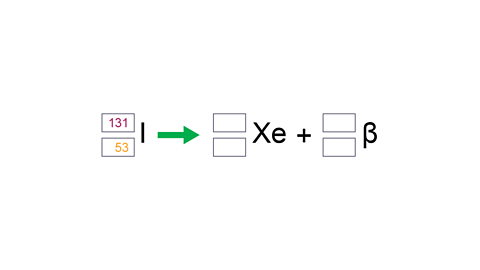
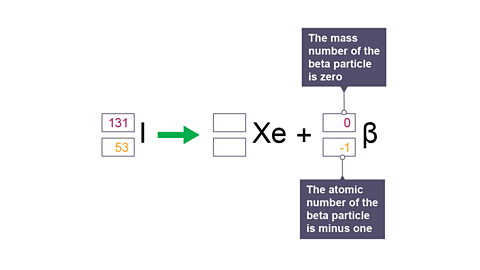
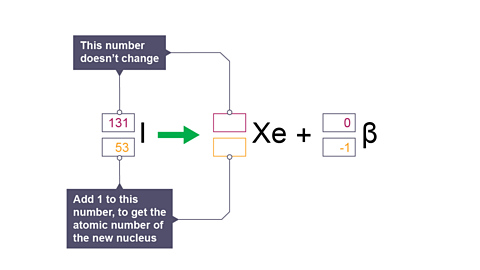
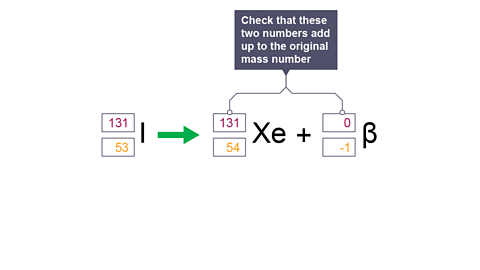
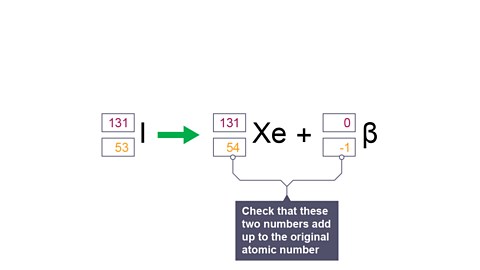
1 of 8
What is an example of beta decay?
Beta decay of carbon-14
\(_{6}^{14}\textrm{C} \rightarrow_{7}^{14}\textrm{N} +\ _{-1}^{0}\textrm{e}\)
What are the key features of beta particles?
Beta particles are relatively:
small
light
fast
What is gamma radiation?
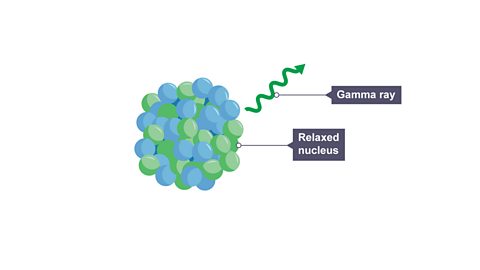
After emitting an alpha or beta particle, the nucleus will often still be ‘excited’ and will need to lose energy.
It does this by emitting a high energy A transverse wave caused by oscillations in an electromagnetic field. called a gamma ray.
Gamma radiation does not consist of particles but as short The length of a single wave, measured from one wave peak to the next., high energy electromagnetic radiation emitted from unstable nuclei.
It is normally emitted alongside A type of ionising radiation consisting of 2 protons and 2 neutrons. or A type of ionising radiation consisting of a single electron. radiation.
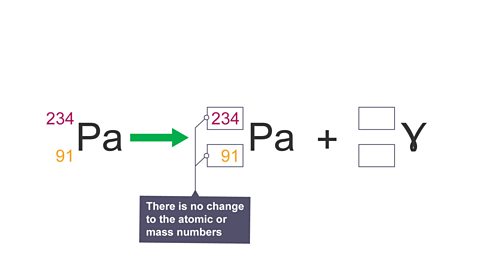
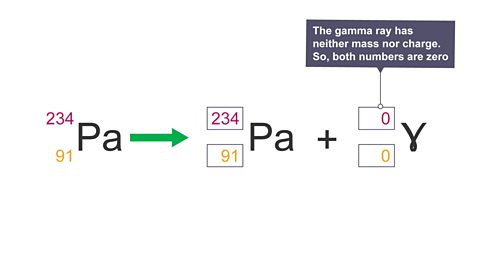
Gamma radiation has no The amount of matter an object contains. Mass is measured in kilograms (kg) or grams (g). and no charge.
It can be written as γ or \(_{0}^{0}\textrm{γ}\)
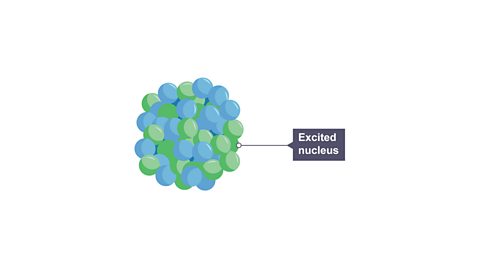
Image caption, 1. After emitting an alpha or beta particle, the nucleus will often still be ‘excited’ and will need to lose energy.
1 of 4
What is an example of beta and gamma decay?
Beta and gamma decay of cobalt-60
\(_{27}^{60}\textrm{Co}\rightarrow_{28}^{60}\textrm{Ni}+_{-1}^{0}\textrm{e}+_{0}^{0}\textrm{γ}\)
What are the properties of nuclear radiations?
The different types of radiation are often compared in terms of what stops them, their The power of the radiation that demonstrates how far into a material the radiation will go., their To ionise is to convert an uncharged atom into a charged particle by adding or removing electrons. and how far they can travel in the air.
| Symbol | Stopped by | Penetration power | Ionising power | Range in air | |
|---|---|---|---|---|---|
| Alpha | α | Skin/paper | Low | High | 4-6 centimetre (cm) |
| Beta | β | 5 mm aluminium | Medium | Low | ≈ 1 metre (m) |
| Gamma | γ | Reduced by thick lead/concrete | High | Very low | > 1 kilometre (km) |
WATCH: What are the 3 types of ionising radiation?
Okay so when radioactive decay occurs, there are three different types of ionising radiation that could be emitted.
Here is everything that you need to know.
The first one is an alpha particle, which is a helium nucleus consisting of two protons and two neutrons.
Then there is a beta particle, which is a fast‑moving electron, and finally a gamma ray which is a high‑energy electromagnetic wave.
Radioactive decay can cause dangerous ionisations, which means the ionising radiation has enough energy to remove an electron from an atom, causing cell mutations.
These cell mutations can cause the cell to divide too much and form a lump of extra cells, causing tumours to grow which could lead to cancer.
Alpha particles have the highest ionisation ability, meaning they are most likely to mutate a cell.
Beta particles have a medium ionisation ability and gamma rays have the lowest ionisation ability.
Now to remember penetration distance we reverse it.
Gamma rays have the highest penetration distance, as they can only be stopped by lead or concrete.
Beta particles can be stopped by several metres of air or a thin sheet of aluminium, so they have a lower penetration distance.
Finally alpha particles have the lowest penetration distance as they can be stopped by a few centimetres of air, a sheet of paper or a layer of skin.
Okay, let's recap: the three types of ionising radiation are alpha, beta and gamma decay.
They can cause dangerous ionisations that can lead to cancer.
Alpha particles have the highest ionisation ability, followed by beta particles and gamma rays have the lowest.
Then if we reverse it gamma rays have the highest penetration distance, followed by beta particles and alpha particles have the lowest.
How to measure amounts of radiation?
Radioactivity can be detected using a Geiger-Muller tube connected to a counter.
When alpha particles, beta particles or gamma rays enter the G-M tube the counter clicks and the count is displayed on the screen.
The number of counts per second or per minute is called the count rate or activity of the source.
The simplest unit of activity is the becquerel (Bq).
It is the number of counts per second.
A source that emits one particle per second has an activity of one Bq.
Since This is the disintegration of unstable nuclei by emitting alpha particles, beta particles or gamma rays. Radioactive decay occurs spontaneously and randomly. is a In relation to radioactive decay, this means it is impossible to predict when it will happen (for a particular nucleus). process, it is always good practice to determine the average count rate rather than to measure the counts that occur in just one second or one minute.
What is background radiation?
Radioactive materials occur naturally and, as a result, everyone is exposed to a low-level of radiation every day.
Background radiation is the name given to the radiation that is always present in our surroundings.
It is released by soil, rocks and cosmic rays and is always in the environment.
A Device used to detect and measure the quantity of ionising radiation in an area. will detect radiation even when there is no apparent radioactive source present.
Most radioactive background activity comes from natural sources such as:
Carbon-14, found in carbon dioxide in the air and in the cells of all living organisms.
Soils and rocks containing uranium which is radioactive. These may be used for building materials. When uranium decays, radon, a radioactive gas, is released.
Cosmic rays - radiation reaching the Earth from outer space.
Human behaviour adds slightly to the background activity that we are exposed to through medical X-rays, radioactive waste from nuclear power plants and the radioactive fallout from nuclear weapons testing.
As a result, gas, living things and plants absorb radioactive materials from the soil, which are then passed along the food chain.
For example, by eating a banana which contains radioactive potassium.
As it passes along the food chain the concentration of radioactivity will increase.
The actual amount of radiation that a person is exposed to depends on where they live, what job they do and many other things.
There is little we can do about natural background radiation, although people who live in areas with a high background due to radon gas require homes to be well ventilated to remove the gas.
How to measure the background radiation
- Remove all known sources of radioactivity from the room.
- Set the counter to zero.
- Switch on and start a stop clock.
- After 20 minutes switch off. Record the count.
- Divide the count by 20 to calculate the count rate per minute.
The background count rate is measured over a period of 20 minutes because of the random nature of radioactive decay.
Dividing by 20 enables the average count rate per minute to be determined.
Background count rate is typically 18 counts per minute which does not present a serious health risk to humans.
How to deal with background radiation (Higher tier only)
Scientists must always take into consideration the amount of background radiation when working or experimenting with radioactive sources and subtract it from their results when making measurements.
The corrected count rate for a source is found using:
Corrected count rate = measured count rate – background count rate.
Example
In an experiment with a radioactive source, the average count rate measured using a G-M tube is found to be 250 counts per minute.
If the background count rate is 18 counts per minute, what is the corrected count rate due to the source alone?
Answer
Measured count rate = 250 counts per minute.
Background count rate = 18 counts per minute.
Corrected count rate = measured count rate – background count rate.
Corrected count rate = 250 – 18 = 232 counts per minute.
The corrected count rate due to the source alone is 232 counts per minute.
Key fact
The background count rate must be subtracted from any other count rate when measuring the activity of a radioactive source.
What is half-life? (Higher tier only)
This is the disintegration of unstable nuclei by emitting alpha particles, beta particles or gamma rays. Radioactive decay occurs spontaneously and randomly. is a In relation to radioactive decay, this means it is a process which cannot be sped up or slowed down by physical conditions (e.g. temperature and pressure). and In relation to radioactive decay, this means it is impossible to predict when it will happen (for a particular nucleus). process.
A block of radioactive material will contain many trillions of nuclei and not all nuclei are likely to decay at the same time so it is impossible to tell when a particular nucleus will decay.
A spontaneous process means that it is not possible to say which particular nucleus will decay next, but given that there are so many of them, it is possible to say that a certain number will decay in a certain time.
It also means that the process of radioactive decay cannot be speeded up or slowed down by any physical changes such as a change of temperature or pressure.
A random process means that scientists cannot tell when a particular nucleus will decay, but they can use statistical methods to tell when half the unstable nuclei in a sample will have decayed.
This is called the half-life.
Key fact
Half-life is the time taken for the activity of the source to fall to half its original value.
The illustration below shows how a radioactive sample is decaying over time.
In this example, the starting activity is 80 counts per minute.
Half of 80 is 40. Find this on the graph.
Look at this point on the graph in relation to the y-axis.
You will see that the counts per minute have halved in two days.
This means that it has a half-life of two days.
It takes two days for the count to halve from 80 counts per minute down to 40 counts per minute.
It takes another two days for the count rate to halve again, this time from 40 counts per minute to 20 counts per minute.
The half-life of this source is 2 days.
Note that this second two days does not see the count drop to zero, only that it halves again.
A third, two-day period from four days to six days sees the count rate halving again from 20 counts per minute to 10 counts per minute.
This process continues and although the count rate might get very small, it does not drop to zero completely.
Question
What is the half-life of this radioactive source?
Answer
It takes five days for the count to halve from 80 counts per minute to 40 counts per minute.
It takes another five days for the count rate to halve again, this time from 40 counts per minute to 20 counts per minute.
The half-life of this source is 5 days.
WATCH: What is half-life?
Here is everything you need to know about half-life in 60 seconds.
The activity of a source tells us how many nuclei decay every second.
So an activity of 5 becquerels means 5 nuclei decay every second.
The half-life of a radioactive source is the amount of time it takes the mass or activity of a sample to halve.
We can see here our source starts at 80 and takes two days for half the nuclei to decay and reach 40.
To halve again and reach 20 it takes a further two days, so one half-life of our source is 2 days.
Let's look at this another way. Each kernel of corn represents an unstable nucleus which needs to decay.
Each piece of popcorn represents a decayed and now stable nucleus.
We start with 20 pieces of corn and it takes 5 seconds for half of the kernels to pop. We're now left with 10 pieces of unpopped corn.
We go for another 5 seconds and now half of our remaining corn has popped too, so we're left with 5 pieces of unpopped corn.
Note that each time a different amount of corn is popping, but it is halving at the same rate.
Just like our popcorn, we can't say exactly when each individual nucleus in a source will decay, but we can work out how long it would take half of our source to decay.
The half-lives of different isotopes can range from a fraction of a second to millions of years, and knowing this half-life is important when using isotopes for different applications in industry and medicine.
So to recap, the half-life of a radioactive source is the amount of time it takes for the mass or activity of a sample to halve.
How to handle radioactive material safely (Higher tier only)
Knowing about half-lives is important because it enables you to work out when a radioactive sample is safe to handle.
With each half-life the activity of the source halves and so it gets weaker, and the activity approaches the level of background radiation, which is considered to be safe.
As a rule, that occurs at 10 half-lives.
So, if radioactive source has a half-life of 4 days, it is considered to be safe in 10 half-lives, or 40 days.
Example question
Radioactive technetium-99m is used in medicine to image the skeleton and heart and has a six-hour half-life.
If it is injected into a patient and considered to be safe in 10 half-lives, how long will this take?
Answer
The half life of technetium-99m = 6 hours.
10 half-lives = 10 x 6 = 60 hours.
It will take 60 hours, or two and a half days, for the Technetium-99m to be considered safe and “gone” from the patient.
How much do you know about radioactive decay and half-life?
More on Radioactivity
Find out more by working through a topic
- count2 of 2