What are the key learning points about road transport and safety?
Most transport currently relies on fossil fuels (petrol/diesel).
Efforts to reduce reliance include substitutes (biofuels) and technologies (regenerative braking, hybrids, EVs).
Stopping distance = thinking distance + braking distance (affected by speed, driver, road and vehicle conditions).
Friction opposes motion; it can help (grip, braking) or hinder (heating, wear).
Car safety features (seatbelts, airbags, crumple zones, rigid cell) reduce injury by increasing stopping time.
Road safety measures (speed limits, cameras, speed bumps) reduce speeds and injuries.
What percentage of the fuel used in transport comes from fossil fuels?
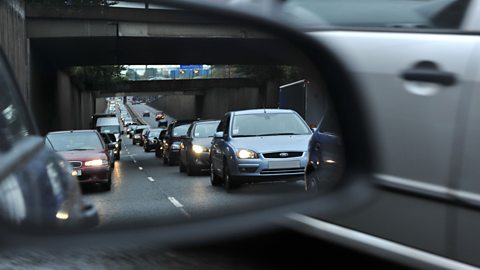
Currently, over 90% of fuel used for transport comes from fossil fuels, mainly crude oil which is used to produce petrol and diesel.
This is a problem because fossil fuels:
are non-renewable;
release CO2, contributing to climate change.
For these reasons, it is very important that we look for ways to reduce our reliance on fossil fuels by:
using the fossil fuels we have left more efficiently;
using alternative renewable fuels instead of fossil fuels.
How can we reduce our reliance on fossil fuels for transport?
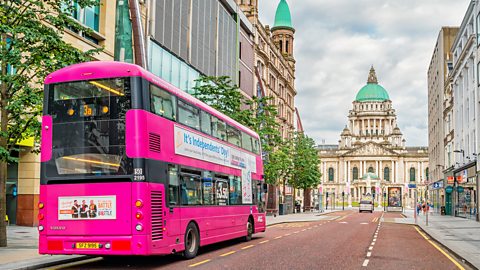
Use public transport (buses/trains): this leads to a lower amount of CO2 per passenger than cars.
Walking/cycling: this results in minimal emissions and has health benefits.
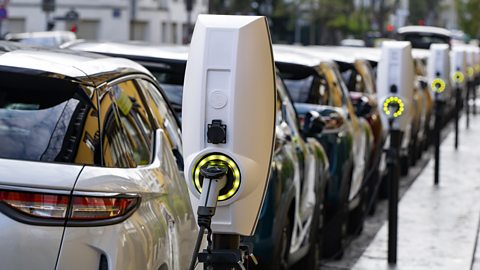
Electric cars: there are zero emissions from the car itself and when charged from renewables has the lowest impact on the environment.
Buy locally: this reduces transport fuel use.
What are substitute fuels? (Higher tier only)
Biofuels are fuels made from Animal or plant waste that can be burned to generate electricity. including wood, crops, plant materials and animal waste.
Examples include ethanol and biodiesel that can be used in vehicles as an alternative to petrol or diesel.
Ethanol is made from An anaerobic process in which yeast converts sugar to ethanol and carbon dioxide at a warm temperature. crops such as, corn and sugar cane to produce fuel that can be used in vehicles.
The majority of biodiesel in the UK comes from recycled cooking oil.
What are the advantages of using biofuels?
They are a renewable source of energy if plants and crops are regrown.
Biofuels are considered to be ‘carbon neutral’ as the carbon dioxide released when they are burned is taken in again by the plants grown to replace them.
What are the disadvantages of using biofuels?
High cost of production increases the cost of transport.
Using fields to grow crops for biofuels means they are not being used to produce food – this could lead to food shortages or food price increases.
The demand for biofuel crops means greater demand on rainforest land.
What are extenders?
In some countries, an extender such as alcohol is added to normal fuel to increase the volume of fuel that can be used.
It is called an extender because it allows a certain amount of fuel (like petrol or diesel) to go further.
What is regenerative braking? (Higher tier only)
Regenerative braking is a way of taking the wasted energy from the process of slowing down a car and using it to recharge the car’s batteries.
When a car’s brakes are applied on a normal car, the The energy an object possesses by being in motion. of the car is mainly converted to heat energy, which is then lost to the surroundings.
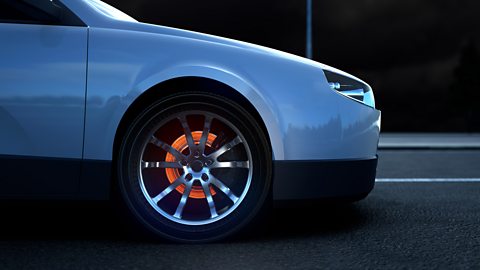
With regenerative braking, some of the kinetic energy is converted to useful electric energy and reused.
On petrol and diesel cars with regenerative braking, kinetic energy is converted to electrical energy to charge the battery that runs things like the lights, heating, instruments and the radio, meaning less work for the engine and less petrol or diesel burned.
For a car with regenerative braking:
Kinetic energy → electrical energy + heat energy + sound energy.
What are hybrid cars? (Higher tier only)
In hybrid cars (a car with an electric motor and a diesel or petrol engine) and also in pure electric cars, regenerative braking is used so that when the brakes are applied, the car’s kinetic energy is converted to electric energy to help charge the larger batteries that directly drive the car.
What are the advantages of hybrid cars?
- They reduce the petrol or diesel used which means less carbon dioxide released and reduce dependency on fossil fuels.
What are the disadvantages of hybrid cars?
They are expensive to buy.
They are less powerful because the engine size is small.
The batteries used have a limited lifetime and need to be replaced.
How important is reaction time in road safety?
Thinking, braking and stopping distances
Stopping vehicles as quick as possible in an emergency is important but many factors affect this.
The driver's reactions and the road and vehicle conditions play a part, as well as mass and speed.
What is stopping distance in road safety?
stopping distance = thinking distance + braking distance
thinking distance is the distance a vehicle travels in the time it takes for the driver to apply the brakes after realising they need to stop - this time is called their reaction time.
braking distance is the distance a vehicle travels in the time after the driver has applied the brake.
What factors affect thinking distance?
Reaction times vary from person to person but are typically 0.2 to 0.9 seconds (s).
A driver's reaction time can be affected by:
- tiredness;
- alcohol/illegal drugs;
- medication prescribed by a doctor;
- distractions – such as texting, reading text, adjusting the radio, background noise.
The greater the reaction time the longer the thinking distance.
During the reaction time, a car travels at constant speed because the driver has stopped pressing the accelerator but has not yet pressed the brake.
This means that if the speed of the car is known and the driver’s reaction is known, thinking distance can be calculated using:
Distance = speed x time.
There are different ways to measure reaction times.
One simple method to measure reaction time involves dropping a ruler between someone's open thumb and forefinger.
The higher the reaction time needed to grasp the falling ruler, the further the ruler falls before being stopped.
How to carry out an investigation into reaction time
A simple method to measure reaction time is to use the ruler drop test.
What is the aim of the ruler drop test?
The aim of this experiment is:
- to measure human reaction time;
- compare human reaction time with and without background noise.
What apparatus is needed?
- 50 cm rule;
- radio or Smart speaker.
How to carry out the ruler drop test?
Work with a partner. Ensure that the room is totally quiet.
Person A holds out their hand with a gap between their thumb and first finger.
Person B holds the ruler with the zero at the top of Person A's thumb.
Person B drops the ruler without telling Person A and they must catch it.
The number level with the top of Person A's thumb is recorded in a suitable table. Repeat this five times.
Now play loud music through a speaker and ask some friends to carry out a loud conversation beside Person A.
Repeat the investigation again and record the number level with the top of Person A's thumb in the table.
You can record the catch distance in centimetres.
| Attempt | Distance on ruler /cm | Distance on ruler /cm |
|---|---|---|
| Number | Without noise | With background noise |
| 1 | 18 | 25 |
| 2 | 15 | 38 |
| 3 | 22 | 36 |
| 4 | 24 | 31 |
| 5 | 13 | 38 |
| Average | 18.4 | 33.6 |
What conclusion can be drawn from the ruler drop test?
There is a clear difference between length of ruler that passed through the fingers before it was caught, with and without background noise.
For example, the average distance travelled by the ruler before it was caught with background noise was 33.6 cm compared to 18.4 cm without noise.
Background noise increases reaction time.
What is an example of a thinking distance calculation?
A car travels at 12 m/s.
The driver has a reaction time of 0.5 s and sees a cat run into the road ahead.
What is the thinking distance as the driver reacts?
Answer
During the reaction time, the car travels at constant speed because the brakes have not been applied.
Distance = speed × time.
Speed = 12 m/s.
Time = 0.5 s.
d = 12 × 0.5.
d = 6 m.
The thinking distance at 12 m/s is 6 m.
What factors affect braking distance?
The braking distance of a vehicle can be increased by:
poor road conditions, such as oil on the road - less friction between tyres and the road;
poor weather conditions, such as wet or icy roads or snow - less friction between tyres and the road;
poor vehicle conditions, such as worn brakes or worn tyres - less friction between brakes and wheels and wheels and road;
more mass in the vehicle (extra passengers for example) - the braking friction has to work for a greater distance to remove the larger kinetic energy.
How to calculate stopping distance
The diagram below shows some typical stopping distances for an average car in normal conditions.
What are some typical stopping distances?
Travelling at 20 mph (32 km/h):
- thinking distance = 6 m
- braking distance = 6 m
- total stopping distance = 12 m
Travelling at 40 mph (64 km/h):
- thinking distance = 12 m
- braking distance = 24 m
- total stopping distance = 36 m
Travelling at 70 mph (112 km/h):
- thinking distance = 21 m
- braking distance = 75 m
- total stopping distance = 96 m
Worked example: Stopping distance calculation
For a car travelling at 12 m/s the thinking distance is 6 m and the braking distance is found to be 32 m.
Calculate the stopping distance.
Answer
Stopping distance = thinking distance + braking distance.
Thinking distance = 6 m.
Braking distance = 32 m.
Stopping distance = 6 + 32.
Stopping distance = 38 m.
For a car travelling at 12 m/s the stopping distance is 38 m.
Question
Calculate the thinking distance for a car and driver when travelling at 24 m/s.
Calculate the stopping distance for the car if the braking distance is 128 m.
How might a wet road affect thinking distance, breaking distance and stopping distance for the same car and driver?
Answer
1.During the reaction time the car travels at constant speed because the breaks have not been applied.
Distance = speed × time.
Speed = 24 m/s.
Time = 0.5 s.
d = 24 × 0.5.
d = 12 m.
The thinking distance at 24 m/s is 12 m.
- Stopping distance = thinking distance + braking distance.
Thinking distance = 12 m.
Braking distance = 128 m.
Stopping distance = 12 + 128.
Stopping distance = 140 m.
For a car travelling at 24 m/s the stopping distance is 140 m.
- Thinking distance: a wet road has no effect on reaction time and so the thinking distance will not change.
Braking distance: the wet road could reduce friction between the tyres and the road, increasing braking distance.
Stopping distance: since stopping distance = thinking distance + braking distance, and braking distance increases, stopping distance will also increase.
What is friction?
Friction is a force which always acts to oppose the motion of an object.
Friction always acts to stop an object from starting to move, or to slow down a moving object.
It can be a help or a hinderance.
When is friction helpful?
Friction can be useful.
For example:
- friction between our shoes and the floor stop us from slipping;
- friction between tyres and the road stop cars from skidding;
- friction between the brakes and wheel help bikes and cars to slow down.
Frictional forces are much smaller on smooth surfaces than on rough surfaces, which is why we slide on ice but not on concrete.
When is friction unhelpful?
Friction can also be unhelpful.
If you do not lubricate your bike regularly with oil, the friction in the chain and axles increases.
Your bike will be noisy and difficult to pedal.
When there is a lot of friction between moving parts, energy is transferred to the surroundings, causing heating.
Think of what happens when you rub your hands together quickly.
The friction warms them up.
What is air resistance?
Friction caused by air is called air resistance or drag.
Bikes, cars and other moving objects experience air resistance as they move.
Air resistance is caused by the frictional forces of the air against the vehicle.
The faster the vehicle moves, the bigger the air resistance becomes.
The top speed of a vehicle is reached when the force from the cyclist or engine is balanced (equal in size, opposite in direction) by air resistance.
What is streamlining?
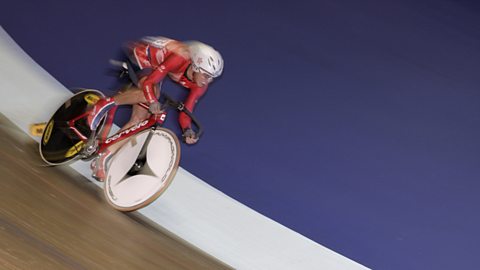
Racing cyclists crouch down low on their bikes to reduce the air resistance on them.
This helps them to cycle faster.
They also wear streamlined helmets.
These have special, smooth shapes that allow the air to flow over the cyclist more easily.
Modern vehicles are also streamlined.
Their smooth shapes make the air resistance smaller, which allows them to travel further on the same amount of fuel.

What are ways of increasing friction?
Adding grit to icy roads.
The tread on car tyres.
Anti-skid high friction road surfacing increases skid resistance and reduces braking distance. Typical locations for high friction surfacing include road junctions, approaches to traffic lights, pedestrian crossings and roundabouts.
Grooves on the soles of shoes.
Gymnasts apply powdered chalk to their hands or grips so that they do not slip.
Studs on football boots.
What are ways of reducing friction?
| Method | How it helps | Example |
|---|---|---|
| Lubricate with oil or grease. | Makes the surfaces smoother. | Bicycle chain, frying pan, baking tray. |
| Polishing. | Makes the surfaces smoother. | Bowling alley, ice in front of a curling stone. |
| Reduce surface area. | Reducing the area of contact between the surfaces. | Rolling instead of sliding using ball bearings or wheels, ice skates. |
| Streamlining. | Smooth shape allows air to flow around an object more easily. | Crouched racing cyclist, smooth, tapered helmet, high speed racing cars, jet aircraft. |
| Cushion of air between surfaces. | Separates the surfaces. | Hovercraft, air track, air hockey. |
Very simply, a force is either a push or a pull.
There are many different types of forces, but they are just different names for pushing or pulling forces.
For example, squashing is a pushing force.
And the force stretching this material is a pulling one.
Forces can't be seen, and so, in science, the size and direction of force is shown with an arrow.
The length of the arrow tells us the size of the force, and the head of the arrow shows the direction in which the force is pushing or pulling, here, around the cyclist's leg, and here, the cyclist pushing down on the pedal.
Here on Earth, forces act against or change movements all the time, but, in theory, once a force has started an object moving, the object will continue to move in a straight line at a constant speed unless another force acts on it.
This means that while an object, like a bike, is moving at a constant speed, neither speeding up or slowing down, the forces acting on it are balanced.
A change in this movement will only happen when the forces become unequal or unbalanced.
When the cyclist wants to speed up, the forward force is increased to become bigger than the opposing movement and the bike speeds up.
The object, the bike, continues to accelerate until the forces working against the forward movement are again equal to the forward force.
The forces are then balanced again and the object moves at a constant speed once more.
If the cyclist reduces the forward push, the forces become unbalanced again, and the bike slows down.
When an object is stationary, the forces acting on it are balanced again.
Another set of balanced forces are the weight of the bike and cyclist balanced with an equal upward force, preventing them from sinking into the ground.
Remember — the words balanced or unbalanced are nothing to do with the way we balance on a bike.
They refer to the forces that act on all objects.
What causes friction?
A surface may appear to be smooth, but when examined under a microscope surfaces appear rough with many bumps and hollows.
Friction is caused in part by the tiny bumps and hollows on surfaces as they rub against each other.
The bumps on one surface interlock with the hollows on the other making it hard for the surfaces to slip over each other.
This explains why polishing and lubricating surfaces reduces friction.
Polishing helps to flatten out the bumps and hollows, while oil or grease helps to lift the top surface off the bottom surface by filling the gaps in between.
As a result, the surfaces move over each other more easily.
Friction is also due to attraction between molecules making up the two surfaces, so that there is friction between even extremely smooth surfaces.
When the surfaces move the molecules need to be torn away from each other, and we experience this as friction.
This explains why reducing surface area and separating surfaces reduces friction.
What are modern car safety features?
When there is a car crash, the car, its contents and the passengers Slowing down or negative acceleration, eg the car slowed down with a deceleration of 2 ms⁻². rapidly.
They experience great forces which can cause injuries.
Modern cars have safety features that absorb Energy which an object possesses by being in motion. in collisions.
These typically include:
- seat belts;
- airbags;
- crumple zones.
How do these safety features reduce injuries? (Higher tier only)
These features reduce injuries to the people in the car by absorbing energy from the impact.
These features absorb energy when they change shape.
This reduces injuries to the people in the car.
They increase the time taken for the car and passengers to slow down, and so reduce the forces involved and any subsequent injuries.
Seat belts
Seat belts stop you tumbling around inside the car if there is a collision.
However, they are designed to stretch a bit in a collision.
This increases the time taken for the body's speed to reach zero and so reduces the forces on it.
The body stops with less of a jolt which reduces injury.
Airbags
Airbags increase the time taken for the head's speed to reach zero and so reduce the forces on it.
They also act as a soft cushion and prevent cuts.
Crumple zones
Crumple zones are areas of a vehicle that are designed to crush in a controlled way in a collision.
They increase the time taken to change the speed of the driver and passengers in a crash, which reduces the force acting on them.
How does speed affect road safety?
Speed is a major factor in most road accidents.
As drivers move faster, their stopping distance increases, and collisions cause more severe injuries.
There are several road safety measures designed to reduce speed, particularly in built up areas.
These include:
Setting speed limits and then enforcing them with fines and penalties.
Speed cameras to check drivers are obeying the speed limits.
Speed bumps - vehicles’ front wheels pass over the bump entirely before the rear wheels pass over - causing the driver to experience two bumps. This requires drivers to slow to pass over them safely and comfortably.
What are the advantages of speed bumps?
- they are quick and easy to install;
- they are low cost;
- they work – studies have shown 40% reduction in speed for most vehicles;
- their impact does not wear off over time – for example, drivers can get used to other measures like “Slow” signs meaning they become less effective in the long term.
What are the disadvantages of speed bumps?
- they can cause damage to vehicles;
- they can be noisy.
How much do you know about road safety and transport?
More on Road transport and safety
Find out more by working through a topic
- count2 of 4
- count3 of 4
- count4 of 4