Summary

Media caption,
Why has the UK inflation rate fallen?
  1. Analysis

    Inflation likely to fall - but not for longpublished at 06:55 BST 22 July

    Ben King
    Business reporter, BBC News

    As we just reported, inflation numbers could see a temporary dip as a result of lower petrol and diesel prices.

    June saw a period of relative calm in the US-Iran war, when Washington and Tehran agreed to halt military operations and reopen the Strait of Hormuz - a key route for global oil supplies.

    This led to cheaper prices at the pumps.

    Lower inflation is, however, expected to be short-lived. The price cap on gas and electricity rose in July, lifting the typical household energy bill by 13%.

    Meanwhile, the resumption of military strikes in the Middle East has sent oil prices back over $90 a barrel. If it stays elevated, that risks inflaming inflation.

    For now, much depends on how long the war continues, and how high energy prices remain.
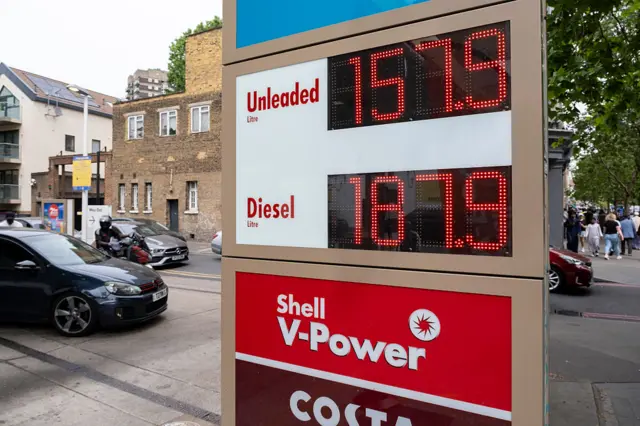
    A petrol forecourt on London on 29 MayImage source, Getty Images
    Image caption,

    A petrol forecourt on London on 29 May

  2. Inflation was 2.8% in Maypublished at 06:53 BST 22 July

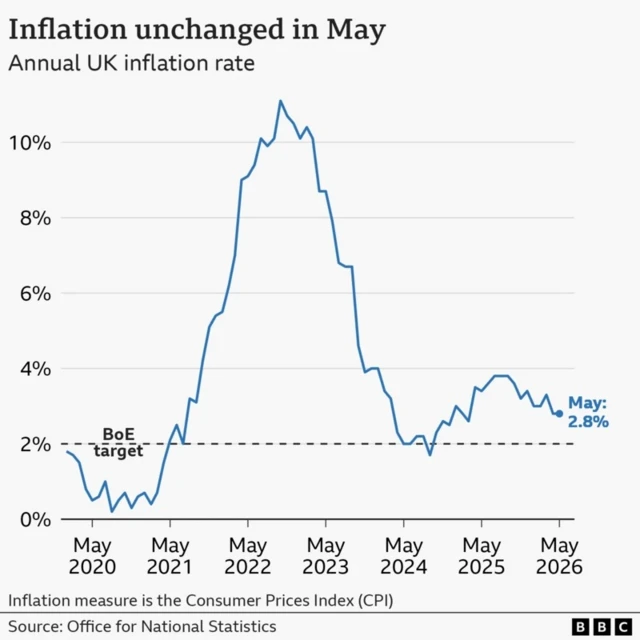
    Last month, it was announced that the UK's inflation rate remained at 2.8% in the year to May, slightly lower than the 3% that had been predicted.

    This means the prices of good and services in the UK, on average, were 2.8% more expensive in May compared to May of 2025.

    That figure is above the Bank of England's target of 2%. It is, however, well below the 11.1% figure of October 2022, which was a 40-year high.

    Following last month's announcement, former chancellor Rachel Reeves said the government had "the right economic plan to build a stronger more secure Britain".

    Today's figure is expected to drop slightly - driven by lower petrol prices.

    Graph showing the inflation rate for the UK from 2020 to May 2026, which was at 2.6%
  3. Latest UK inflation figure about to be releasedpublished at 06:48 BST 22 July

    We're about to find out the latest UK inflation rate, when the Office for National Statistics releases the figures at 07:00 BST.

    Inflation measures the increase in the price of goods over the last 12 months. The figure covers hundreds of everyday items.

    Experts expect the figure to fall to around 2.6% - this means prices are still rising, just at a slower pace. In May, inflation was 2.8% for the second month in a row.

    We'll bring you the figure as soon as we get it, along with analysis and reaction.