As the US pauses the war with Iran, is Trump really running out of weapons?


 BBC
BBCWhen US President Donald Trump took the stage earlier this month at the Pennsylvania Defense and Innovation Summit, flanked by the CEOs of some of America's largest defence firms, he had one message in mind: build more weapons, and build them faster.
"We have the best quality in the world," Trump told the armsmakers gathered at the US Army War College, with 'Secretary of War' Pete Hegseth at his side. "But we need a little more speed."
The Trump administration framed the summit as part of a two-pronged approach to revitalise American industry and bolster US warfighting capabilities and, in Hegseth's words, its "arsenal of freedom".
Largely unspoken, however, was the vast expenditure of sophisticated and difficult-to-manufacture weapons used during nearly 40 days of intense combat operations in Iran during Operation Epic Fury earlier this year and tit-for-tat strikes that have taken place since. So far, the US government says the war has cost $37.5bn (£28bn), and the vast majority of that has been spent on munitions.
By the time a tenuous ceasefire took effect on 8 April, US forces had struck over 13,000 targets across Iran, according to the White House. American air defences intercepted over 1,700 Iranian drones and ballistic missiles over the same period.
Now, the US has paused its strikes on Iran to allow negotiations to go ahead. A New York Times report says that Trump was advised to shelve plans to escalate the conflict as it would further drain American stockpiles.
On Monday, Trump denied there was a shortfall, telling the Wall Street Journal: "We have far more munitions than anyone in the world, and far more than we need."
 AFP via Getty Images
This has been a touchy subject for some time within the US administration. Last month, when pressed on the subject, Hegseth denied that supplies were thinning out.
His position seems to have changed since. Last week, he told the Senate Appropriations Committee that the Pentagon needed another $87bn (£68bn) to address "critical shortfalls", including equipment.
Exact ammunition expenditures and remaining stockpiles remain classified. But publicly available data compiled by the Washington DC-based Center for Strategic and International Studies (CSIS) paints a stark picture of depleted stockpiles that, in the short-term, are difficult to replace.
"It depends on the munition - but one to five years [to make a single missile] is the bottom line," says Mark Cancian, a retired Marine Corps colonel and senior adviser at CSIS who has been researching the issue. "And there's nothing you can do to speed that up."
But is the US really eating through ammunition so fast that it may struggle to fulfil its military duties and objectives?
A depleted US arsenal
The critical munitions used in the war span two categories: long-range ground attack systems, and the air and missile defences used to intercept incoming Iranian attacks.
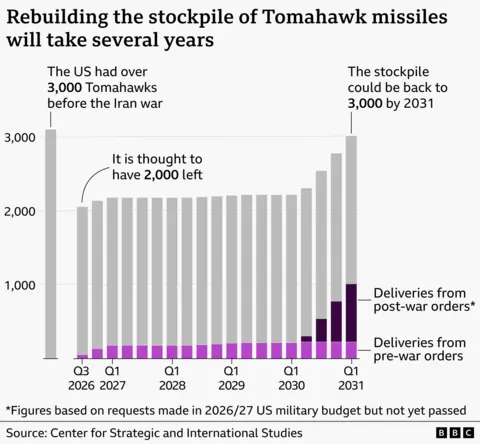
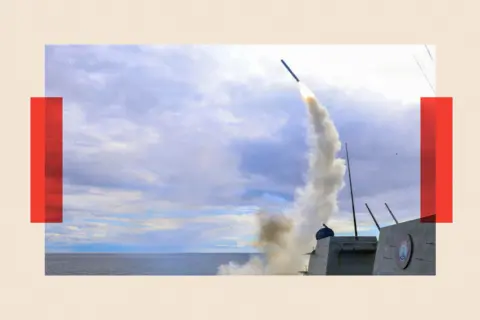
Among the ground attack systems that saw the greatest use was the Tomahawk Land Attack Missile - or TLAM - that is typically fired from ships or submarines at targets that could be well over 1,000 miles (1,600km) away. These weapons allow the US to conduct precision strikes against hardened military targets, such as command bunkers or fortified military facilities, without putting manned aircraft in harm's way.
More than 1,000 Tomahawks have been fired during the war, the CSIS estimates, and the stockpile may not return to pre-war levels until 2031. According to the CSIS, the latest variants of the TLAM cost about $2.6m (£2m) per missile.
Of the air defence systems used in the war, the most heavily used was the Patriot, a ground-based missile used to target aircraft, as well as ballistic and cruise missiles. According to the CSIS estimate, as many as 1,430 were used during the conflict from an estimated pre-war stockpile of about 2,330. Each Patriot interceptor costs approximately $4m - an expensive but effective option repeatedly used to shoot down Iranian drones that themselves only cost between $20,000-50,000 each.
These will be hard to replace. "It takes several years to produce a missile. If you put money into the system today, you wouldn't get a missile for three or four years. Sometimes even five," Cancian says. "What we're getting [now] are missiles that were funded in 2023."
Also used was a newer, more sophisticated system known as Terminal High Altitude Area Defense, or THAAD, which has a longer range and higher intercept altitudes than the older Patriot. Supplies were already limited, with CSIS estimating that between 190 and 290 were fired out of an estimated pre-war stock of 360. With only nine THAAD batteries operational in the world - and seven of them American - sustained expenditure could leave US forces without a system that would be critical to defending ballistic missile threats from countries such as Russia, China or North Korea.
All eyes on Taiwan and the Pacific
The war with Iran comes just before what is often referred to as the "Davidson window", in which a Chinese effort to invade Taiwan becomes, in the eyes of some US military planners, more likely.
The controversial concept - which is central to US military thinking in the Pacific - stems from a 2021 congressional hearing in which Admiral Philip Davidson, then in charge of US forces in the region, warned that an invasion would happen "in the next six years". In 2023, then-CIA director William Burns predicted China would be ready to invade by 2027.
China has long vowed to "reunify" with self-governing Taiwan, which it views as a breakaway province, and has not ruled out the use of force.
Whether or not the US will defend Taiwan and go to war with China is a hotly debated topic. Despite the ambiguity, the US provides the island with defensive weaponry.
 Getty Images
Cancian refers to the munitions shortfalls as a "window of vulnerability" in which the US "is not going to have the depth of the preferred munitions it needs" if there is a conflict in the Pacific.
This, he believes, increases the risk of US forces being left unprepared to face a vast arsenal of Chinese missiles and aircraft it could bring to bear in a Pacific conflict.
China - which US officials say has been closely studying US air defences in the Iran war - has invested heavily in missile technology in recent years, including hypersonic glide missiles far more sophisticated than the missiles and cheap drones used by Iran.
Beijing has also heavily invested in developing massive "drone-swarm" tactics.
However, not everyone views the depleted US stockpiles as purely a liability.
Jacob Olidort, a veteran of the CIA and former adviser on Middle East Policy in the Office of the Secretary of Defense, points out that using these weapons in combat also sends a powerful message.
"Weapons create deterrence, not merely because nations have them, but also because they demonstrate a willingness to use them," said Olidort, now director for American security policy at the conservative-leaning America First Policy Institute.
He adds that US "successes at eroding Iran's military capabilities with precision, with record time, send a signal to other adversaries, including China and their ambitions."
What about Europe?
The apparent tension between arming allies and preserving US reserves is one that has already been played out over Ukraine.
Back in October 2025, months before Operation Epic Fury began, Trump declined to give Ukraine Tomahawks, citing a need to avoid depleting US stockpiles.
The episode was a preview of the trade-offs now shaping the post-Iran debate over the wider arsenal. Ukrainian officials say they urgently need Patriots and other air defence systems to stem wave after wave of Russian drone and missile attacks.
"In addition to energy prices, it [the Iran war] means the depletion of US reserves, and the depletion of air defence manufacturers," Zelensky told the BBC in March. "So we [Ukraine] have a depletion of resources."
 AFP via Getty Images
Zelensky put numbers to the concern: the US produces roughly 60 to 65 missiles a month, or between 700 to 800 a year, with 803 used on the first day of the Operation Epic Fury alone.
More recently, however, Trump surprised many European officials by offering to give Ukraine the right to produce Patriots domestically. Similar arrangements already exist in Germany and Japan.
Elaine McCusker, a 13-year veteran of the Department of Defence who now works as an expert with the American Enterprise Institute, says Ukraine's experience fighting Russia - as well as the US experience fighting Iran - could help create cheaper, mass-produced systems to complement existing high-ticket items.
"We've known for a long time that we don't want to be shooting $6m interceptors at $1,000 drones," she says. "I think we now have more focus on that solution, and more people focusing on manufacturing more attritable solutions that don't cost so much".
The aftermath
Despite it all, there is little near-term alarm about the prospect of munitions running out - not because US stockpiles are unlimited, but because Iran's are in far worse shape.
"The United States military has more than enough munitions, ammo, and stockpiles to serve all of President Trump's strategic goals and beyond, and Operation Epic Fury has exposed what happens when you mess with the United States," White House spokesperson Anna Kelly said in a statement sent to the BBC.
"Even still, the president has urged our defence contractors to constantly produce more made-in-America weapons," she added.
Recent strikes announced by US Central Command have been largely focused on degrading Tehran's ability to threaten ships in the Strait of Hormuz, the vital shipping lane that Iran and the US have blockaded.
 AFP via Getty Images
Iran's military losses have been far greater than America's following wave after wave of US and Israeli strikes - and the country has extremely limited ability to address those shortages anytime soon.
"A lot of commentary portrays Iran as having an almost unlimited amount of weaponry," says Jason Brodsky, policy director of United Against Nuclear Iran.
"I think we have to realise that there are limitations there, and that the US has degraded their defence industrial base to a very significant extent," he says.
He adds that Iran's "capacity to produce, at scale, the kinds of missiles, drones and other weapons systems" it needs has been largely destroyed.
Iran's remaining stockpiles, according to Brodsky, are being funnelled towards what he termed Tehran's trump card - its ability to threaten the Strait of Hormuz. In his view, it is a fading capability. "The Iranian regime is running out of time here."
The current, manageable conflict with Iran - what Brodsky called the US military's "centre of gravity" takes immediate precedence for Washington, even as officials acknowledge it would be "irresponsible" to ignore the broader stockpile picture.
"The Indo-Pacific is a more distant threat right now," he says. "Policymakers have to prioritise, and the Middle East right now has the president's attention."
For now, every missile fired at an Iranian target, sent to Ukraine's frontlines or held back for Taiwan, comes from a pool that has steadily shrunk. Despite this, Washington is betting it can get through this conflict while production catches up.
Lead image: Getty

BBC InDepth is the home on the website and app for the best analysis, with fresh perspectives that challenge assumptions and deep reporting on the biggest issues of the day. Emma Barnett and John Simpson bring their pick of the most thought-provoking deep reads and analysis, every Saturday. Sign up for the newsletter here